If you fell into a pool of liquid nitrogen, why would you remain initially completely dry
It sounds like a death sentence, yet for a fleeting moment, your skin wouldn’t even get wet. Discover the mind-bending physics behind the "invisible shield" that protects you from instant freezing in a pool of sub-zero liquid nitrogen.

Too Long; Didn't Read
You stay dry due to the Leidenfrost effect. Because liquid nitrogen is significantly colder than your body, it boils instantly upon contact, creating a protective, insulating layer of nitrogen gas that prevents the liquid from touching your skin.
Diving into the Deep Freeze: Why Would You Stay Dry in a Pool of Liquid Nitrogen?
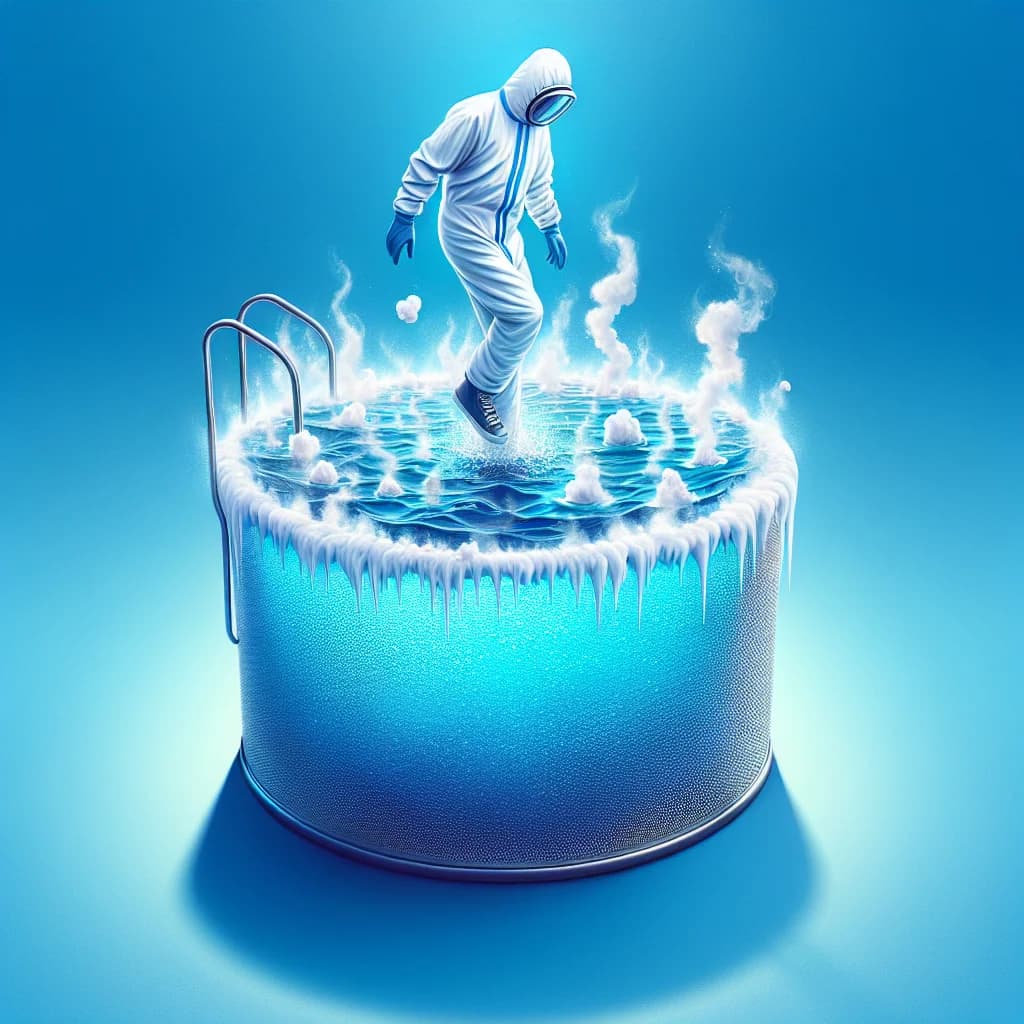
Imagine the most extreme version of a "polar plunge" conceivable. Instead of a chilly lake, you find yourself hovering over a pool of liquid nitrogen, a substance so cold it sits at a staggering -196 degrees Celsius (-321 degrees Fahrenheit). In this hypothetical scenario, if you were to fall into the vat, a counterintuitive physical phenomenon would occur: for a few brief, shimmering moments, you wouldn’t feel "wet" at all. You would remain entirely dry.
This thought experiment isn't just a dive into a sub-zero abyss; it is a masterclass in thermodynamics and fluid dynamics. To understand why your skin wouldn't immediately soak up the liquid, we must look at the foundational principles of heat transfer and a specific physical behavior known as the Leidenfrost Effect. By applying the laws of physics to this chilling premise, we can uncover the invisible barrier that separates biological warmth from absolute cold.
The Massive Thermal Gradient
The secret to staying dry lies in the astronomical temperature difference between your body and the liquid nitrogen. Human skin maintains a surface temperature of approximately 33°C to 35°C (91°F to 95°F). Liquid nitrogen, however, boils at -196°C.
When these two entities meet, the temperature gradient is roughly 230 degrees Celsius. In the world of physics, this is a colossal disparity. To put this into perspective:
- The difference between a comfortable room and a boiling pot of water is only about 80°C.
- The difference between your skin and liquid nitrogen is nearly three times that amount.
Because the liquid nitrogen is so far above its boiling point relative to your body heat, it doesn't just sit on your skin; it reacts violently and instantaneously.
The Leidenfrost Effect: Nature’s Protective Cushion
The primary reason you would remain dry is the Leidenfrost Effect. This occurs when a liquid comes into contact with a surface significantly hotter than its boiling point.
- Instant Vaporization: The moment your skin touches the liquid nitrogen, the nitrogen at the point of contact boils instantly into a gas.
- The Gas Barrier: This rapid transition creates a thin, insulating layer of nitrogen gas between your skin and the liquid.
- Thermal Resistance: Because gas is a much poorer conductor of heat than liquid, this vapor "glove" temporarily prevents the rest of the liquid nitrogen from touching you.
Mathematically, we can view this as a battle of energy output. Your body is essentially a high-energy radiator. The rate of heat flux from your skin is so intense that it generates a continuous supply of gas, supporting a pressurized pocket that holds the liquid at bay. This is why liquid nitrogen droplets "skitter" across a room-temperature floor like beads of mercury; they are actually floating on their own tiny clouds of vapor.
Volume, Scale, and Displaced Air
If you were submerged, the scale of gas production would be massive. Liquid nitrogen has an expansion ratio of approximately 1:694. This means that for every liter of liquid that boils off your body, it produces 694 liters of gas.
In a pool-sized scenario:
- The surface area of an average adult is about 1.5 to 2 square meters.
- Even a microscopic layer of evaporated nitrogen across that surface area would result in a significant volume of gas attempting to escape to the surface.
This rapid expansion creates a turbulent, bubbling envelope. Because the liquid is being pushed away by the sheer force of its own evaporation, it cannot "wet" the surface of your clothes or skin. In physics terms, the surface tension of the liquid is irrelevant because the liquid is never actually making molecular contact with you.
The Constraints of Time
While the Leidenfrost Effect is powerful, it is not a permanent shield. It is a transient state of non-equilibrium. As your skin loses heat to the gas layer, its temperature will eventually drop. Once your surface temperature falls below the threshold required to maintain that vigorous "boiling barrier," the gas layer will collapse.
At that point, the Leidenfrost Effect ceases, and true "wetting" occurs. The liquid would then make direct contact, leading to a rapid transition toward thermal equilibrium—a clinical way of saying your biological tissues would begin to match the temperature of the pool.
Conclusion
The science of falling into liquid nitrogen reveals the fascinating ways matter behaves at extremes. You remain initially dry because your own body heat acts as a propellant, creating a protective cushion of gas through the Leidenfrost Effect. This phenomenon demonstrates the incredible power of thermal gradients and the protective qualities of phase changes.
Ultimately, this thought experiment highlights the elegant laws of thermodynamics that govern our universe. While liquid nitrogen is a staple of laboratory science and high-tech cooling, it also serves as a reminder that even in the most extreme conditions, physics provides a predictable, albeit brief, sanctuary of safety. It is a testament to the invisible forces that constantly balance the world around us, even at -196 degrees Celsius.