
How does gluing thin wood sheets together make plywood stronger than a solid board
It defies intuition, but the secret to plywood's incredible strength isn't the glue—it's the clever, crisscrossing arrangement of the wood sheets within.

Too Long; Didn't Read
TLDR: Plywood's strength comes from gluing thin wood sheets with their grain running at 90-degree angles to each other. This cross-graining distributes stress in all directions, preventing the splitting and warping common in solid wood, which is only strong along its grain.
The Plywood Paradox: How Gluing Thin Wood Sheets Together Makes It Stronger Than a Solid Board
It seems counterintuitive, doesn't it? How can a panel made from thin, flimsy-looking sheets of wood glued together be stronger and more reliable than a solid, thick plank cut from the same tree? This common question touches on one of the most brilliant innovations in woodworking and construction: plywood. While solid wood is beautiful and strong in its own right, it has inherent weaknesses that plywood’s clever engineering was specifically designed to overcome. This post will break down the simple yet powerful principles that give plywood its superior structural integrity. We will explore how the arrangement of its layers, not just the glue, transforms weak veneers into a remarkably robust and stable material.
Understanding the "Flaw" in Solid Wood
To appreciate plywood, we must first understand the nature of solid wood. Every piece of wood has a grain—the direction in which the tree’s fibers grew. This grain is both wood's greatest strength and its most significant weakness.
- Along the Grain: Wood is incredibly strong. The long, parallel fibers resist being pulled apart (tensile strength) and compressed (compressive strength). Think of it like a bundle of uncooked spaghetti; it's difficult to stretch or crush the bundle along its length.
- Across the Grain: Wood is significantly weaker. The fibers can be easily split apart. Using our spaghetti analogy, it’s very easy to snap the entire bundle in half across its width.
Furthermore, solid wood is dimensionally unstable. As it absorbs and releases moisture from the air, it expands and contracts, but it does so unevenly—mostly across the grain. This movement is what causes solid wood boards to warp, cup, and twist over time.
The Secret Ingredient: Cross-Graining
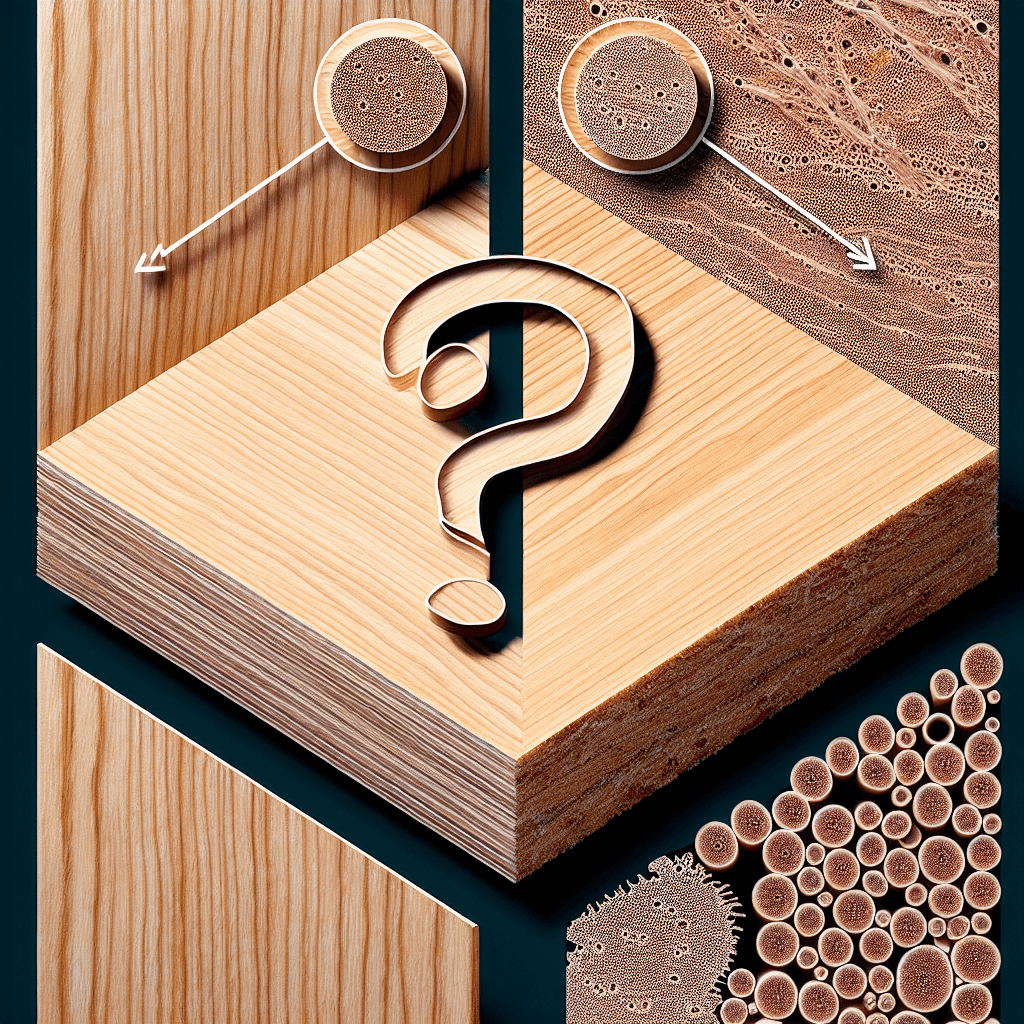
Plywood's immense strength comes from a single, ingenious concept: cross-graining. Instead of having all the wood fibers run in the same direction, plywood is constructed by layering thin sheets of wood veneer with the grain of each successive layer turned 90 degrees to the one before it.
Imagine a simple three-ply panel:
- The bottom layer's grain runs vertically.
- The middle layer's grain runs horizontally.
- The top layer's grain runs vertically again.
These layers, or "plies," are bonded together under immense heat and pressure with strong adhesives, creating a single, unified panel.
How Cross-Graining Creates Superior Strength
This alternating grain structure is what neutralizes the natural weaknesses of wood and distributes stress across the entire panel. Here’s how it creates a stronger material:
-
Strength in All Directions: In a solid board, you have a strong axis and a weak axis. In plywood, the weakness of one layer is directly compensated for by the strength of the adjacent layer. A force trying to split the top layer across its grain is resisted by the immense lengthwise strength of the layer right below it. This gives plywood uniform strength in both length and width, making it far more versatile.
-
Exceptional Dimensional Stability: The cross-graining is the key to preventing warping and cupping. As one layer tries to expand or contract with humidity changes, it is held firmly in check by the perpendicular layer next to it, which is stable in that direction. This internal tug-of-war effectively locks the panel in place, making it a far more stable and predictable material for construction and furniture making.
-
Resistance to Splitting: It’s nearly impossible to split a sheet of plywood. A crack that starts on the surface and follows the grain will immediately be stopped when it hits the next layer, where the grain runs perpendicularly. To break plywood, you have to fight against the grain in every other layer, which requires enormous force.
The Unsung Hero: Modern Adhesives
While cross-graining is the core principle, the glue holding the plies together is equally crucial. Modern structural adhesives used in plywood manufacturing create bonds that are, in many cases, stronger than the wood fiber itself. When a piece of plywood is stressed to its breaking point, the wood is more likely to tear apart than the glue line is to fail. This ensures that the panel acts as one solid, cross-laminated unit, not just a stack of individual veneers.
Conclusion: Engineering a Better Board
The strength of plywood is a testament to smart engineering. By taking thin sheets of wood and reassembling them in a cross-grained pattern, we cancel out wood's natural tendency to split and warp, creating a composite material that is stronger, more stable, and more reliable than a solid board of the same dimensions. It isn't just "glued wood"; it's a panel where each layer's strength is used to overcome the weakness of its neighbor. So, the next time you see a sheet of humble plywood, you can appreciate the simple genius that makes it a cornerstone of modern building and design.


