What causes the angel's share of whiskey to vanish from sealed barrels
Every year, gallons of whiskey vanish from sealed barrels as a "gift to the angels." Discover the surprising science that allows this celestial spirit to escape right through solid oak.

Too Long; Didn't Read
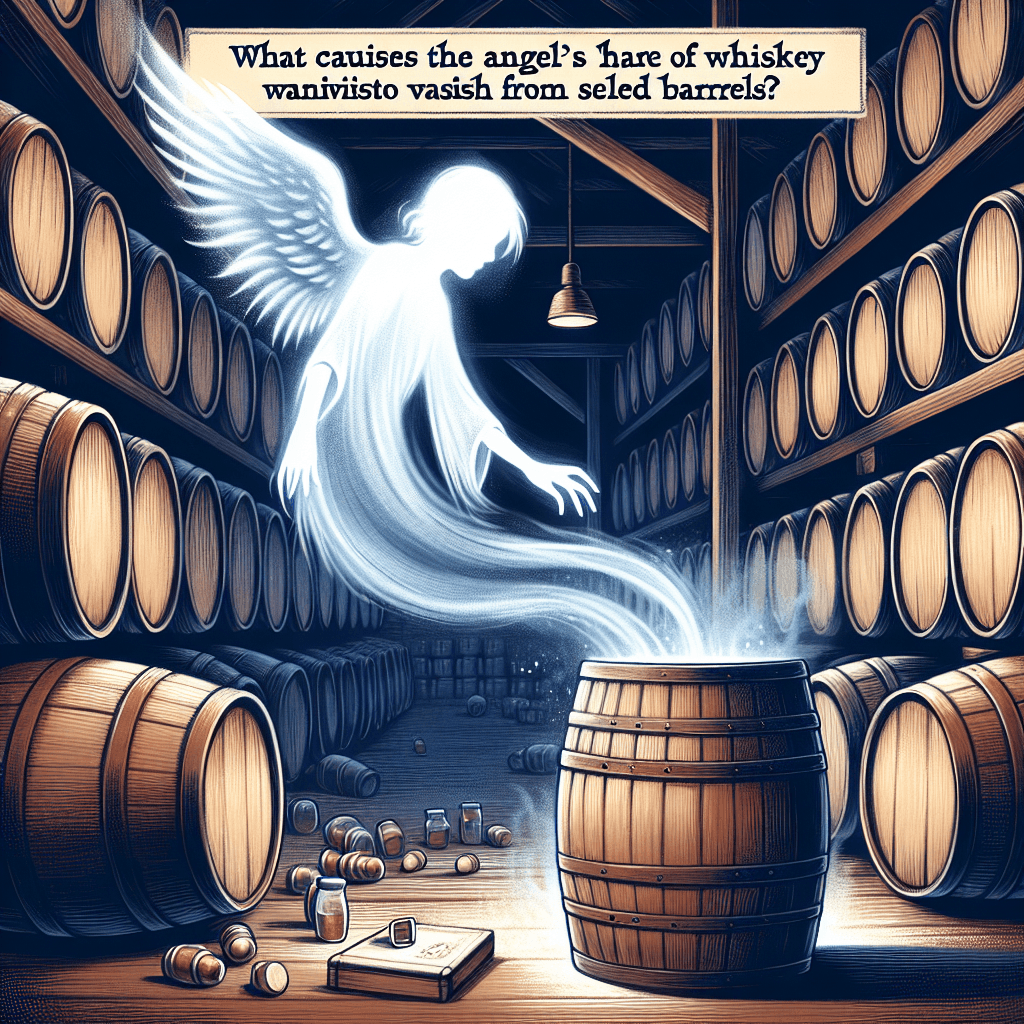
TLDR: The angel's share is whiskey that evaporates directly through the porous wood of the barrel. Since wood isn't perfectly airtight, alcohol and water molecules escape over time, with the rate affected by heat and humidity.
Solving the Mystery: What Causes the Angel's Share of Whiskey to Vanish from Sealed Barrels?
Have you ever heard that distillers lose up to 2% of their aging whiskey to evaporation each year? For a spirit aging over a decade, that's a significant portion of the barrel simply vanishing into thin air. This poetic and costly phenomenon is known as the "angel's share," a tribute paid to the heavens for the magic of maturation. But this disappearance isn't magic; it's a fascinating interplay of chemistry, physics, and craftsmanship. This post will delve into the science behind the angel's share, exploring exactly what causes precious whiskey to vanish from a seemingly sealed barrel and why this process is crucial for creating the spirit we love.
The Secret of the Oak Barrel: A Breathable Container
The first clue to solving this mystery lies in the container itself: the oak barrel. While a whiskey barrel is watertight, it is not airtight. Wood is a natural, porous material made of microscopic capillaries and cells. This structure allows the barrel to "breathe," facilitating a slow, controlled exchange between the whiskey inside and the air outside.
When a barrel is constructed, the staves are heated and bent into shape, a process that opens up the wood's pores. The interior is then often toasted and charred, creating a layer of activated carbon that filters out harsh compounds while allowing the spirit to interact with the wood. It is through these very pores that tiny molecules of ethanol and water can escape over the long years of maturation. This process is not a flaw; it's a fundamental and intentional part of making whiskey.
The Science of Evaporation and Maturation
At its core, the angel's share is a result of evaporation. Two primary components make up the bulk of the spirit in the barrel: ethanol (alcohol) and water. Both can transform from a liquid to a gas and escape, but they do so at different rates depending on several key factors.
Ethanol molecules are smaller and more volatile than water molecules, meaning they can turn into vapor more easily. This slow, continuous evaporation is essential for the whiskey's development. As the volume of liquid decreases, the remaining compounds—including flavors from the grain and the wood—become more concentrated. This process helps to mellow the harshness of the young spirit and develop the complex flavor profile that only time can create.
Climate's Crucial Role: The Deciding Factor
The most significant factor influencing the rate and composition of the angel's share is the climate of the warehouse, or "rickhouse," where the barrels are stored. The interplay between temperature and humidity dictates what the "angels" drink most.
Scotland vs. Kentucky: A Tale of Two Climates
-
Cool, Humid Climates (e.g., Scotland): In regions with high humidity and cool, stable temperatures, the surrounding air is already saturated with water vapor. This makes it difficult for more water to evaporate from the barrel. However, ethanol is still volatile and escapes more readily. The result? More alcohol is lost than water, causing the whiskey's Alcohol By Volume (ABV), or proof, to gradually decrease over its long maturation period.
-
Hot, Dry Climates (e.g., Kentucky, USA): In hotter and often drier climates, the conditions are reversed. The high heat accelerates overall evaporation. Because the surrounding air is less humid, water is drawn out of the barrel at a faster rate than the alcohol. Consequently, more water is lost than alcohol, which causes the whiskey's ABV to increase as it ages. This is why it's not uncommon to find an older bourbon that has a higher proof than when it was first barreled.
Other Influential Factors
Beyond climate, a few other variables can affect the angel's share:
- Warehouse Location: Barrels stored on the higher floors of a rickhouse are exposed to more heat and light, leading to a faster rate of evaporation compared to barrels on the cooler, more humid lower floors.
- Airflow: A well-ventilated warehouse can increase the rate of evaporation by constantly moving air over the surface of the barrels.
- Barrel Size: Smaller barrels have a higher surface-area-to-volume ratio, meaning more of the spirit is in contact with the wood. This results in a much faster maturation process and a larger angel's share percentage.
Conclusion: A Necessary and Beautiful Loss
The angel's share is far more than just lost product; it is an indispensable part of whiskey's journey from a raw spirit to a complex, flavorful beverage. This evaporative loss, driven by the porous nature of the oak barrel and dictated by the surrounding climate, is what concentrates flavors, mellows the spirit, and creates the deep, rich character that connoisseurs cherish. So, the next time you enjoy a glass of finely aged whiskey, raise a small toast to the angels. Their share is the price of perfection, a beautiful and necessary sacrifice that makes the final product worth the wait.