
What creates the bizarre hole-punch effect sometimes seen in a layer of clouds
It looks like a visit from a UFO, but the truth behind these massive, circular gaps in the clouds is a bizarre atmospheric chain reaction that starts with a single, tiny particle.

Too Long; Didn't Read
TLDR: A plane flies through a cloud of supercooled water droplets that are below freezing but haven't turned to ice. The plane's passage triggers a chain reaction, causing the droplets to instantly freeze into ice crystals which then fall out of the cloud, leaving a hole behind.
Blog Post Title: The Sky's Mysterious Eye: What Creates the Bizarre Hole-Punch Effect Sometimes Seen in a Layer of Clouds?
Introduction
Have you ever gazed up at a blanket of high, thin clouds and seen a perfect circle or ellipse carved out of it, as if a giant celestial cookie-cutter had paid a visit? Sometimes, a wispy trail of ice crystals can even be seen dangling from the center. This stunning and often eerie sight, frequently mistaken for a UFO or some other unexplained aerial phenomenon, is known as a hole-punch cloud or fallstreak hole. While it may look like something out of a science fiction movie, its origin is firmly rooted in fascinating atmospheric physics. This post will demystify this beautiful spectacle, explaining exactly what creates the bizarre hole-punch effect and turning a skyward mystery into a clear scientific marvel.
Main Content
## What Exactly is a Hole-Punch Cloud?
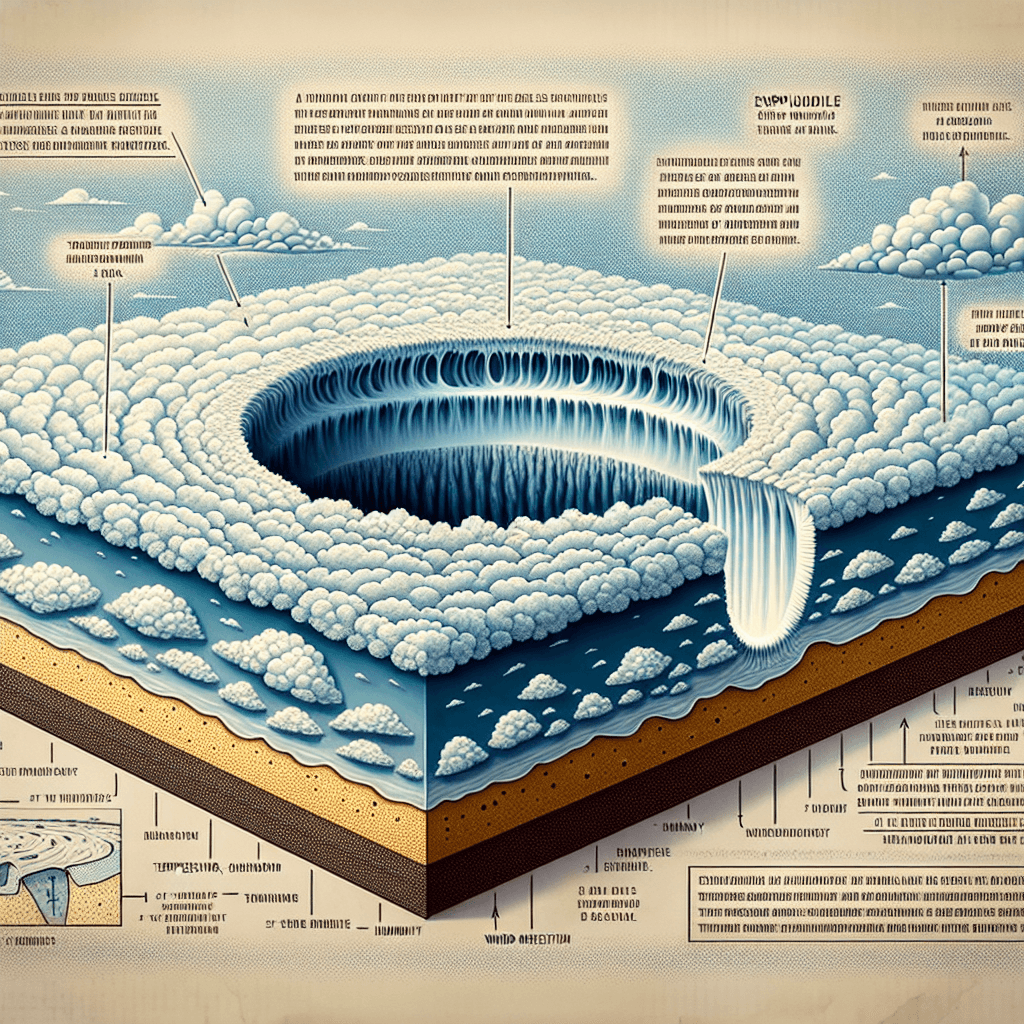
A hole-punch cloud, also known by the more scientific name "fallstreak hole," is a large gap, typically circular or elliptical, that appears in a layer of mid-to-high-level altocumulus or cirrocumulus clouds. These cloud layers are often visually uniform, which makes the sudden appearance of a perfectly defined hole so striking.
Often accompanying the hole is a trail of falling ice crystals, known as virga. This "fallstreak" of precipitation evaporates before it ever reaches the ground, but it provides a crucial clue to the cloud's formation. To understand how the hole forms, we first need to look at the unique composition of these specific clouds.
## The Key Ingredient: Supercooled Water
The clouds where hole-punch effects appear have a secret ingredient: supercooled water. This means the water droplets within the cloud exist in a liquid state despite being at a temperature well below the standard freezing point of 0°C (32°F).
How is this possible? For water to freeze, it needs a nucleus—a tiny particle like a speck of dust, pollen, or soot—to crystallize around. In the very clean air at high altitudes, these nuclei are scarce. Without them, the water droplets can remain in a liquid, highly unstable state, sometimes at temperatures as low as -40°C (-40°F). They are just waiting for a trigger to set off a chain reaction of freezing.
## The Trigger: An Airplane's Icy Touch
So, what provides the trigger that "punches" the hole? The most common culprit is an airplane.
When an aircraft flies through a cloud layer filled with supercooled water droplets, it dramatically disturbs the delicate atmospheric balance. The rapid pressure drop caused by air expanding over the wings and propellers causes the air to cool suddenly and significantly. This process, known as adiabatic expansion, can plunge the temperature low enough to instantly freeze the supercooled droplets without the need for a nucleus.
Once these first few droplets freeze, they create the ice crystals that were missing. This sets the stage for a beautiful domino effect.
## The Chain Reaction: From Tiny Crystals to a Giant Hole
The formation of that first set of ice crystals kickstarts a process that atmospheric scientists call the Wegener-Bergeron-Findeisen process. Here’s how it works:
- Ice Crystals Act as Seeds: The newly formed ice crystals become magnets for the surrounding water vapor.
- Water Vapor Deposition: It is much easier for water vapor to deposit onto an existing ice crystal than it is to condense onto a liquid water droplet. This causes the ice crystals to grow rapidly at the expense of the nearby supercooled droplets.
- Droplet Evaporation: As the ice crystals grow, they pull moisture from the air, causing the surrounding supercooled liquid droplets to evaporate.
- The Hole Widens: This chain reaction spreads outwards in a circle, clearing a large area of the cloud as the liquid droplets vanish and are replaced by growing ice crystals.
- The Fallstreak Forms: Eventually, these ice crystals become heavy enough to fall from the cloud, creating the signature wispy virga seen in the center of the hole.
This entire sequence creates the spectacular and perfectly defined hole-punch cloud that leaves so many sky-gazers in awe.
Conclusion
The next time you spot a hole-punch cloud, you can look past the UFO theories and appreciate the elegant physics on display. This stunning phenomenon isn't a message from another world but a beautiful demonstration of atmospheric science in action. It’s a perfect storm of supercooled water droplets, the passage of an airplane, and a cascading chain reaction that turns a simple cloud deck into a breathtaking natural spectacle. So, keep your eyes on the skies, especially on days with thin, high-level cloud cover near flight paths. You might just witness one of these celestial wonders for yourself, now fully equipped with the knowledge of how it came to be.


