
Why did an ancient army win a major battle by simply holding cats
Discover the brilliant psychological trick that turned cats into living shields, forcing an entire army to choose between surrender and sacrilege.

Too Long; Didn't Read
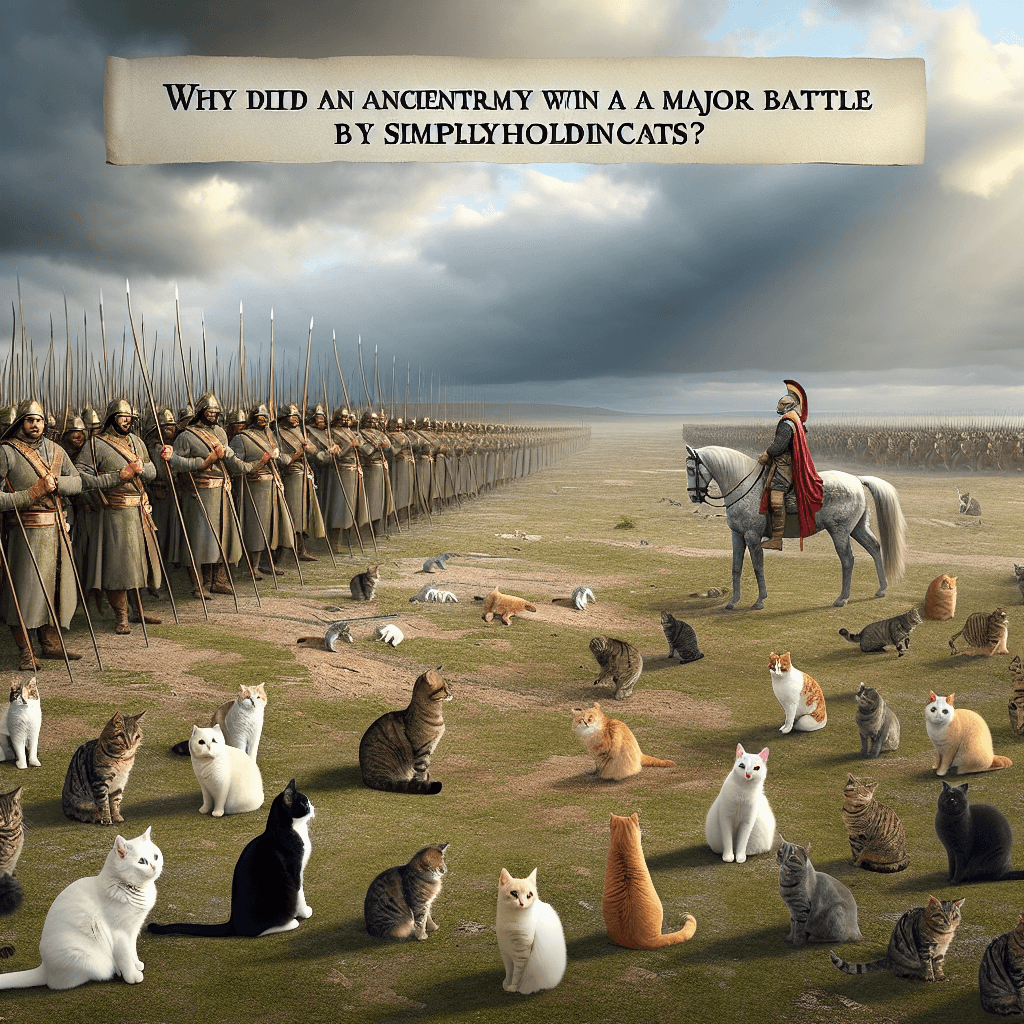
At the 525 BC Battle of Pelusium, the invading Persians used cats and other animals considered sacred by the Egyptians as shields. The Egyptian soldiers were so afraid of harming the sacred animals that they refused to fight back, allowing the Persians to easily win.
Feline Warfare: Why Did an Ancient Army Win a Major Battle by Simply Holding Cats?
Imagine a battlefield where the decisive weapon isn't a sword, a spear, or a siege engine, but a living, purring cat. It sounds like a scene from a fantasy novel, but according to ancient historians, this bizarre scenario was the key to a pivotal victory that changed the course of an empire. In 525 BCE, the Persian army faced the Egyptians at the fortress city of Pelusium, and they came armed with an unconventional strategy rooted in psychological warfare. This post will delve into the historical account of this brilliant military tactic, exploring the unique cultural context that made it possible and analyzing how an army won a major battle by weaponizing an opponent's beliefs.
The Setting: A Clash of Empires
In the 6th century BCE, the Achaemenid (Persian) Empire, under the ambitious King Cambyses II, was a rapidly expanding superpower. Its next target was one of the oldest and wealthiest civilizations in the world: Egypt. The Egyptians, led by Pharaoh Psamtik III, prepared to defend their homeland at Pelusium, a heavily fortified city that served as the gateway to the Nile Delta.
On paper, the Egyptians had a strong defensive position. They were fighting on home soil to protect their way of life. However, Cambyses II had a secret weapon that had nothing to do with military might and everything to do with his deep understanding of Egyptian culture.
The Unconventional Weapon: Egypt's Sacred Animals
To understand the Persian strategy, one must first understand ancient Egypt’s profound reverence for animals. Many animals were associated with specific gods and were considered sacred incarnations of these deities on Earth.
- The Goddess Bastet: The most relevant deity in this story is Bastet, the goddess of home, fertility, and protection. She was most commonly depicted as a woman with the head of a cat.
- Reverence for Cats: Cats were incredibly important in Egyptian society. They were beloved pets, valued for their ability to protect grain stores from rodents, and revered as sacred.
- The Ultimate Crime: The Greek historian Herodotus noted that the penalty for killing a cat in Egypt, even accidentally, was death. This religious law was deeply ingrained in the Egyptian psyche.
Cambyses II knew that this cultural devotion was not just a belief but a potential military weakness. He devised a plan to turn the Egyptians' greatest reverence into their greatest vulnerability.
The Battle of Pelusium: A Masterstroke of Psychological Warfare
As the Persian army advanced on Pelusium, the Egyptian defenders prepared to rain arrows down upon them. But they were met with a shocking sight. According to the 2nd-century AD writer Polyaenus, Cambyses ordered his front-line soldiers to carry the animals the Egyptians held sacred—including cats, dogs, and ibises—before them as they advanced.
A slightly different account from Herodotus, writing closer to the event, suggests the Persians painted the image of the cat goddess Bastet on their shields and drove a variety of sacred animals before their main line of attack.
Regardless of the precise method, the effect was the same. The Egyptian soldiers were horrified. To defend their city, they would have to fire upon the living embodiments of their gods. Each arrow loosed or spear thrown carried the risk of committing a mortal sin, an act of sacrilege that would doom their souls. Faced with this impossible choice, the Egyptian battle line faltered. Their hesitation and moral paralysis were all the Persians needed. The attackers surged forward, meeting little resistance, and secured a decisive victory that opened the door for their conquest of Egypt.
Conclusion
The Battle of Pelusium is a timeless lesson in the power of psychological warfare. The Persian victory wasn't won through superior numbers or better weapons, but through the brilliant exploitation of an enemy's deeply held beliefs. By turning the Egyptians' reverence for cats and other animals against them, Cambyses II bypassed their physical defenses and shattered their will to fight. This ancient conflict remains a fascinating, if not furry, testament to the fact that in war, the most effective weapon is often the one that targets the mind, not the body. It proves that understanding an opponent's culture is not just a matter of intelligence, but a powerful strategic advantage.


