
Why did France briefly switch to a ten-hour day with hundred-minute hours
In the midst of the French Revolution, radicals declared the 24-hour day an illogical relic and replaced it. For two chaotic years, France ran on a 10-hour day with 100-minute hours—and it was a spectacular failure.

Too Long; Didn't Read
TLDR: During the French Revolution, France adopted a 10-hour day as part of a radical push for logic and reason, creating a decimal-based system similar to the metric system. It was also an attempt to de-Christianize society and break from the old monarchy's traditions, but the system was too confusing and unpopular, so it was quickly abandoned.
A Revolution in Time: Why Did France Briefly Switch to a Ten-Hour Day with Hundred-Minute Hours?
Imagine waking up to a clock that only has ten hours. Each of those hours has 100 minutes, and each minute has 100 seconds. It sounds like a concept from a science fiction novel, but for a brief period in the 1790s, this was the official reality in France. During the feverish height of the French Revolution, not only were the monarchy and social structures overthrown, but the very concept of time was radically redesigned. This ambitious experiment, known as "decimal time," aimed to reshape society from its most fundamental principles. This post explores the revolutionary ideals that birthed the ten-hour day, how the system worked, and the practical reasons this fascinating chapter in timekeeping ultimately failed.
The Spirit of Revolution: Rationality Over Tradition
The French Revolution was more than a political upheaval; it was a profound intellectual movement rooted in the Enlightenment. Revolutionaries sought to dismantle all vestiges of the Ancien Régime—the old monarchical and religious order—and replace them with systems based on logic, reason, and natural principles. The traditional 24-hour day, with its 60-minute hours and 60-second minutes, was seen as an illogical relic of ancient Babylonian and Egyptian systems, tied to religious and royalist traditions.
The goal was decimalization. The revolutionaries had already successfully introduced the metric system for weights and measures, a logical base-10 system that we still use today. They believed applying this same decimal logic to time and the calendar would create a more rational, scientific, and harmonious society, completely untethered from the past. On October 5, 1793, the French National Convention decreed the creation of a new Republican Calendar and, alongside it, a new system for telling time.
A Day in Decimals: Deconstructing the New Clock
The structure of French decimal time was elegantly simple, at least on paper. The day was the fundamental unit, which was then divided into base-10 increments.
- 1 day was divided into 10 decimal hours.
- 1 decimal hour was divided into 100 decimal minutes.
- 1 decimal minute was divided into 100 decimal seconds.
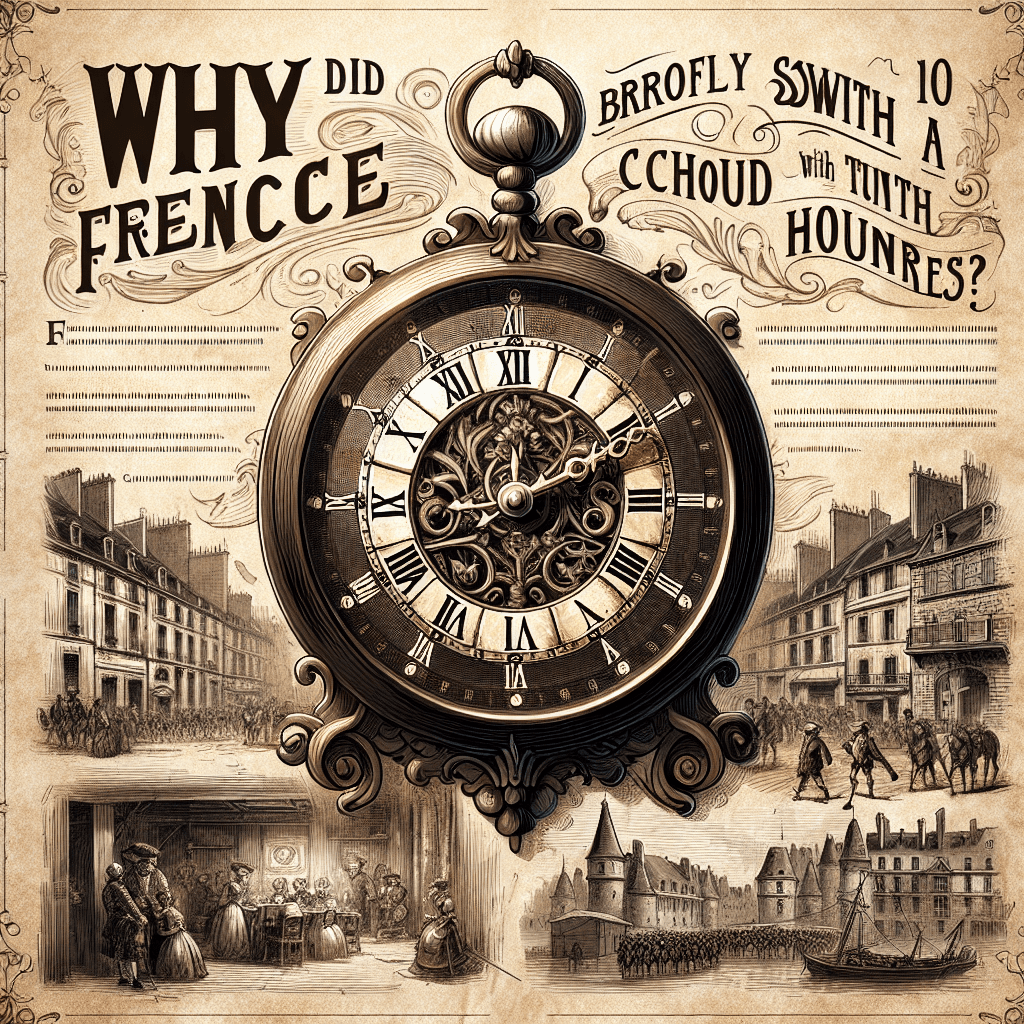
This meant a decimal hour was significantly longer than a traditional one, equivalent to 2 hours and 24 standard minutes. A decimal minute was slightly shorter than our current minute, lasting about 86.4 standard seconds. To support this, clockmakers were tasked with producing new timepieces with faces showing 10 hours instead of 12 or 24. These clocks were symbols of the new republican era, intended to replace the old ways in every home and public square.
The Clock Stops Ticking: Why the System Failed
Despite its logical foundation, decimal time was a spectacular failure. It was made mandatory in 1794, but the law was suspended just 17 months later in 1795 and officially abolished by Napoleon in 1806. Several key factors contributed to its demise.
Public Resistance and Confusion
The 24-hour day was not just a convention; it was deeply woven into the fabric of daily life. People’s work schedules, meal times, and social rhythms were all based on the traditional clock. The new system was alien and confusing, and the public was largely unwilling to relearn how to tell time.
Prohibitive Cost and Inconvenience
Replacing every clock and watch in the nation was an astronomical expense. While the government commissioned new public clocks, the average citizen could not afford a new timepiece. This led to a chaotic period where both old and new time systems operated simultaneously, defeating the purpose of a universal standard.
Lack of International Adoption
Unlike the metric system, which offered clear advantages for international trade and science, decimal time isolated France. For any form of international communication, trade, or navigation, the French were forced to constantly convert between their new system and the one used by the rest of the world.
Conclusion
The story of France's ten-hour day is a fascinating case study in the clash between radical idealism and entrenched human habit. Born from a desire to build a perfectly rational world, decimal time ultimately proved that some traditions are too deeply integrated into our culture to be easily replaced by logic alone. While the experiment failed, it remains a powerful reminder of the French Revolution's incredible ambition to remake society from the ground up. It stands in stark contrast to the enduring success of its contemporary, the metric system, and serves as a compelling footnote in the long history of how humanity measures its days.


