Why did some US cities once outlaw unattractive people from appearing in public
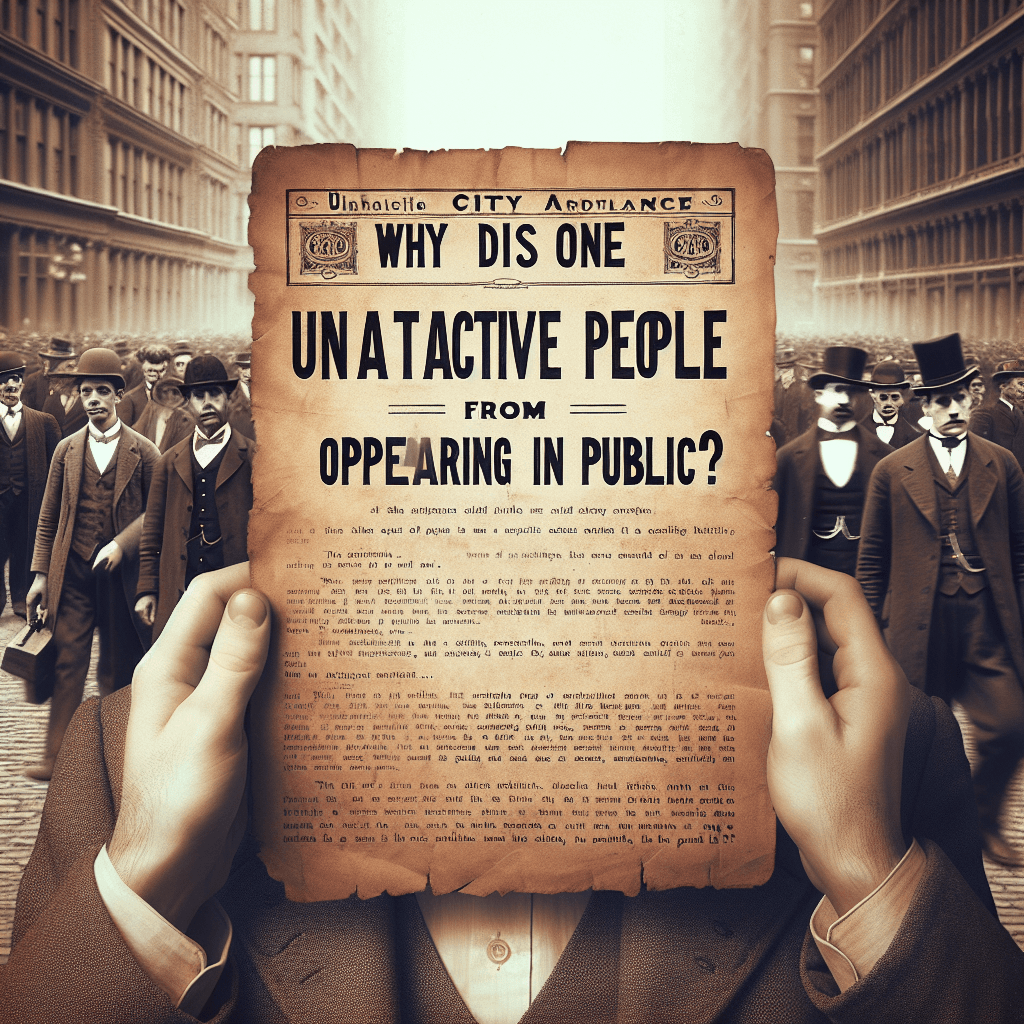
For nearly a century, major US cities had "ugly laws" on the books, making it a literal crime for anyone deemed "diseased, maimed, or unsightly" to be seen in public.

Too Long; Didn't Read
TLDR: From the late 1800s to the 1970s, US cities enacted ugly laws to ban visibly poor, disabled, or disfigured people from public spaces. The goal was to hide poverty and begging, promote an image of a prosperous, orderly city, and remove unsightly reminders of social problems from sight.
The Ugly Laws: Why Did Some US Cities Once Outlaw Unattractive People From Appearing in Public?
Can you imagine a time when simply appearing "unsightly" in public could get you arrested? It sounds like a dystopian fantasy, but for nearly a century, it was a harsh reality in several major American cities. From the end of the Civil War until the 1970s, municipalities enforced ordinances that targeted and penalized individuals based on their physical appearance. These statutes, known collectively as the "ugly laws," represent a dark and often forgotten chapter in US history. This post will delve into the disturbing story behind these laws, exploring why they were enacted, who they targeted, and the social forces that finally led to their repeal.
What Were the "Ugly Laws"?
The first known "ugly law" was passed in San Francisco, California, in 1867. The ordinance was chillingly specific, stating: "No person who is diseased, maimed, mutilated, or in any way deformed, so as to be an unsightly or disgusting object, or an improper person to be allowed in or on the streets, highways, thoroughfares, or public places in this city, shall therein or thereon expose himself to public view."
Over the next few decades, other cities followed suit. Notable examples include:
- Chicago, Illinois: Enacted a similar law in 1881.
- Omaha, Nebraska: Passed its ordinance in 1889.
- Portland, Oregon: Adopted its version in 1881.
These laws essentially criminalized the public presence of people with visible disabilities, severe injuries, or physical differences. The punishment for violating them was typically a fine (often $1, equivalent to a day's wages for an unskilled worker at the time) or imprisonment. While enforcement was often sporadic, the laws' existence created a constant threat of harassment and institutionalized the social exclusion of an entire segment of the population.
The Social and Economic Forces Behind the Laws
The emergence of ugly laws was not a random occurrence. It was the product of a powerful confluence of post-Civil War social anxieties, economic pressures, and pseudoscientific ideologies.
Fear of Panhandling and Urban "Cleanliness"
In the decades following the Civil War, American cities saw a dramatic increase in the number of visibly disabled individuals, including many impoverished and wounded veterans. This influx coincided with rapid industrialization and urbanization, which brought new social pressures. City leaders and business owners became preoccupied with maintaining public order and creating an aesthetically pleasing urban environment to encourage commerce. The ugly laws were, in part, a tool for social control—a way to sweep poverty and disability from public view. By making it illegal for "unsightly" people to be on the streets, these laws were an attempt to crack down on begging and remove individuals who were perceived as a public nuisance.
The Rise of Eugenics
The ugly laws also mirrored the growing influence of the eugenics movement in the late 19th and early 20th centuries. Eugenicists promoted the dangerous and unscientific idea that society could be improved by controlling heredity. They believed that disabilities, poverty, and even "immorality" were inherited traits that weakened the gene pool. People with disabilities were often labeled as "unfit" or "defective." The ugly laws were a physical manifestation of this ideology, reinforcing the belief that such individuals were inferior and should be hidden away, both for aesthetic reasons and to prevent them from being part of public life.
The Long Road to Repeal
For decades, these discriminatory ordinances remained on the books, largely unchallenged. However, shifting social attitudes after World War II and the rise of the disability rights movement in the 1960s and 1970s finally began to turn the tide. Activists fought to reframe disability not as a personal failing or a medical problem to be hidden, but as a matter of civil rights.
The laws began to crumble under legal and social pressure. One of the last documented arrests under an ugly law occurred in Omaha in 1974, when a man was arrested because of his visible scars from a severe burn. The case drew public attention and highlighted the blatant discrimination of the ordinance. Chicago was the last major city to repeal its ugly law, finally striking it from the code in 1974. The passage of the landmark Americans with Disabilities Act (ADA) in 1990 made such laws unequivocally illegal and unconstitutional, guaranteeing the right of all individuals, regardless of ability, to access public spaces.
A Legacy to Remember
The history of America's "ugly laws" is a sobering reminder of how easily fear and prejudice can be codified into law. Born from a desire for aesthetic order and fueled by flawed scientific theories, these ordinances systematically marginalized some of the most vulnerable members of society. While the laws themselves are gone, their legacy serves as a powerful cautionary tale. They underscore the importance of the disability rights movement and the ongoing fight for a society that values inclusion and recognizes the inherent dignity of every individual, not just those who fit a narrow definition of "normal."