
Why did thousands of lost rubber ducks become crucial tools for mapping ocean currents
It started with a cargo spill of 28,000 bath toys lost at sea; it ended by accidentally revolutionizing our understanding of the planet's massive ocean currents.

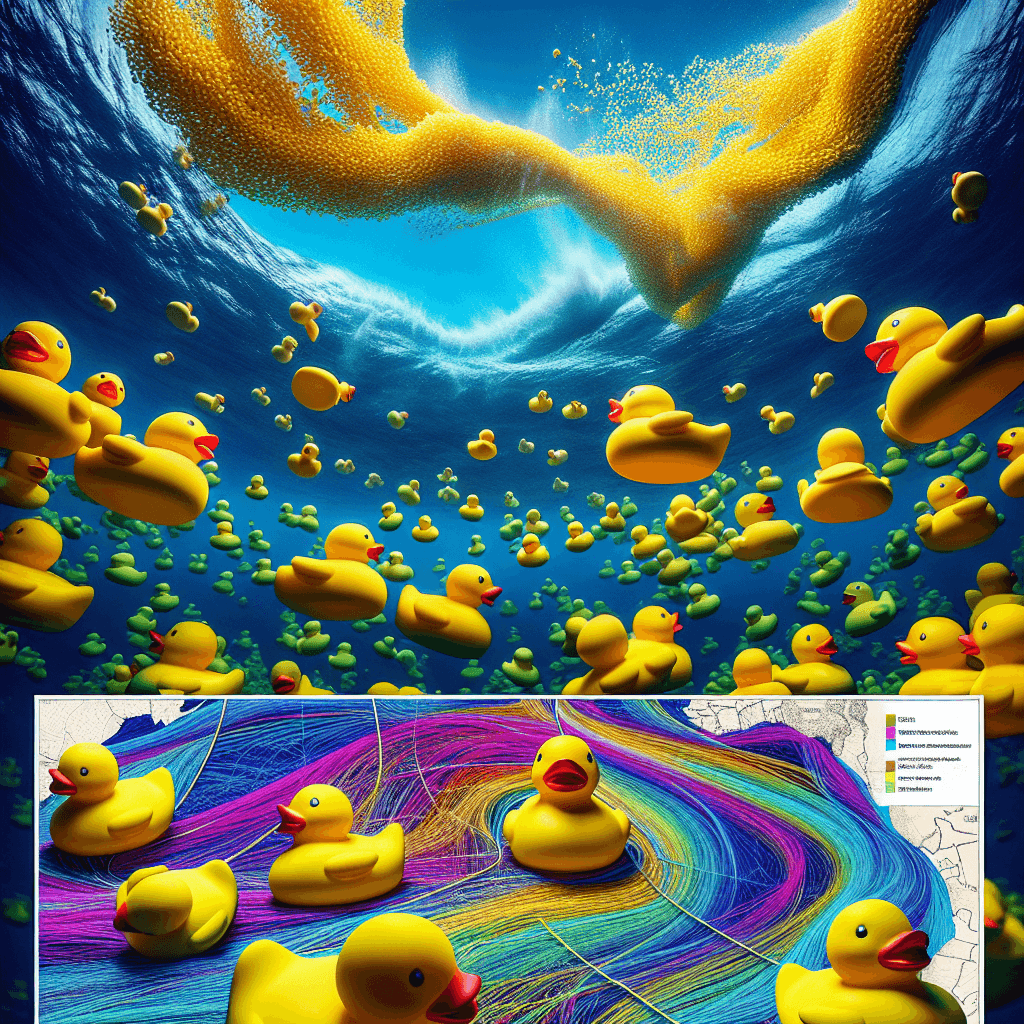
Too Long; Didn't Read
TLDR: A cargo ship spilled 28,000 rubber ducks into the Pacific Ocean, creating a massive, unplanned experiment. By tracking where these ducks washed ashore over the next 15+ years, scientists were able to map the speed and direction of global ocean currents.
Accidental Oceanographers: Why Did Thousands of Lost Rubber Ducks Become Crucial Tools for Mapping Ocean Currents?
Imagine a small, yellow rubber duck. It’s a simple bathtub toy, a symbol of childhood. Now, imagine nearly 29,000 of them, adrift in the vast, stormy expanse of the North Pacific Ocean. This isn't the beginning of a children's story, but the true account of a bizarre maritime accident that provided scientists with one of the most unique and valuable datasets in the history of oceanography. This incident inadvertently transformed thousands of plastic toys into unintentional scientific instruments. This blog post will explore the incredible journey of these "Friendly Floatees" and explain why thousands of lost rubber ducks became crucial tools for mapping the planet's complex ocean currents.
The Spill That Launched a Fleet of Ducks
Our story begins on January 10, 1992. A container ship, the Ever Laurel, was sailing from Hong Kong to Tacoma, Washington, when it encountered a severe storm in the middle of the North Pacific Ocean. During the tempest, several shipping containers were washed overboard. One of these containers burst open, releasing its cargo into the churning waves: approximately 28,800 plastic bath toys.
This floating menagerie, manufactured by The First Years Inc. and dubbed the "Friendly Floatees," included not just the now-famous yellow ducks, but also red beavers, blue turtles, and green frogs. Lost and seemingly insignificant in the world's largest ocean, they were about to embark on an epic, unplanned voyage that would capture the public's imagination and the attention of the scientific community.
From Bathtub Toy to Scientific Drifter
The scientific hero of this story is Curtis Ebbesmeyer, an American oceanographer based in Seattle. Ebbesmeyer had a unique specialty: tracking ocean debris. When he heard reports of these toys washing ashore, he realized their incredible potential.
Scientists typically study ocean currents using expensive, satellite-tracked "drifter buoys." These are released in small numbers and provide precise data. The 1992 spill, however, was a massive, uncontrolled experiment. It offered a chance to track the movement of a huge number of objects over a long period. Ebbesmeyer began to build a network of "beachcombers"—people living in coastal communities around the world—to report sightings of the toys. He treated each washed-up duck, beaver, or turtle as a data point, noting its location and the date it was found.
Charting the Unseen Rivers of the Sea
By meticulously collecting this data, Ebbesmeyer and his colleague James Ingraham were able to map the toys' incredible journey and, in doing so, validate their computer models of ocean currents. The toys' travel patterns provided a real-world test of the Ocean Surface Current Simulator (OSCURS) model.
The journey of the Friendly Floatees revealed the powerful and predictable nature of large-scale ocean circulation systems, particularly the North Pacific Gyre.
- First Landfall: Ten months after the spill, the first wave of toys began washing ashore near Sitka, Alaska, having traveled over 2,000 miles.
- Circulating the Gyre: Over the next few years, the toys continued their journey. Some were found in Japan, while others drifted south toward Hawaii and even South America, completing a massive circular route dictated by the gyre.
- An Arctic Adventure: A portion of the fleet took an even more remarkable detour. They floated north through the Bering Strait, became trapped in Arctic sea ice, and slowly drifted across the North Pole. Years later, beginning around 2000, some of these intrepid toys began to emerge from the ice into the North Atlantic, eventually washing up on the shores of Scotland and the eastern United States.
What the Ducks Taught Us
The Friendly Floatees provided invaluable, long-term data on a scale that would have been impossible to replicate in a planned experiment. They demonstrated the speed and pathways of major ocean currents, showing how debris from one side of the Pacific could end up on another in just a few years. Their trans-Arctic journey also provided some of the first practical evidence of the Transpolar Drift Stream, a current that flows across the Arctic Ocean. This accidental experiment highlighted the interconnectedness of our world's oceans, proving how pollution and debris can travel globally.
The story of the lost rubber ducks is a perfect example of serendipity in science. A simple shipping accident provided a profound and accessible lesson in oceanography. It demonstrated that with keen observation and a bit of ingenuity, even a child's toy can unlock secrets about the powerful, unseen forces that shape our planet. Their long voyage reminds us that our oceans are not static bodies of water but a dynamic, interconnected system of currents that can carry the smallest of objects across the entire globe.


