
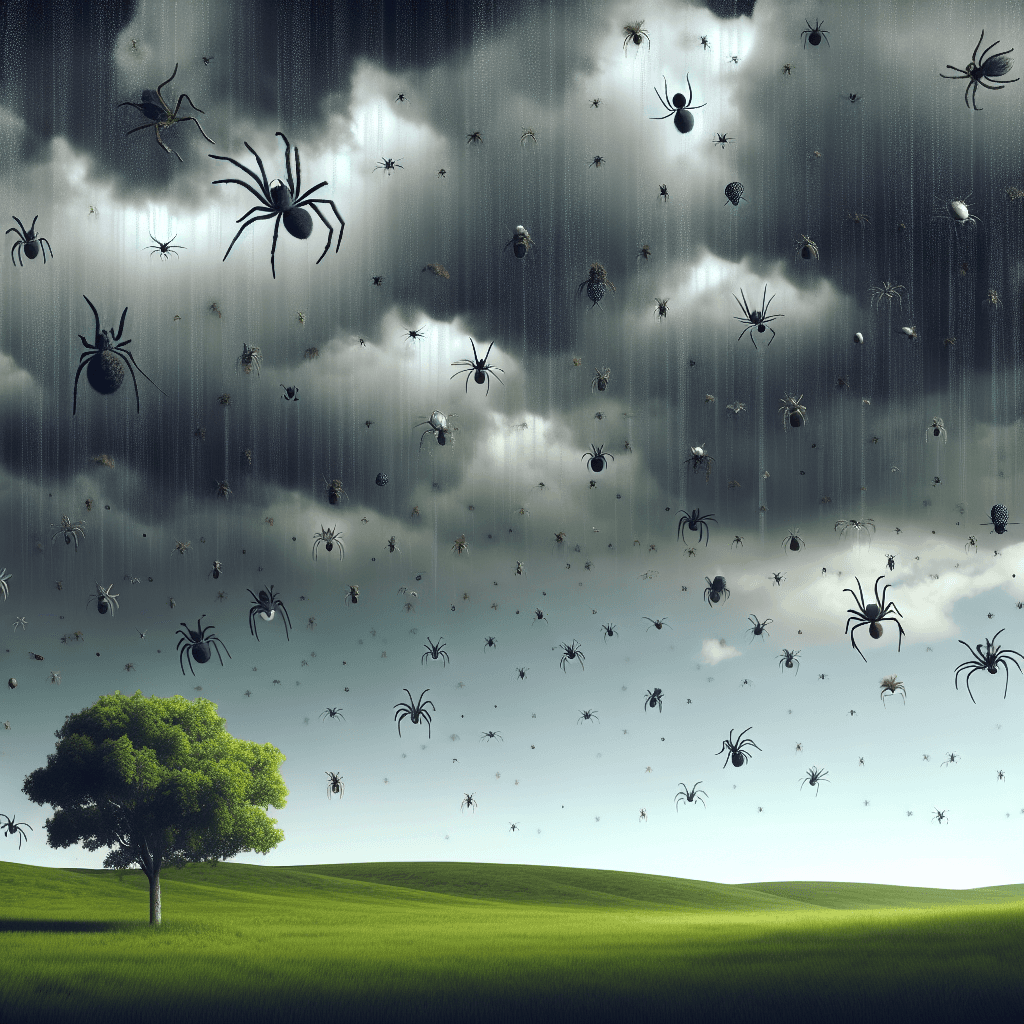
Why do millions of spiders sometimes seem to fall from the sky like rain
It's not a horror movie plot—it's a real, bizarre phenomenon where entire landscapes become draped in silk as millions of spiders seemingly descend from the clouds.

Too Long; Didn't Read
TLDR: It's a phenomenon called ballooning. Spiders release silk threads to catch the wind like parachutes to travel and find new homes. When weather conditions are right, millions do it at the same time, creating the appearance of spider rain when they land.
Spider Rain Explained: Why Do Millions of Spiders Sometimes Seem to Fall from the Sky Like Rain?
Have you ever heard the phrase "it's raining cats and dogs"? Now, imagine looking up to see not rain, but thousands, even millions, of tiny spiders descending on silky threads, blanketing the landscape in a shimmering, gossamer web. This isn't a scene from a horror film; it's a real, albeit rare, natural phenomenon that has been documented in places like Brazil and Australia. This eerie and fascinating event, often called "spider rain," can leave entire fields and towns covered in a silvery sheet of silk. But what causes this bizarre spectacle? This post will unravel the science behind why millions of spiders sometimes appear to fall from the sky.
The Phenomenon: Not Rain, But "Ballooning"
First, let's clear up a common misconception: the spiders aren't actually falling from clouds like raindrops. Instead, they are engaging in a remarkable method of travel known as "ballooning" or "kiting." This is a dispersal technique used by many species of spiders, especially young spiderlings, to travel vast distances and find new territories.
When a large number of spiders "balloon" at the same time, it creates the illusion of them raining from the sky. The delicate silk strands they use can tangle together in the air, forming large sheets that drift down and drape over everything on the ground. This silky residue is sometimes referred to as "angel hair."
The Physics of Flight: How Do They Do It?
The ability of a creature without wings to become airborne seems to defy logic, but spiders have mastered the art by harnessing the subtle forces of nature. The process is a fascinating display of natural engineering.
Step 1: Finding a Launchpad
A spider looking to balloon will first climb to an exposed, high point—a fence post, the tip of a leaf, or a tall stalk of grass.
Step 2: The "Tiptoe" Stance
Once in position, the spider will often perform a behaviour called "tiptoeing," where it raises its abdomen into the air. It tests the atmospheric conditions, waiting for the perfect moment to launch.
Step 3: Releasing the Silk
The spider then releases multiple strands of fine silk from its spinnerets. These strands are so lightweight that they are easily caught by natural forces, creating a triangular-shaped "parachute" that generates lift.
For decades, scientists believed wind was the sole force responsible for lifting these eight-legged aviators. While wind is certainly a major factor, recent research has uncovered another, more surprising force at play: electricity. According to studies, including work from the University of Bristol, spiders can harness the Earth's natural electric field. The Earth's surface holds a negative charge while the atmosphere is positively charged, creating a gradient. Spider silk is typically negatively charged upon release, causing it to be repelled by the negatively charged surface the spider is standing on and lifted upward toward the positive charge in the air. This electrostatic lift is powerful enough to launch spiders into the air even on very still days with no wind.
Why a "Rain"? The Perfect Conditions for a Mass Exodus
A single spider ballooning is unnoticeable. A "spider rain" event only occurs when millions of individuals take flight simultaneously. This mass migration is not random but is typically triggered by specific environmental conditions.
- Synchronized Hatching: Many spider species lay eggs that hatch around the same time. The resulting spiderlings need to disperse quickly to avoid competing with their siblings for food and space, leading to a coordinated ballooning event.
- Escaping Unfavorable Conditions: The most dramatic spider rain events are often linked to extreme weather. After heavy rains or floods, ground-dwelling spiders must flee their waterlogged homes. By climbing to higher ground and ballooning, they can escape the flooded plains and seek out drier territory. This is a common explanation for the massive events seen in Australia.
- Ideal Weather: A mass launch requires perfect atmospheric conditions. A combination of light, steady breezes and the right electrostatic conditions can signal to an entire population of spiders that it's the perfect time to take to the skies.
Conclusion
What appears to be a surreal and unnerving "spider rain" is actually a beautiful and ingenious survival strategy. It is a mass dispersal event where millions of spiders, mostly spiderlings, use a technique called ballooning to travel. By releasing silk strands, they harness the power of both wind and the Earth's electric field to become airborne and find new homes. So, the next time you see a field draped in an otherworldly blanket of "angel hair," you'll know you're not witnessing a strange weather event, but rather the remarkable aftermath of an epic journey undertaken by millions of tiny, resourceful arachnids.


