
Why do new books often have blank pages at the very beginning or end
Those blank pages aren't a misprint, but a clever and necessary solution to a centuries-old puzzle in the art of bookbinding.

Too Long; Didn't Read
TLDR: Blank pages are a normal byproduct of printing. Books are printed on large sheets folded into sections, and if the book's content doesn't perfectly fill the last section, the leftover pages are simply left blank to complete the set for binding.
The Blank Page Mystery: Why Do New Books Have Blank Pages at the Beginning or End?
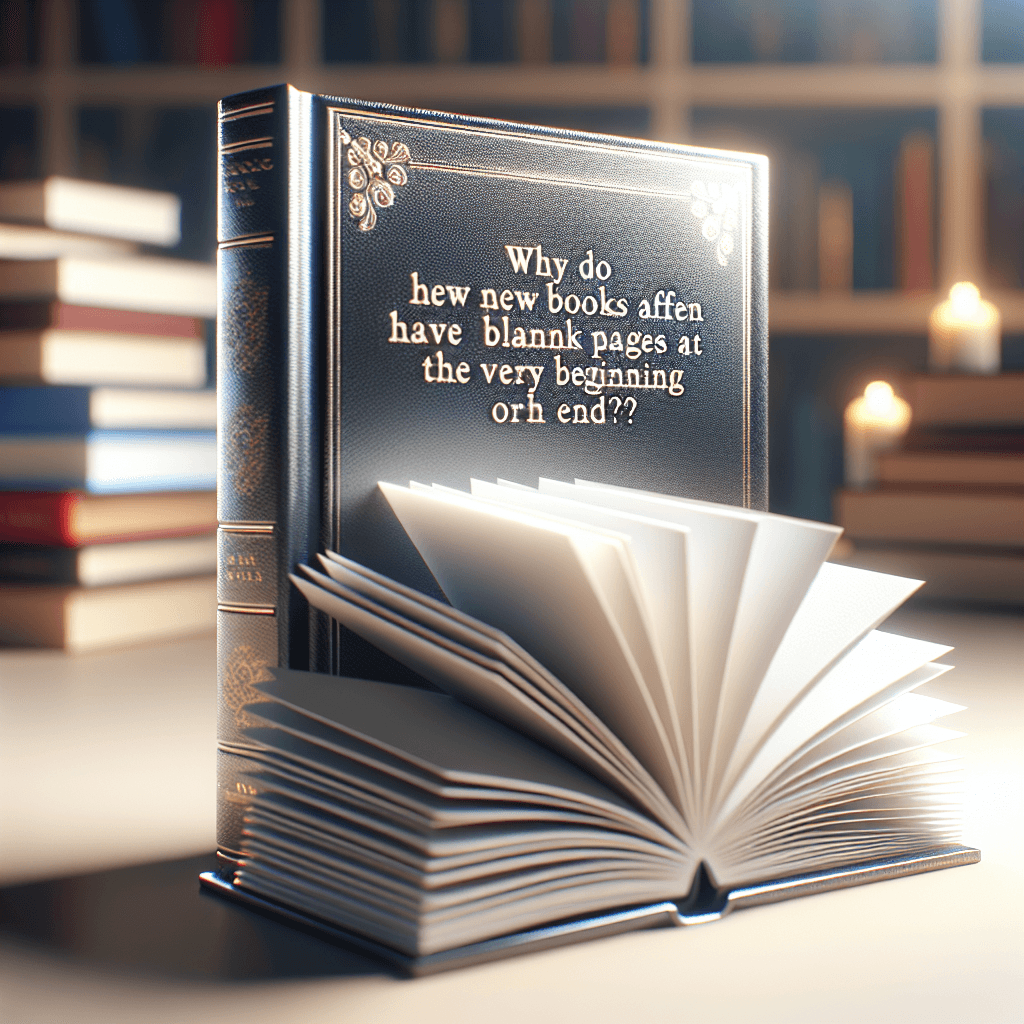
Have you ever opened a brand-new book, fresh from the store, only to be greeted by one, two, or even a handful of completely blank pages at the very beginning or end? It can feel like a slight misprint or a waste of paper. You might wonder, "Did they run out of words?" The truth, however, is far from a mistake. These blank pages are not an oversight but an intentional and fascinating byproduct of the modern book manufacturing process. They are a silent clue that reveals how a book is physically made. This post will pull back the curtain on the printing industry to solve the mystery of those empty pages once and for all.
It's All About the "Signature"
To understand the blank pages, we first need to understand a core concept in printing: the signature. Books aren't printed one page at a time like you might print a document at home. Instead, they are printed on massive sheets of paper that hold multiple pages at once. A typical signature might contain 8, 16, or 32 book pages arranged in a specific order.
Imagine a giant piece of paper with 16 pages printed on it—eight on the front and eight on the back. This large sheet is then expertly folded, trimmed, and cut to create a small booklet of 16 consecutive pages. This booklet is a single signature. The entire book is constructed by printing multiple signatures and then stitching or gluing them together to form the "book block" before the cover is attached.
The Inevitable Math of Book Binding
Here is where the blank pages come into play. The manuscript a writer submits—the actual content of the book—can end on any page number. It might be 287 pages long, 315, or 402. However, the printing process is bound by the fixed number of pages in a signature.
Let's use an example:
- A publisher is printing a book that has 310 pages of text.
- The printing press uses 16-page signatures.
- To accommodate all 310 pages, the printer must calculate how many signatures are needed.
To get to 310 pages, the printer needs 19 full signatures (19 x 16 = 304 pages) and then part of another. But you can't print part of a signature; the whole sheet must go through the press. Therefore, the printer must use 20 full signatures. This gives a total of 320 available pages (20 signatures x 16 pages/signature).
Since the book's content only takes up 310 of those pages, there are 10 leftover pages that will be blank.
So, Where Do the Blanks End Up?
Rather than leaving these blank pages randomly scattered, publishers strategically place them to create a clean, professional product. Most often, they are grouped at the very beginning (after the cover but before the title page) and at the very end (after the final chapter or index). This is done for several practical reasons:
- Protection: Blank pages act as a buffer, protecting the first and last printed pages of the book from damage during shipping and handling.
- Aesthetics: It provides a clean, deliberate transition into and out of the content, which is more visually appealing than ending abruptly.
- Practicality: These pages, sometimes called endsheets, provide a perfect space for author signatures at book signings or for readers to jot down their own notes.
Is This a Waste of Paper?
While it might seem inefficient to print blank pages, it is actually the most cost-effective and resource-efficient way to manufacture books on a large scale. The process of printing with standardized signatures is a well-oiled machine. Creating a custom, smaller signature for the end of every single book would require re-calibrating massive printing presses, leading to immense costs, time delays, and a far greater potential for error. The few blank pages are a small trade-off for the incredible efficiency that allows millions of books to be printed affordably.
So, the next time you crack open a new book and find a blank page, you can see it for what it truly is: not an error, but a ghost of the printing press. It’s a quiet reminder of the intricate and fascinating journey a book takes from a digital file to the physical object in your hands. These pages aren’t empty by mistake; they are a necessary part of a process that has put books into the hands of readers for centuries.


