
Why do some mushrooms create their own miniature weather systems
On a perfectly still day, some mushrooms don't wait for a breeze to spread their spores—they create their own. Uncover the astonishing science behind fungi that have evolved to become masters of their own miniature climate.

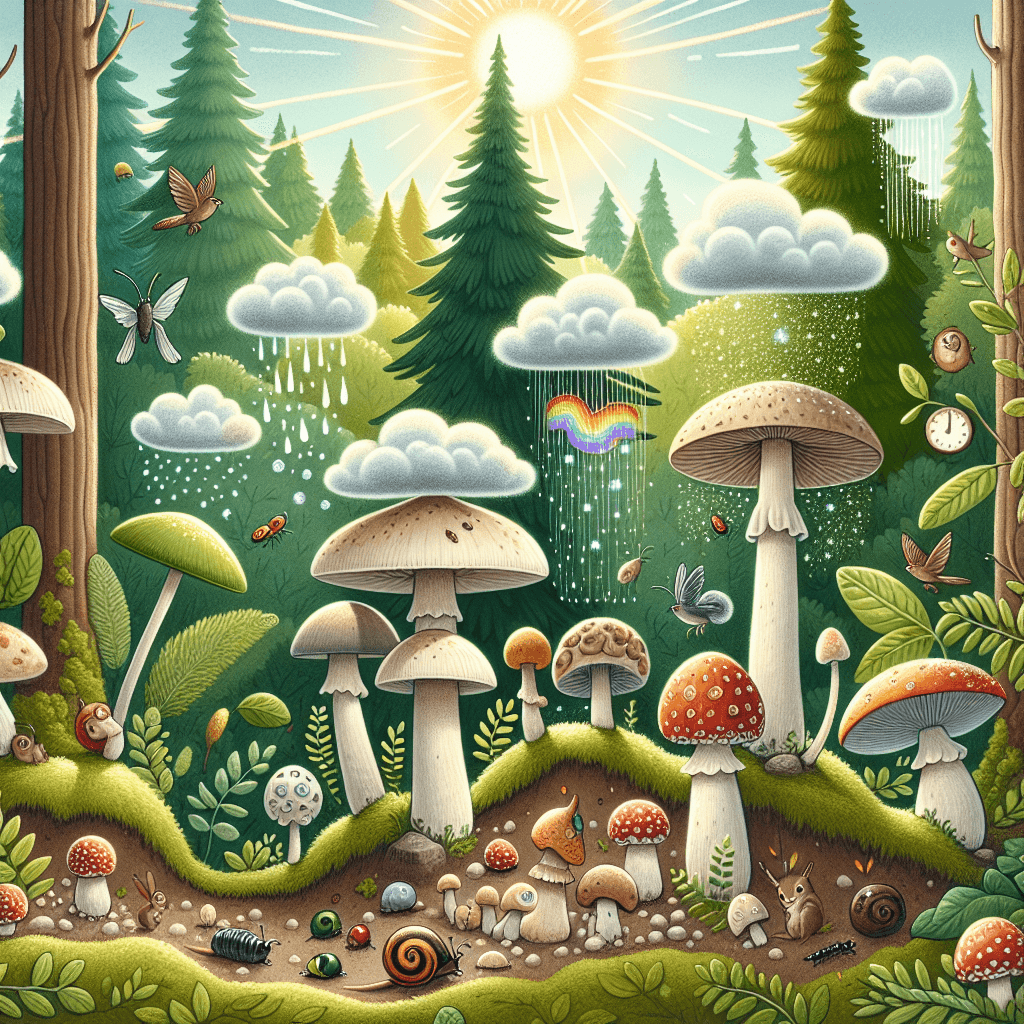
Too Long; Didn't Read
TLDR: Mushrooms release water vapor to cool the air around them, creating a tiny, personal breeze that helps carry their spores away to reproduce, even on a still day.
Fungal Forecasters: Why Do Some Mushrooms Create Their Own Miniature Weather Systems?
Have you ever stopped to consider how a mushroom, rooted firmly to the forest floor on a perfectly calm day, manages to spread its microscopic spores far and wide? It’s a puzzle that seems to defy basic physics. Yet, these fascinating organisms have evolved an ingenious solution: they become their own personal weather-makers, creating tiny, localized atmospheric changes to give their offspring the best possible start in life. This blog post delves into the remarkable science behind how and why some mushrooms generate their own miniature weather systems to ensure their survival.
The Spore Dispersal Dilemma
For a fungus, successful reproduction hinges on spore dispersal. Each mature mushroom can produce billions of microscopic spores, but their mission is fraught with challenges. The most significant obstacle is the layer of still, undisturbed air that exists directly underneath the mushroom's cap, nestled between the delicate, spore-producing structures known as gills.
This "boundary layer" of air is a major problem. If a spore were to simply drop from a gill, it would likely fall straight down, landing in the inhospitable shadow of its parent. To colonize new territory, the spore needs a lift—it must escape this stagnant air and reach the more turbulent currents blowing just a few millimeters away. But how can it do that without any wind?
The Solution: A Self-Made Breeze
The mushroom's solution is a masterful piece of biological engineering centered on a simple physical principle: evaporative cooling. By manipulating the air temperature and humidity around itself, the fungus creates its own localized air currents.
This process, confirmed by studies from researchers at institutions like Harvard University, works in a few key steps:
- Evaporation: The large, moist surface area of a mushroom's gills is constantly releasing water vapor into the surrounding air. This process is similar to transpiration in plants.
- Cooling: As the water evaporates, it draws heat energy from the air. This has a cooling effect, making the air immediately surrounding the gills slightly colder and more humid than the ambient air just outside the mushroom's cap.
- Creating Convection: Cold air is denser than warm air. This pocket of cool, dense air under the cap begins to sink and flow outwards. As it does, it displaces the warmer, less dense air around it, creating a gentle but persistent circulatory airflow, or a convection current.
In essence, the mushroom acts as a tiny, self-powered air-conditioning unit. This subtle, continuous flow is the "wind" the mushroom needs to solve its dispersal problem.
The Perfect Launch Mechanism
This self-made weather system is perfectly synchronized with the way spores are released. The spores aren't just passively dropped; they are ballistically launched from the gills with a tiny "pop." This initial ejection gives them just enough momentum to clear the gill surface.
Once airborne, the spores are immediately caught by the mushroom's own convective airflow. This gentle current is strong enough to carry the lightweight spores out from between the gills and into the open air. There, they can be swept up by larger wind currents, traveling meters or even kilometers to find a new home. It’s a sophisticated two-stage launch system: a ballistic push followed by a weather-powered lift.
Conclusion
The ability of a mushroom to create its own microclimate is not just a scientific curiosity; it is a fundamental survival strategy. By harnessing the power of evaporation to generate tiny air currents, mushrooms overcome the physical barrier of still air, ensuring their spores can travel and propagate the species. This incredible feat of natural engineering highlights the complex and often hidden processes at work in the fungal kingdom. So, the next time you encounter a mushroom in the wild, take a moment to appreciate the invisible, intricate weather system it is tirelessly creating to send its next generation out into the world.


