
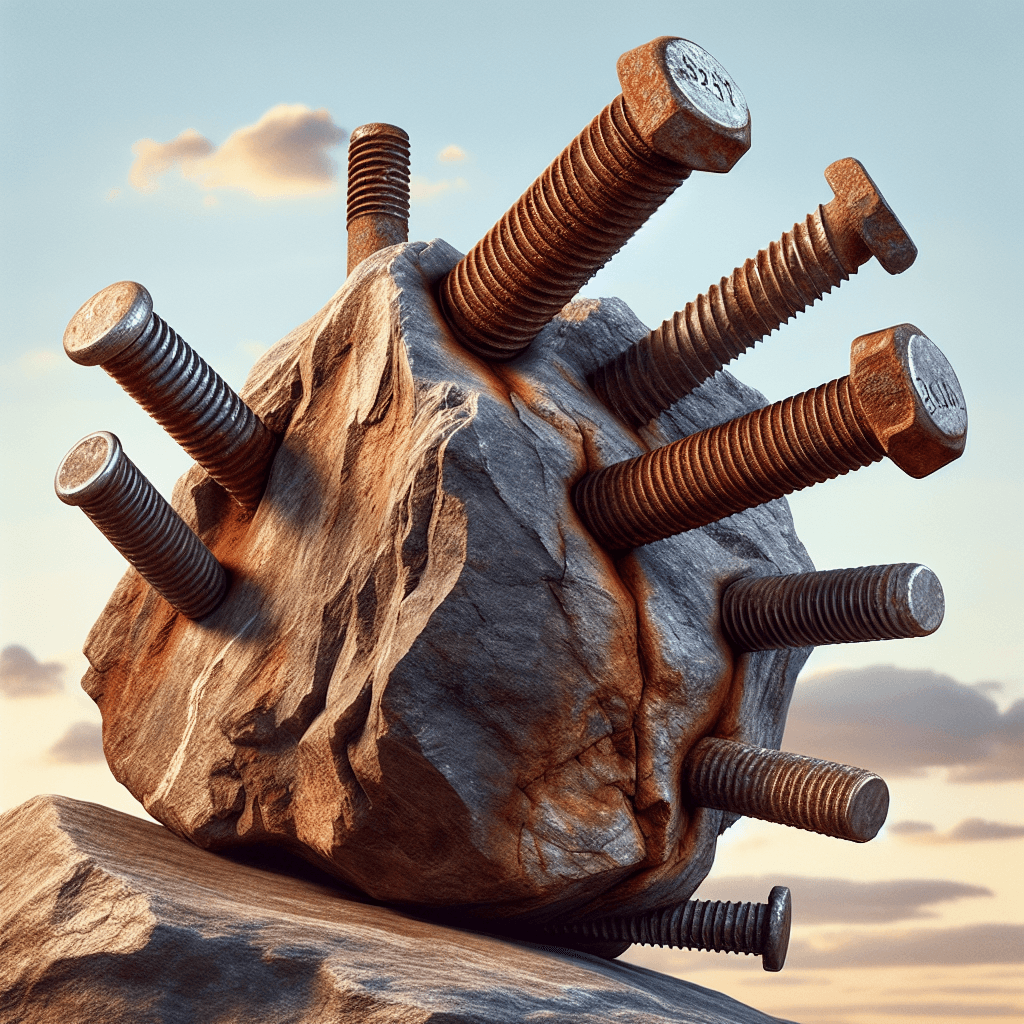
Why do some rocks have rusty metal bolts sticking out of them
It’s a bizarre sight on any hike—a rusty metal bolt mysteriously embedded in solid rock. Far from being random junk, these markers are clues to a forgotten history of how we first mapped the world around us.

Too Long; Didn't Read
TLDR: Those rusty bolts are man-made anchors placed by rock climbers for safety, by surveyors as measurement points, or by engineers to stabilize rock formations. They rust from long-term exposure to weather.
Unbolting the Mystery: Why Do Some Rocks Have Rusty Metal Bolts Sticking Out of Them?
Have you ever been on a hike, admiring the ancient, silent grandeur of a rock formation, only to be jolted back to the modern world by the sight of a rusty metal bolt sticking out of it? It can seem jarring—a man-made intrusion on a natural canvas. You might wonder if it’s leftover junk or some long-forgotten project. In reality, these bolts are rarely random. They are intentional, precisely placed markers that tell a story of science, safety, and engineering. This post will delve into the primary reasons why you find these metal bolts in rocks, transforming them from mysterious objects into fascinating points of interest.
The Primary Culprits: Surveying and Geodetic Control
One of the most common reasons for a bolt in a rock is that it's part of a survey marker, often called a "benchmark" or a "geodetic control point." These aren't just random pieces of hardware; they are fundamental to how we map and build our world.
Surveyors and cartographers from organizations like the U.S. Geological Survey (USGS) or the National Geodetic Survey (NGS) place these markers in stable locations—and what’s more stable than a massive boulder or bedrock? Each marker serves as a permanent point with a precisely known location, including:
- Latitude and Longitude: Its exact position on the Earth's surface.
- Elevation: Its height above sea level.
These reference points are crucial for a huge range of activities, from creating accurate topographic maps and property boundaries to planning major infrastructure projects like highways, bridges, and dams. The bolt, often the center of a brass or aluminum disk, is the specific point of measurement. Over decades of exposure to the elements, the steel in these older bolts naturally oxidizes, giving them their characteristic rusty appearance.
A Climber's Lifeline: Anchors for Safety and Sport
If you spot a bolt on a sheer cliff face, especially in an area known for outdoor recreation, there's a good chance it was placed by a rock climber. In the world of climbing and mountaineering, bolts are life-saving pieces of equipment.
These bolts are permanent anchors drilled directly into the rock to create a "sport climbing" route or to provide a secure anchor point (a belay station) where natural protection like cracks is unavailable. Climbers clip their ropes to these bolts as they ascend, which protects them in case of a fall.
Why do they look rusty?
- Older Materials: Historically, many climbing bolts were made from plated carbon steel. While strong, this material is susceptible to rust, especially in humid or coastal environments.
- Corrosion: The combination of moisture, oxygen, and time inevitably leads to corrosion.
Modern climbing ethics and safety standards now strongly favor stainless steel or even more corrosion-resistant titanium bolts, but thousands of older, rusty steel bolts still exist on classic routes around the world. For climbers, identifying and assessing the condition of a bolt is a critical safety skill.
Holding It All Together: Geotechnical Engineering and Rock Stabilization
Sometimes, bolts in rocks are less about mapping or recreation and more about holding the landscape together. This is the work of geotechnical engineers, who use a technique called "rock bolting" to prevent dangerous rockfalls and landslides.
You are most likely to see these along highway cuts, in tunnels, or near dams. When a rock face is identified as unstable, engineers drill long steel rods, sometimes over 20 feet long, deep into the rock. These bolts, often secured with grout or an expansion mechanism, effectively pin the unstable outer layers of rock to the solid, stable bedrock behind them. The part you see is just the tip of the iceberg—the end of the rod, often with a large plate and nut to distribute the load. The rust is simply a sign of an older steel bolt doing its job, silently preventing tons of rock from collapsing onto a road or structure below.
Conclusion: More Than Just a Rusty Bolt
So, the next time you encounter a rusty metal bolt in a rock, you’ll know it’s not just a piece of litter. It is a silent testament to human ingenuity and our interaction with the natural world. It could be a surveyor's mark that helped map the very trail you're standing on, a climber's anchor that enabled a thrilling ascent, or an engineering solution that keeps you safe on your journey. These humble bolts connect us to stories of exploration, adventure, and the constant effort to build and secure our world, proving that even the smallest man-made objects can have a profound purpose.


