
Why does a drop of coffee dry into a dark ring instead of an even spot
That dark, ring-shaped stain from a forgotten coffee drop is no accident. It’s the result of a microscopic traffic jam, and the physics behind it is surprisingly fascinating.

Too Long; Didn't Read
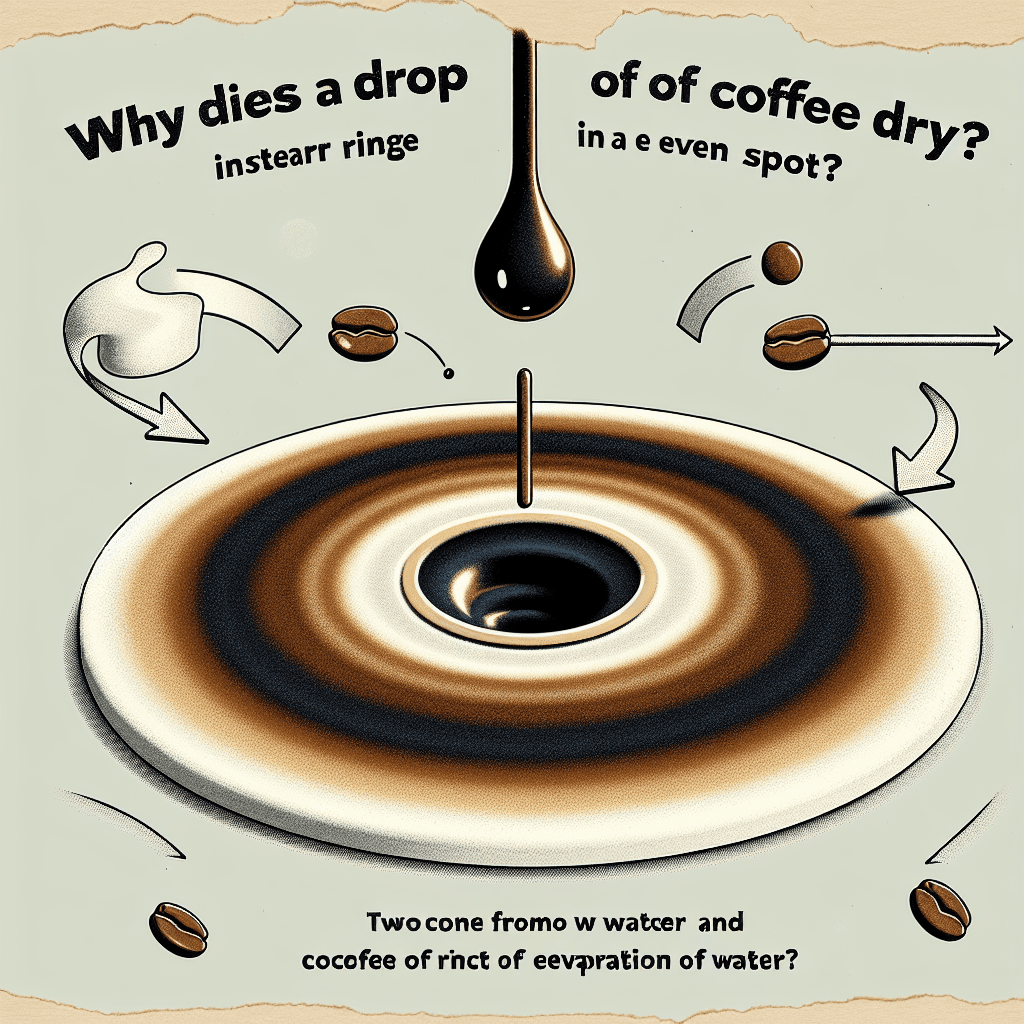
TLDR: Evaporation is faster at the edge of the drop. This pulls liquid and suspended coffee particles from the center to the perimeter, depositing them to form a dark ring as the water dries.
The Coffee Ring Effect Explained: Why Does a Drop of Coffee Dry into a Dark Ring Instead of an Even Spot?
Have you ever spilled a drop of coffee on your desk or a piece of paper and noticed something peculiar once it dries? Instead of a uniform brown stain, you’re almost always left with a pale center and a strikingly dark, well-defined ring around the edge. This isn't a fluke; it's a fascinating and predictable phenomenon rooted in physics. This common kitchen-table observation, known as the "coffee ring effect," has puzzled people for decades and has surprisingly significant implications in fields from printing to medical diagnostics. This post will demystify this everyday occurrence, exploring the science that turns a simple spill into a distinct ring.
The Real Culprit: Pinned Edges and Capillary Flow
The secret behind the coffee ring lies in the interplay between evaporation and the physics of fluids. When a droplet of coffee (which is essentially water with suspended solid coffee particles) sits on a surface, its journey to becoming a dry stain begins.
The process can be broken down into a few key steps:
- Contact Line Pinning: The edge of the coffee drop doesn't shrink smoothly as it evaporates. Instead, it gets "stuck" or "pinned" to the tiny, rough imperfections of the surface it's on. This means the perimeter of the drop remains fixed for most of the drying process.
- Faster Evaporation at the Edge: Evaporation doesn't happen uniformly across the entire drop. The liquid at the very edge evaporates much faster than the liquid in the center. This is because the edge has a greater surface area exposed to the air relative to its small volume, allowing for a quicker escape of water molecules.
- An Outward Rush: Because the edge is pinned and liquid is evaporating there quickly, the droplet needs to replenish that lost liquid. To do this, an outward flow is generated from the center of the drop toward the edge. This tiny but powerful current is known as capillary flow.
- Particle Conveyor Belt: This outward capillary flow acts like a microscopic conveyor belt. It picks up the suspended coffee particles from the center of the drop and carries them all the way to the pinned edge.
As the water at the edge continues to evaporate, it leaves the coffee particles behind. This process continues until all the liquid is gone, resulting in a high concentration of coffee particles deposited right at the original edge of the drop, forming the dark ring. The center, meanwhile, is left pale because most of its particles were swept away.
More Than Just a Stain: The Coffee Ring Effect in Science
While it might seem like a trivial observation, understanding and controlling the coffee ring effect is crucial in many high-tech industries. Scientists and engineers actively work to either combat or harness this phenomenon.
For example, in inkjet printing, the effect is a major challenge. Printers need to deposit ink evenly to create a solid, uniform color, not a ring. According to research published in journals like Nature, engineers have developed specialized ink formulations that suppress this outward flow, ensuring a high-quality print.
Conversely, the effect can be incredibly useful. In medical diagnostics, scientists are developing low-cost tests that rely on this principle. A drop of blood or other bodily fluid can be dried on a special surface, and the patterns formed by the particles (like cells or proteins) can help diagnose diseases without expensive equipment. The predictable nature of the ring formation allows for a new way to "read" biological samples.
Conclusion
The next time you see that familiar dark ring left by a coffee spill, you'll know you're not just looking at a stain. You're witnessing a beautiful demonstration of fluid dynamics in action. The phenomenon is a direct result of the droplet's edge pinning to the surface, causing faster evaporation there and triggering an outward capillary flow that transports all the solid particles to the perimeter. This seemingly simple coffee ring effect is a perfect example of how complex scientific principles are at play all around us, influencing everything from our morning brew to cutting-edge technology.


