
Why does a fast-spinning hard-boiled egg suddenly stand up on its end
It’s a kitchen trick that seems to defy gravity: a spinning egg suddenly leaps onto its tip like a ballerina. Uncover the counterintuitive physics that lifts the egg against all odds.

Too Long; Didn't Read
TLDR: As the egg spins, friction with the surface creates a force that pushes one end up. The egg converts some of its spinning energy into the energy needed to lift itself, achieving a more stable, upright spinning position on its tip.
Spinning Science: Why Does a Fast-Spinning Hard-Boiled Egg Suddenly Stand Up on its End?
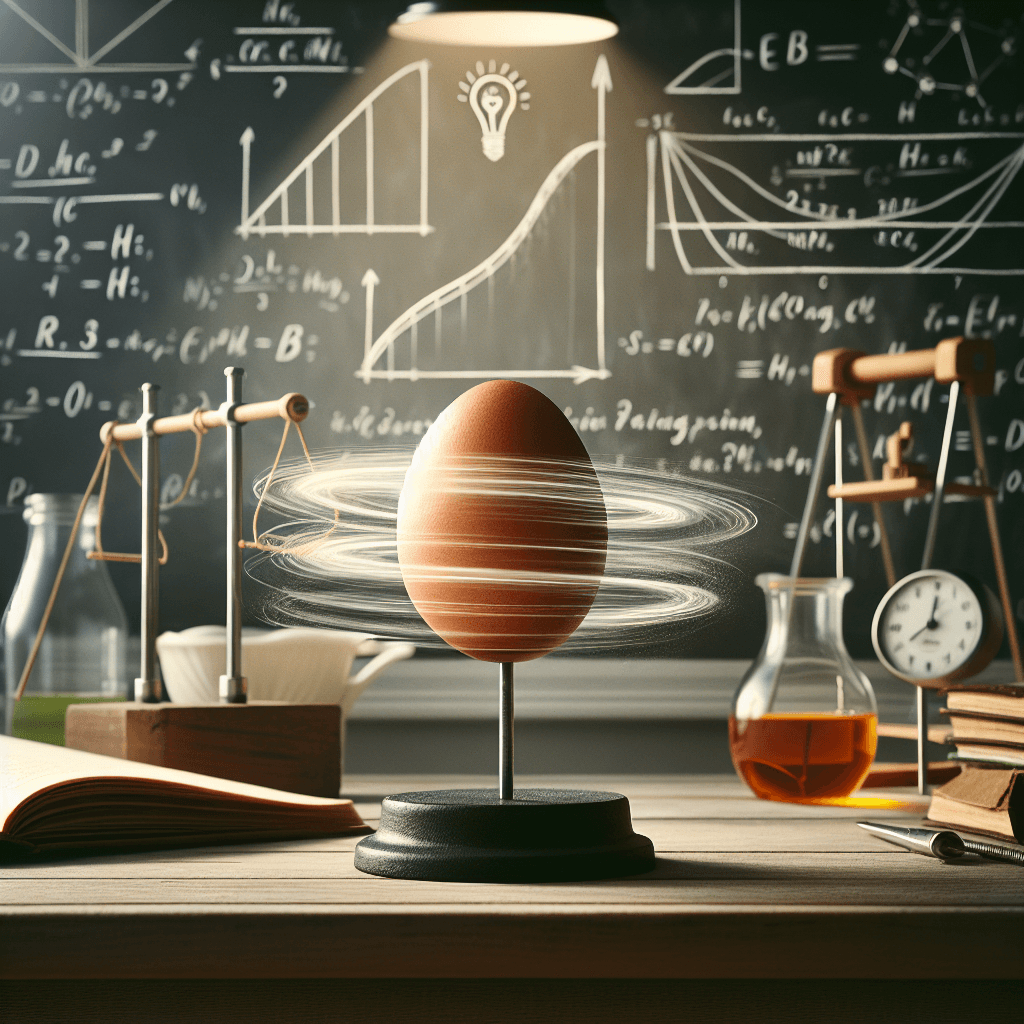
Have you ever spun a hard-boiled egg on your kitchen counter, only to watch it do something seemingly impossible? With enough speed, the egg, initially spinning on its side, wobbles, rises, and suddenly stands upright, spinning gracefully on its pointed end. This isn't a magic trick; it's a fascinating display of physics at work in our everyday lives. While it might seem to defy logic by raising its own center of gravity, this phenomenon is a perfect, bite-sized lesson in mechanics. This post will break down the science behind this curious behavior, exploring the interplay of friction, energy, and gyroscopic forces that make an egg stand tall.
The Foundation: Starting the Spin
Before we get to the rise, it's crucial to understand the initial setup. This trick only works with a hard-boiled egg. If you try to spin a raw egg with the same force, its liquid insides will slosh around, creating internal friction and instability that dampens the spin. The solid, unified mass of a hard-boiled egg is essential because it can behave like a single rigid object, allowing the forces we're about to discuss to take effect.
When you spin the egg, you impart a significant amount of kinetic (rotational) energy. Initially, it spins on its long side, which is its most stable position with the lowest center of gravity—a state of low potential energy. In a world without friction, it would simply keep spinning on its side until it ran out of energy. But on your kitchen counter, friction is the secret ingredient that initiates the magic.
The Rise: How Friction Lifts the Egg
The key to the egg's rise is a specific type of friction called "sliding friction." The bottom of the spinning egg isn't perfectly smooth, and neither is your countertop. As the egg spins, the points of contact with the surface are constantly slipping.
- Creating a Torque: This slipping action generates a frictional force. Because the egg is a curved, oblong shape, this force doesn't just slow the egg down; it also creates a turning force, or torque.
- Converting Energy: This frictional torque pushes on the bottom of the egg, causing its axis of rotation to tilt upwards. In essence, the kinetic energy from the spin is converted into potential energy as the egg's center of mass is lifted higher off the counter.
This is the most counter-intuitive part of the phenomenon. We typically see objects settle into their lowest energy state. However, as physicists like Keith Moffatt of Cambridge University have detailed, the frictional force provides the external "kick" needed to propel the egg into a higher-energy, upright position. The total energy of the system still decreases due to heat loss from friction, but a portion of the spin energy is cleverly repurposed to lift the egg.
The Finale: Gyroscopic Stability
Once the friction has done its job of lifting the egg, another physical principle takes over to keep it there: gyroscopic stability. You've seen this effect with a spinning top. A slow-moving top will topple over immediately, but a fast-spinning one remains perfectly balanced on its tip. The fast-spinning egg behaves in the same way.
As the egg rises, its axis of spin becomes vertical. The rapid rotation creates gyroscopic stiffness, which fiercely resists any force—like gravity—that tries to pull it off its axis. The egg becomes a "sleeping top," spinning stably on its point in a state of higher potential energy. It will continue to spin in this upright position until its rotational speed decreases to a point where the gyroscopic forces are no longer strong enough to overcome gravity, and it will then wobble and fall back onto its side.
Conclusion
The mystery of the standing egg is a beautiful demonstration of complex physics hidden in plain sight. It’s not one single force, but a chain reaction of principles working in harmony. It begins with the high rotational energy you provide, which is then acted upon by sliding friction on the countertop. This friction generates a torque that converts kinetic energy into potential energy, physically lifting the egg. Finally, gyroscopic stability takes over, allowing the egg to maintain its elegant, upright spin.
So, the next time you're preparing a meal, take a moment to test this out. You aren't just playing with your food; you're conducting a hands-on experiment in classical mechanics and witnessing how the fundamental laws of the universe can turn an ordinary egg into an extraordinary spinning top.


