
Why does a microwave oven create hot and cold spots in your food
Tired of a meal that's both scalding hot and icy cold? It's not a faulty appliance; it's a fascinating battle of invisible waves happening right on your plate.

Too Long; Didn't Read
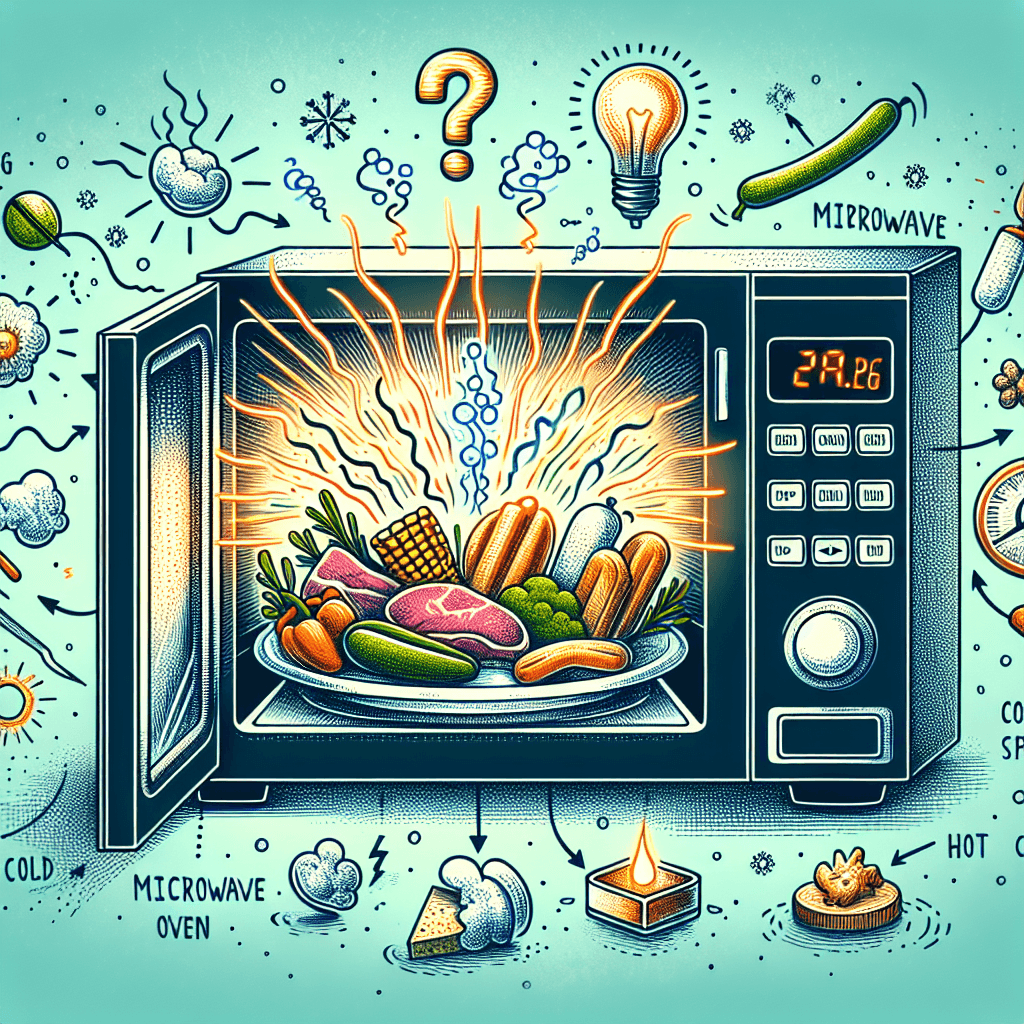
TLDR: Microwaves create a standing wave pattern inside the oven with fixed points of high energy (hot spots) and no energy (cold spots). The rotating plate moves your food through these spots to try and heat it evenly.
The Uneven Heat Mystery: Why Does a Microwave Oven Create Hot and Cold Spots in Your Food?
Have you ever pulled a bowl of leftovers from the microwave, only to find it searing hot on the edges and frustratingly cold in the middle? This common kitchen annoyance isn't a sign that your microwave is broken; it's a fundamental consequence of the very physics that allows the appliance to cook food so quickly. The tell-tale hot and cold spots are a direct result of how microwave energy behaves inside that metal box. This post will delve into the science behind this uneven heating, explaining everything from the nature of microwaves themselves to the role your food's composition plays in the process, helping you become a master of your microwave.
How Your Microwave Really Works
Before we can understand the problem, we need to understand the process. A microwave oven doesn't generate heat in the traditional sense. Instead, it generates, well, microwaves. These are a form of electromagnetic radiation, similar to radio waves. The oven's magnetron shoots these waves into the food compartment.
Here’s the key: these waves are specifically tuned to excite certain molecules, with water being the primary target. When the microwaves hit water molecules in your food, they cause them to rapidly vibrate and flip back and forth—billions of times per second. Think of it as making the water molecules dance furiously. This frantic movement creates friction between the molecules, and it's this friction that generates the heat that cooks your food from the inside out.
The Main Culprit: Standing Waves
Now, for the source of those hot and cold spots. The inside of your microwave is a metal box. When the microwaves are beamed into this box, they don't just travel in a straight line; they bounce off the reflective metal walls. As these waves reflect and interfere with each other, they create a pattern of energy inside the oven known as a "standing wave."
To visualize a standing wave, imagine two people holding a long jump rope and shaking it. There will be points on the rope that move up and down a lot (high energy) and other points that barely move at all (low energy).
- Hot Spots (Antinodes): These are the areas where the wave energy is at its peak. Any food in this location will be bombarded with intense microwave energy, causing its water molecules to vibrate intensely and heat up quickly.
- Cold Spots (Nodes): These are the areas where the waves effectively cancel each other out, resulting in little to no energy. Food in these spots receives minimal microwave radiation and remains cold.
This pattern of energy peaks and valleys is stationary, meaning the hot and cold spots don't move.
The Role of the Turntable (and Its Limits)
Microwave engineers are well aware of the standing wave problem, and their primary solution is the rotating turntable. The purpose of the turntable is simple: to move the food through the stationary hot and cold spots. By constantly rotating your meal, the turntable attempts to average out the energy exposure, ensuring that every part of the food gets its turn in a high-energy "hot spot."
While the turntable is a massive improvement, it's not a perfect fix. If you have a large or oddly shaped dish, some parts may hang over the edge of the platter or stay in the center, receiving less movement and, therefore, less even heating.
It's Not Just the Oven—It's Your Food
The final piece of the puzzle is the food itself. The physical properties of what you're cooking have a huge impact on how evenly it heats.
- Density and Thickness: Thicker, denser parts of your food (like a chunk of chicken) take longer for the microwaves to penetrate and heat compared to thinner, less dense parts (like a sauce).
- Water Content: Areas with higher water content will heat up much faster. This is why the tomato sauce on your pasta can become scalding hot while the noodles are still lukewarm.
- Initial State: Microwaves struggle to excite the locked-in water molecules in ice. This is why defrosting is so tricky. The parts that thaw first begin to absorb energy rapidly and cook, while the frozen core remains solid ice. This phenomenon, known as "thermal runaway," is why the edges of your frozen dinner can be overcooked while the center is still an ice block.
Conclusion
The mystery of hot and cold spots is not a flaw but an inherent characteristic of microwave cooking technology. It’s a fascinating interplay between the physics of standing waves within a metal box and the diverse composition of our food. While the turntable does its best to mitigate the issue, it can’t eliminate it entirely. By understanding this science, you can become a more effective microwave user. So, the next time you pause your microwave midway through to stir your soup or rearrange your food, you’re not just following instructions—you’re actively outsmarting the physics of standing waves to achieve a perfectly heated meal.


