
Why does a spinning ice skater speed up just by pulling in their arms
It seems to defy logic: a skater pulls their arms in and suddenly spins twice as fast. Uncover the fundamental law of the universe that makes this stunning illusion possible.

Too Long; Didn't Read
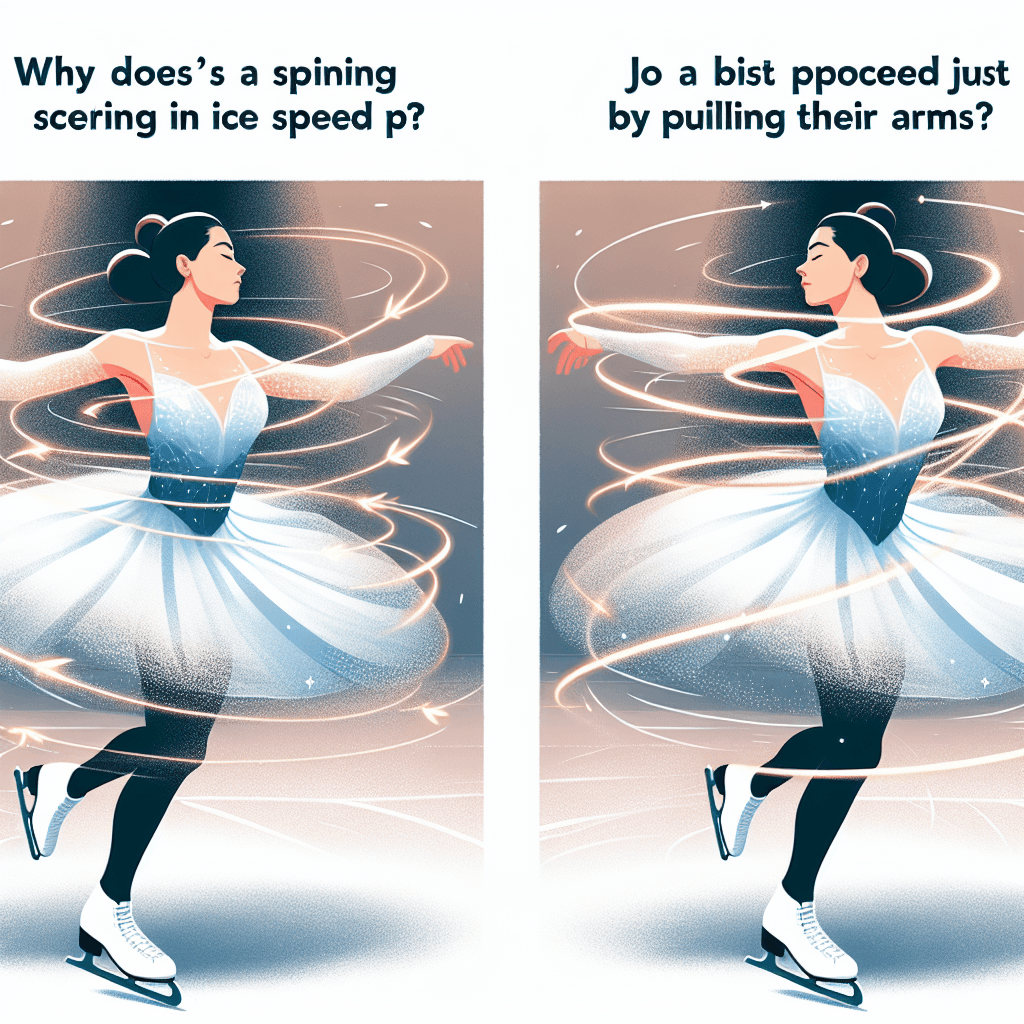
TLDR: By pulling their arms in, a skater concentrates their mass closer to the center of their spin. To conserve angular momentum, a physical law that keeps their total spin consistent, this decrease in width must be balanced by an increase in speed.
The Physics of the Pirouette: Why Does a Spinning Ice Skater Speed Up Just by Pulling in Their Arms?
Have you ever watched a figure skater perform a spin? They begin with a graceful, almost slow rotation, their arms extended wide. Then, in a breathtaking moment, they pull their arms in tight, and their spin accelerates into a dizzying blur. It seems like they’re creating speed out of nowhere, defying the laws of physics. But in reality, they are demonstrating one of physics' most fundamental principles with stunning elegance. This captivating move isn't magic; it's a perfect real-world display of a concept called the conservation of angular momentum. This post will break down the science behind this incredible feat, explaining exactly why a simple change in posture creates such a dramatic change in speed.
The Secret Isn't Magic, It's Physics
The entire phenomenon boils down to one core principle: the conservation of angular momentum. To understand this, let's first think about regular momentum. An object in motion (like a rolling bowling ball) wants to stay in motion. Angular momentum is simply the rotational equivalent of this. It's the measure of an object's tendency to continue spinning.
The law of conservation of angular momentum states that if no external twisting force (a torque) is acting on a spinning object, its total angular momentum must remain constant. For a skater gliding on nearly frictionless ice, there are no significant external torques. This means the total amount of "spin" they have at the beginning must be the same as the amount they have at the end, even if their speed changes.
Angular Momentum = Moment of Inertia x Angular Velocity
To see how the skater speeds up, we need to look at the two components that make up angular momentum:
- Angular Velocity: This is the simpler part of the equation. It’s just a scientific term for how fast an object is rotating or spinning. This is what we visually see increase when the skater becomes a blur.
- Moment of Inertia: This is the rotational equivalent of mass. It measures how resistant an object is to being spun. Crucially, it depends not just on an object's mass, but also on how that mass is distributed relative to the axis of rotation. The farther the mass is from the center, the higher the moment of inertia and the harder it is to spin. Think of trying to spin a barbell: it's much easier to spin it around its center than it is to swing it around in a large circle at arm's length.
Since angular momentum must stay the same, these two factors have an inverse relationship. If one goes down, the other must go up to keep the total constant.
The "Aha!" Moment on Ice
Now, let's apply this directly to our figure skater. The process is a brilliant manipulation of the moment of inertia.
- The Slow Start (Arms Out): When the skater begins their spin with their arms and a leg extended, they are distributing their body mass as far away from their central axis of rotation as possible. This creates a large moment of inertia. Because the moment of inertia is high, their angular velocity (spin speed) must be low to maintain a constant angular momentum.
- The Acceleration (Arms In): The skater then pulls their arms and leg in, hugging them tightly to their body. This action brings their mass much closer to the axis of rotation. As a result, they dramatically decrease their moment of inertia.
- The Dazzling Finish: According to the law of conservation of angular momentum, since the moment of inertia has plummeted, the angular velocity must increase proportionally to keep the total angular momentum unchanged. The result is the stunning acceleration that captivates audiences. To slow down, they simply reverse the process by extending their arms again.
Beyond the Rink: Other Real-World Examples
This principle isn't just for athletes. You can see it in action all around you:
- Divers and Gymnasts: When they want to perform multiple flips or twists in the air, they pull their bodies into a tight tuck position to decrease their moment of inertia and spin faster.
- Office Chairs: Try it yourself! Sit in a spinning office chair with your legs out, give yourself a gentle push, and then pull your legs in. You will instantly speed up.
- Planetary Orbits: Planets in elliptical orbits speed up as they get closer to the sun, a phenomenon also governed by the conservation of angular momentum.
Conclusion
The next time you witness a figure skater transition from a slow, graceful spin into a high-speed pirouette, you’ll know the secret isn’t an illusion. It is a masterful, intuitive application of the conservation of angular momentum. By simply redistributing their mass—changing their moment of inertia—they have complete control over their speed of rotation. It’s a powerful reminder that physics isn’t just a subject in a textbook; it’s woven into the fabric of the world around us, visible in everything from the orbits of planets to the breathtaking beauty of an athlete on ice.


