
Why does your brain constantly ignore the sight of your own nose
It's the one thing you're always looking at, yet never see. Discover the fascinating trick your brain uses to make your own nose invisible.

Too Long; Didn't Read
TLDR: Your brain learns that your nose is a constant and unimportant piece of visual information, so it actively filters out the blurry sight to give you a clear, unobstructed view and let you focus on things that actually matter.
The Invisible Nose: Why Does Your Brain Constantly Ignore the Sight of Your Own Nose?
Have you ever tried this simple experiment? Close your left eye and look to your left. Then, close your right eye and look to your right. In both cases, you’ll probably notice a blurry, out-of-focus shape intruding on your vision. That ever-present but rarely noticed shape is your own nose. Despite being permanently fixed in the center of your field of view, your brain performs a remarkable vanishing act, effectively deleting it from your conscious perception. This isn't a glitch; it's a testament to the incredible efficiency of your brain. This post will explore the fascinating neurological processes that allow your brain to ignore what’s right in front of your face, helping you focus on the world around you.
Your Nose: Always in Sight, Rarely in Mind
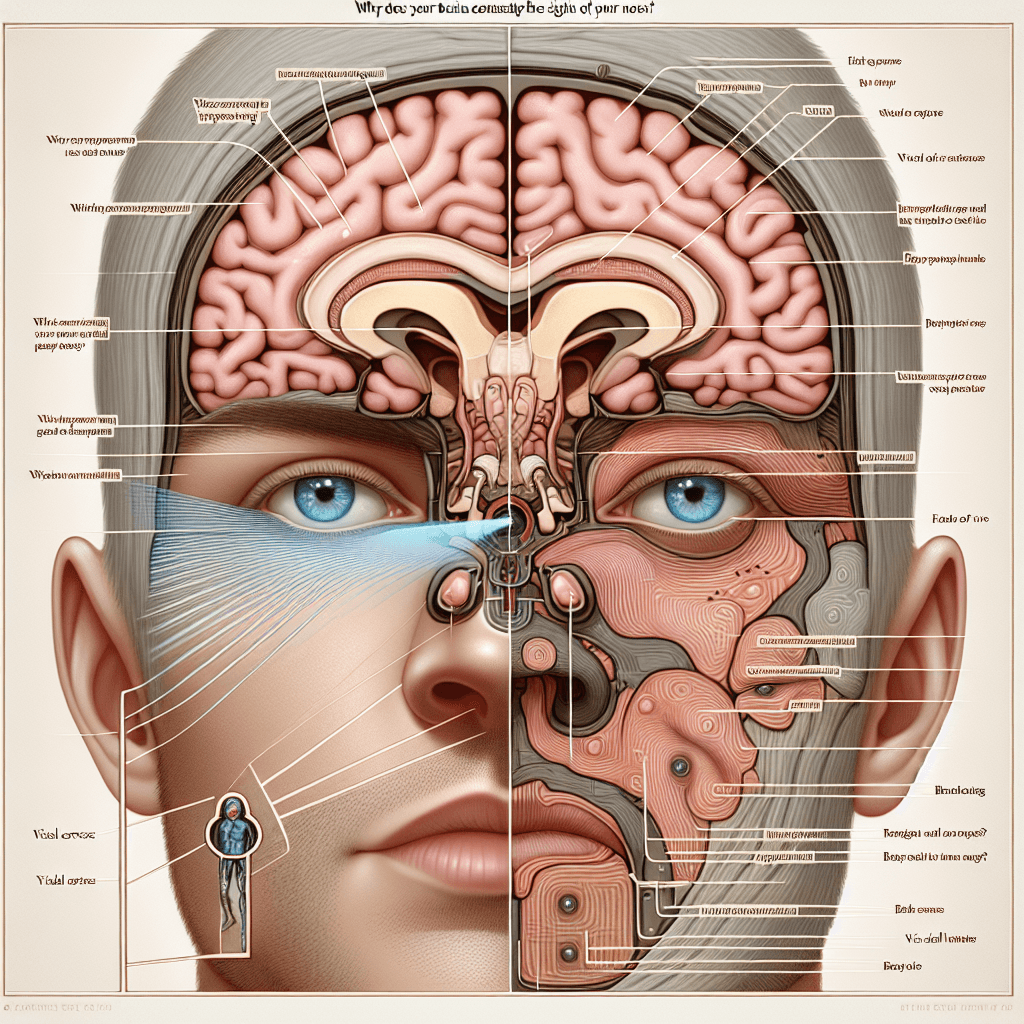
The first piece of this puzzle lies in the mechanics of our vision. Humans have binocular vision, meaning we see the world through two eyes set slightly apart. Each eye captures a slightly different image from a unique angle. Your nose is visible to both eyes, but it obstructs a different part of the view for each one.
Your brain’s visual cortex is tasked with a crucial job: merging these two slightly different images into a single, seamless, three-dimensional picture. In this process of stereoscopic vision, the brain masterfully stitches the two images together. It fills in the blind spots created by the nose using information from the opposite eye, effectively creating a composite image where the nose is "patched over" and rendered mostly invisible.
The Power of Selective Attention
Even with the brain’s clever visual patching, your nose isn't truly gone—it’s just demoted. This is where a powerful cognitive function called selective attention comes into play. Think of it as your brain’s ultimate filter. It’s the same ability that allows you to focus on a single conversation in a noisy, crowded room—a phenomenon known as the "cocktail party effect."
Your brain is constantly bombarded with an overwhelming amount of sensory information. To prevent a cognitive meltdown, it must decide what is important and what can be ignored. Here’s how it evaluates your nose:
- Is it new? No.
- Is it moving? No.
- Does it signal danger or opportunity? No.
Since your nose is a constant, unchanging, and predictable part of your visual landscape, your brain correctly classifies it as irrelevant information. It actively suppresses this static input to free up precious mental resources to focus on things that do change and require your attention, like a car pulling out into the street or the facial expression of someone you're talking to.
Neural Adaptation: How Your Brain Gets 'Bored'
Working hand-in-hand with selective attention is a process called neural adaptation, or sensory adaptation. This is the tendency for our sensory neurons to become less responsive to constant and unchanging stimuli over time. It’s why you stop noticing the feeling of your watch on your wrist a few minutes after putting it on, or why a persistent background hum in a room seems to fade into silence.
The same principle applies to sight. The photoreceptors in your retina that are constantly being stimulated by the static image of your nose gradually decrease their firing rate. This reduced signal tells your brain, "Nothing new to see here!" This physiological response reinforces the brain's cognitive decision to filter out the nose, making the process automatic and effortless. You don’t have to try to ignore your nose; your brain does it for you.
Of course, you can consciously override this process. If you deliberately cross your eyes or focus on the tip of your nose, it will swim back into view. It also reappears if something changes—a smudge of dirt, a water droplet, or a new piercing will suddenly make it novel and relevant, catching your brain's attention until it once again becomes part of the familiar, unchanging scenery.
Conclusion
The fact that you don't see your nose is not a failure of your vision but a triumph of your brain's efficiency. Through a brilliant combination of binocular vision, powerful selective attention, and neural adaptation, your brain edits your reality for a better user experience. It intelligently filters out the constant, predictable static of your own nose to provide you with a clear, unobstructed view of the world that matters. The next time you deliberately bring your nose back into focus, take a moment to appreciate the incredible, silent work your brain does every second to decide what you see—and what you don’t.


