
Why does your brain make things in your peripheral vision vanish
That object you weren't looking at didn't just disappear—your brain actively deleted it from your sight. Discover the strange neurological shortcut that makes your world vanish right before your eyes.

Too Long; Didn't Read
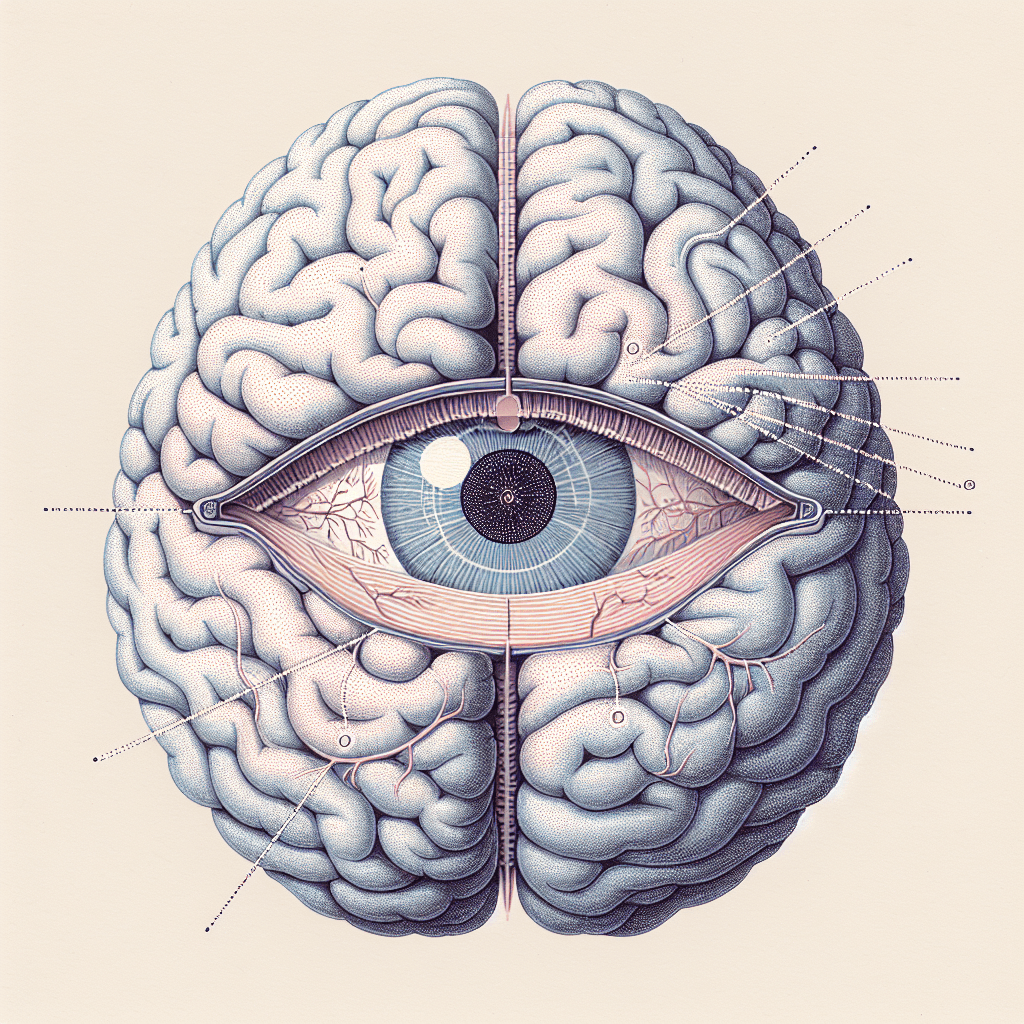
TLDR: To save energy and focus on movement, your brain ignores steady, unchanging things in your less-detailed peripheral vision. It assumes the static object is unimportant and fills in the blank spot with the surrounding background.
The Vanishing Act: Why Does Your Brain Make Things in Your Peripheral Vision Vanish?
Have you ever stared intently at a single point, only to feel as if the world at the edges of your vision was slowly fading to gray? You’re not imagining it, and it’s not a sign that your eyes are failing. This strange disappearing act is a fascinating trick of the mind known as the Troxler Effect, a perceptual phenomenon that reveals how our brains are wired for efficiency. This neurological quirk isn’t a bug in our system; it’s a feature designed to help us focus on what truly matters. In this post, we’ll dive into the science behind this "vanishing act," exploring why your brain deliberately erases unchanging objects from your peripheral awareness.
Introducing the Troxler Effect
First observed by Swiss physician and philosopher Ignaz Paul Vital Troxler in 1804, Troxler's Fading, or the Troxler Effect, describes the optical illusion where static objects in your peripheral vision seem to disappear. If you fix your gaze on a central point for an extended period (usually 20-30 seconds), any unchanging image on the periphery will begin to fade from your perception, often blending into the background.
A simple way to experience this is to draw a small 'X' on a piece of paper and a single, blurred dot about six inches to its right. Cover your left eye and stare directly at the 'X' with your right. Without moving your eye from the 'X', pay attention to the dot in your periphery. After a short while, the dot will seem to vanish completely. It’s still there, but your brain has chosen to ignore it.
Your Brain on Autopilot: The Role of Neural Adaptation
The core reason behind Troxler's Fading is a process called neural adaptation. Our brains are constantly bombarded with an overwhelming amount of sensory information—sights, sounds, smells, and textures. To prevent being overloaded, the brain has become an expert at filtering out redundant or unchanging data.
Here's how it works:
- Constant Stimulus: When neurons in your retina are exposed to a constant, unchanging stimulus (like the static dot in our experiment), they gradually decrease their response. They essentially get "bored" and stop firing as frequently.
- Prioritizing Change: Your brain interprets this lack of new signals as unimportant information. It concludes, "I've seen this before, it's not moving, and it poses no threat. I'm going to stop paying attention to it."
- Central vs. Peripheral Vision: This effect is most pronounced in our peripheral vision. Our central vision, handled by the fovea, is designed for high-acuity detail. We keep it refreshed with tiny, involuntary eye movements called microsaccades. These movements constantly shift the image on our fovea, preventing our neurons from adapting. However, these microsaccades are not as effective at refreshing the large, less-detailed areas of our periphery, allowing stationary objects there to fade away.
An Evolutionary Filter: Why Fading is a Feature, Not a Bug
This seemingly strange quirk is actually a powerful evolutionary advantage. For our ancestors, survival depended on detecting change in the environment. The ability to spot the subtle rustle of leaves indicating a predator or prey was far more important than continuously processing the image of every unmoving tree and rock.
By filtering out the "noise" of the static background, the brain accomplishes two key things:
- Conserves Mental Energy: Processing every single visual detail is computationally expensive. Neural adaptation is an energy-saving mechanism.
- Enhances Motion Detection: When the unchanging background fades away, any new movement or change stands out in stark contrast. This makes our peripheral vision an excellent motion-detection system, alerting us to potential opportunities or dangers outside of our direct line of sight.
In essence, your brain isn't losing information; it's intelligently decluttering your perception to keep you focused on what is most likely to be important for your survival.
Conclusion
The next time you notice something vanishing from the corner of your eye, don’t be alarmed. It’s simply the Troxler Effect at work—a testament to your brain’s incredible efficiency. This phenomenon reveals that what we "see" is not a perfect video feed of the world, but rather a carefully curated reality, constructed by a brain that is constantly making decisions about what is and isn't worthy of our conscious attention. By understanding this fascinating illusion, we gain a deeper appreciation for the complex, behind-the-scenes processes that shape our everyday perception and keep us safe.


