
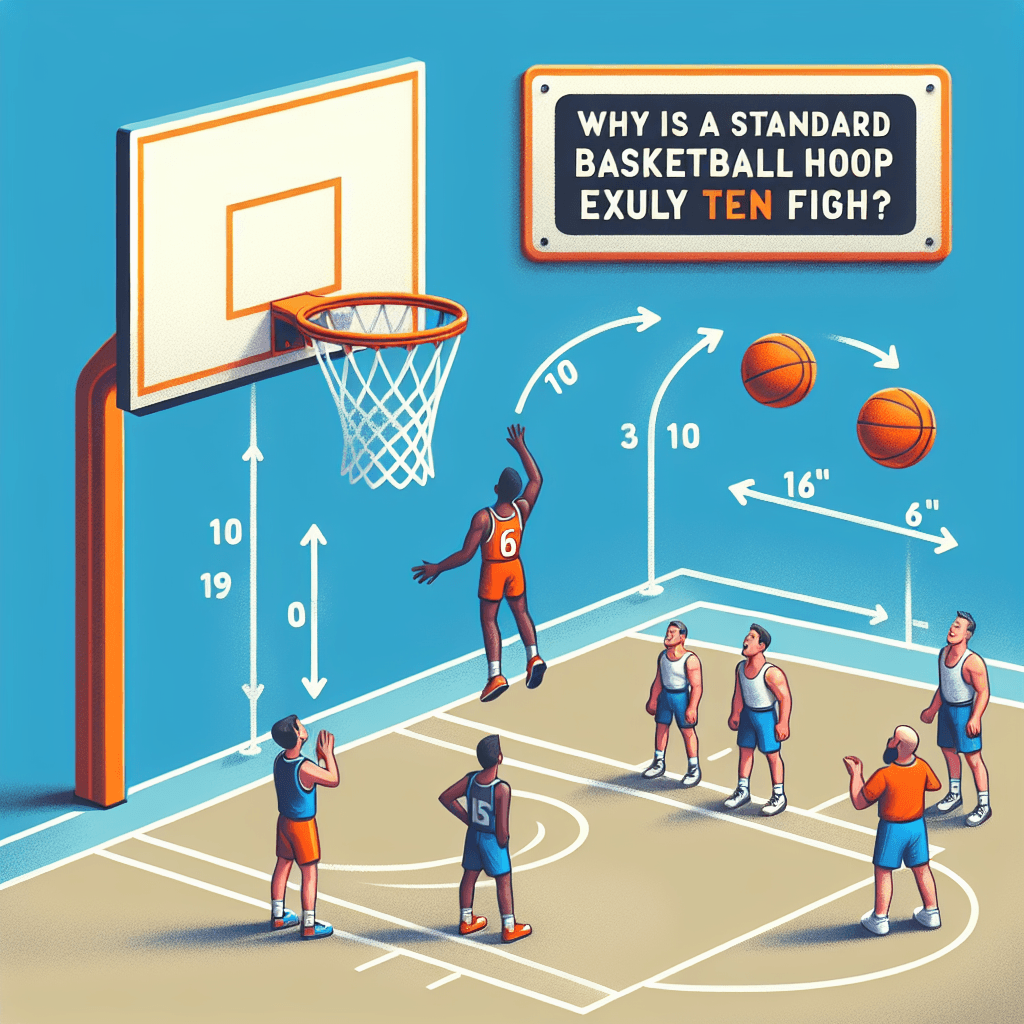
Why is a standard basketball hoop exactly ten feet high
That iconic ten-foot height wasn't determined by sports science or player anatomy, but by a historical accident involving a 19th-century gymnasium's running track.

Too Long; Didn't Read
TLDR: When basketball was invented, the creator hung peach baskets on a running track railing that was 10 feet high because it was a convenient height. The height worked well for the game and it simply became the official standard.
The Ten-Foot Standard: The Surprising History of Why a Standard Basketball Hoop is Exactly Ten Feet High
From a last-second heave at the buzzer to a thunderous slam dunk, the target in basketball is a constant. Whether you're in a high school gym, a neighborhood park, or an NBA arena, the rim hangs precisely ten feet above the court. Have you ever wondered why? Was it the result of scientific analysis to determine the perfect athletic challenge? The answer is much simpler and more accidental than you might think. The ten-foot standard isn't a product of modern sports science, but rather a historical quirk that has become a sacred, unchanging pillar of the game. This post will explore the fascinating origin story of the ten-foot hoop and why, despite decades of debate, it remains the global standard.
The Inventor and the Peach Baskets
The story of the ten-foot hoop begins with the invention of basketball itself. In December 1891, Dr. James Naismith, a Canadian physical education instructor at the International YMCA Training School in Springfield, Massachusetts (now Springfield College), was tasked with creating a new indoor game. He needed a sport less rough than football that could keep his students active during the harsh New England winters.
After laying out his 13 basic rules, Naismith needed a goal. He initially envisioned two square boxes, but the building janitor, Pop Stebbins, couldn't find any. Instead, he returned with two half-bushel peach baskets. Naismith's next instruction would set a precedent for over a century to come. He told Stebbins to nail the baskets to the wall, and the most convenient spot was the lower rail of the gymnasium's elevated running track.
That railing just so happened to be exactly ten feet off the floor.
There was no complex formula or ergonomic study. The height of the first basketball hoop was determined entirely by the architecture of a specific YMCA gymnasium. It was a simple, practical decision that stuck.
From Tedious Retrieval to a Lasting Standard
In those early games, the peach baskets still had their bottoms, meaning someone had to climb a ladder to retrieve the ball after every single made basket. This quickly proved tedious, and soon enough, a hole was drilled in the bottom of the baskets to allow the ball to be poked out with a dowel. By 1906, the peach baskets were replaced by metal hoops with nets, but one thing remained unchanged: the height.
The ten-foot measurement, born of convenience, had become ingrained in the sport's DNA. As basketball's popularity exploded and spread across the country and the world, the original height was adopted universally. It became the official regulation height, a constant that connected every court back to that first game in Springfield.
The Great Debate: Why Hasn't the Height Changed?
As athletes have grown taller, stronger, and more explosive, the question has been raised time and time again: should the hoop be raised? For decades, coaches, players, and pundits have debated moving the rim to 11 or even 12 feet to account for the modern player's incredible athleticism.
Arguments for raising the rim often center on:
- Increasing the Challenge: A higher rim would make dunking more difficult, forcing players to rely more on skill shots like floaters and mid-range jumpers.
- Balancing the Game: It could potentially reduce the dominance of exceptionally tall players near the basket, leveling the playing field.
However, the ten-foot standard has withstood every challenge, primarily due to a few powerful counterarguments:
- Tradition and History: Changing the height would fundamentally alter the game and make it impossible to compare today's players to legends of the past. Every historical record would come with an asterisk.
- Universality and Infrastructure: The ten-foot hoop is a global standard. Raising it would require a massive and prohibitively expensive overhaul of millions of courts worldwide, from professional arenas to school playgrounds.
- The "Above the Rim" Appeal: High-flying dunks and athletic blocks are some of the most exciting plays in sports. Raising the rim could diminish this thrilling aspect of the game, potentially making it less entertaining for fans.
A Legacy by Accident
The journey of the basketball hoop from a peach basket nailed to a balcony to an iconic piece of sporting equipment is a testament to the power of tradition. The ten-foot height that Dr. James Naismith settled on out of pure convenience has shaped the skills, strategies, and very evolution of one of the world's most beloved sports. It stands as a perfect reminder that sometimes, the most enduring standards are not born from meticulous planning, but from a simple, happy accident. So, the next time you watch a player soar for a dunk, remember that their target was set not by design, but by the chance architecture of a long-gone gymnasium.


