
Why is fog white when it is just made of tiny clear water droplets
It's one of nature's most beautiful optical illusions; discover how billions of tiny, perfectly clear water droplets conspire to create a solid, ghostly wall of white.

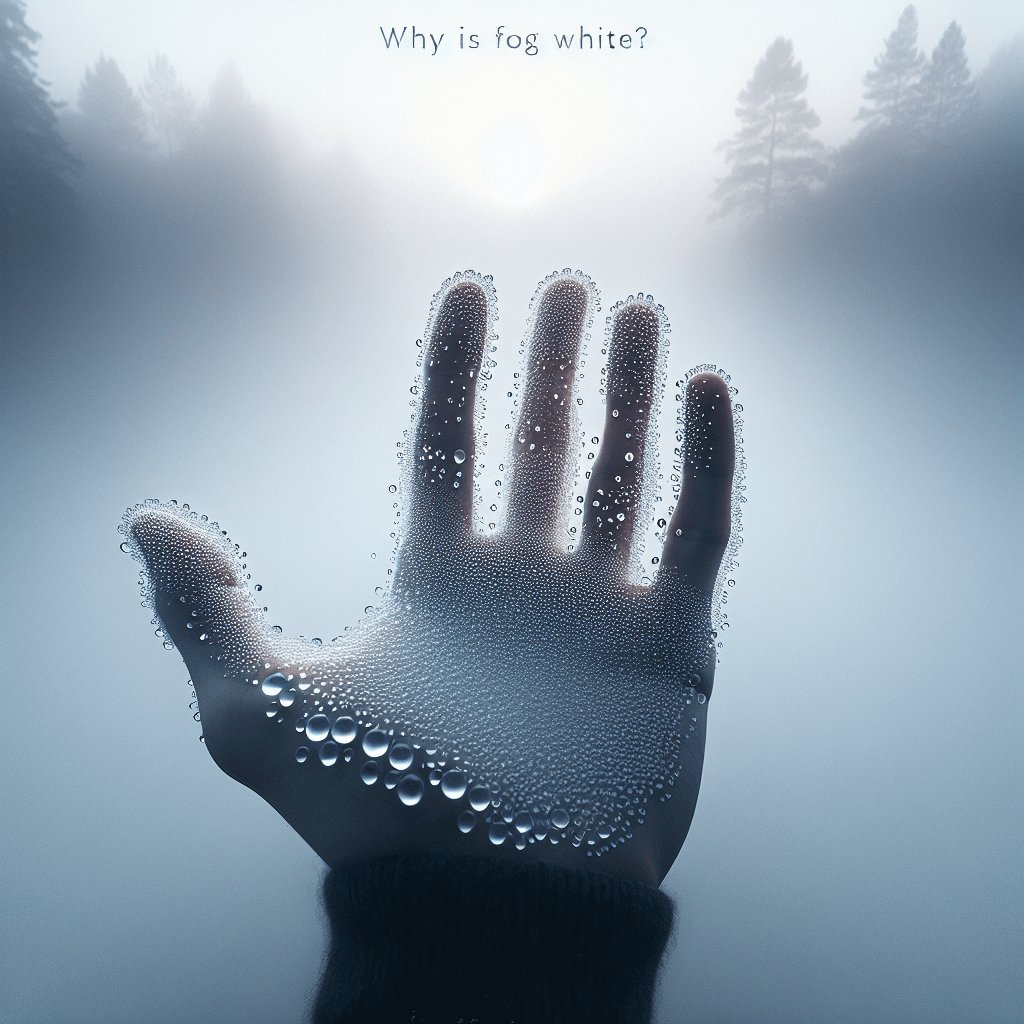
Too Long; Didn't Read
TLDR: Fog's countless tiny, clear water droplets scatter all colors of sunlight in every direction. Our eyes perceive this mix of all colors as white.
Decoding the Mystery: Why is Fog White When It's Made of Tiny Clear Water Droplets?
Have you ever walked through a thick, pearly-white fog and marveled at how it can transform a familiar landscape into something mysterious and new? It’s a common and often beautiful natural phenomenon. But have you ever stopped to consider the paradox at its heart? We know fog is just water—the same clear, transparent liquid that comes from our taps. So how does a collection of billions of tiny, see-through droplets create an opaque, white blanket that can obscure our vision completely? The answer isn’t magic; it’s a fascinating principle of physics and light. This post will unravel the science behind this everyday wonder, explaining exactly how clear water creates white fog.
What is Fog, Really?
Before we dive into the physics of light, let's quickly define our subject. At its most basic, fog is a cloud that has formed at or near the ground. It consists of billions of microscopic water droplets (or in very cold conditions, ice crystals) suspended in the air.
Each individual water droplet is tiny, typically ranging from 5 to 20 micrometers in diameter—far smaller than the width of a human hair. And, crucially, each one of these minuscule spheres of water is completely transparent. If you could isolate a single fog droplet and look through it, it would be as clear as a tiny glass bead. The secret to fog's whiteness lies not in the droplets themselves, but in how they interact with light as a massive group.
The Magic of Light and Color
To understand why fog is white, we first need to remember what "white light" is. The light from the sun, which we perceive as white, is actually a composite of all the colors in the visible spectrum—the classic rainbow of red, orange, yellow, green, blue, indigo, and violet.
An object's color is determined by which wavelengths of light it absorbs and which it reflects (or scatters) back to our eyes.
- A red car looks red because its paint absorbs most colors but reflects the red wavelengths.
- A black shirt looks black because it absorbs nearly all wavelengths of light.
- A white piece of paper looks white because it reflects or scatters all wavelengths of light more or less equally.
This last point is the key to understanding fog. Fog doesn't have a pigment; its color comes from scattering light.
Mie Scattering: The Scientific Explanation
The specific process responsible for fog's white appearance is called Mie scattering. This scientific principle describes how light scatters when it hits a particle that is roughly the same size as, or larger than, the light's wavelength.
Visible light has very short wavelengths, ranging from about 400 to 700 nanometers (0.4 to 0.7 micrometers). As we mentioned, fog droplets are much larger, typically 5 to 20 micrometers in diameter. Because the droplets are significantly larger than the wavelengths of light, they act like tiny disco balls, scattering all colors of the light spectrum equally in all directions.
This is different from the process that makes our sky blue, known as Rayleigh scattering. Rayleigh scattering occurs when particles (like nitrogen and oxygen molecules in the atmosphere) are much smaller than the light's wavelength. These tiny particles are more effective at scattering shorter, bluer wavelengths of light, which is why the sky appears blue on a clear day. With fog, the larger droplets don't play favorites; they scatter red, green, and blue light with equal efficiency.
From Billions of Droplets to a Wall of White
While a single droplet is clear, fog is made of an immense, densely packed collection of them. When a beam of sunlight enters a fog bank, it doesn't just pass through. It immediately hits a water droplet and is scattered in a new direction. That scattered light then hits another droplet and is scattered again, and again, and again.
Think of it like a pinball machine. The light ray is the ball, and the fog droplets are the bumpers. The light bounces around chaotically in a process called multiple scattering. Because of this, light entering the fog is sent in every conceivable direction. When this jumble of all colors of light eventually emerges from the fog and reaches your eyes, the combination of all scattered wavelengths is perceived as one color: white. This same principle is why clouds, snow, and even a pile of crushed clear glass appear white.
Conclusion
So, the next time you find yourself enveloped in a thick fog, you'll know the secret behind its ghostly white appearance. It’s not an inherent color but the result of a collective performance. Billions of perfectly clear, microscopic water droplets work together to catch sunlight, scattering every color of the spectrum equally and randomly until all that reaches your eyes is a uniform, brilliant white. It’s a beautiful reminder that in nature, even the most common phenomena are often rooted in complex and elegant scientific principles. The whole, in this case, is truly different from the sum of its transparent parts.


