
Why is red the color of invisibility in the deep sea
In the crushing black of the deep sea, wearing fiery red is the secret to becoming invisible. Discover the bizarre trick of light that turns this vibrant hue into the ultimate underwater camouflage.

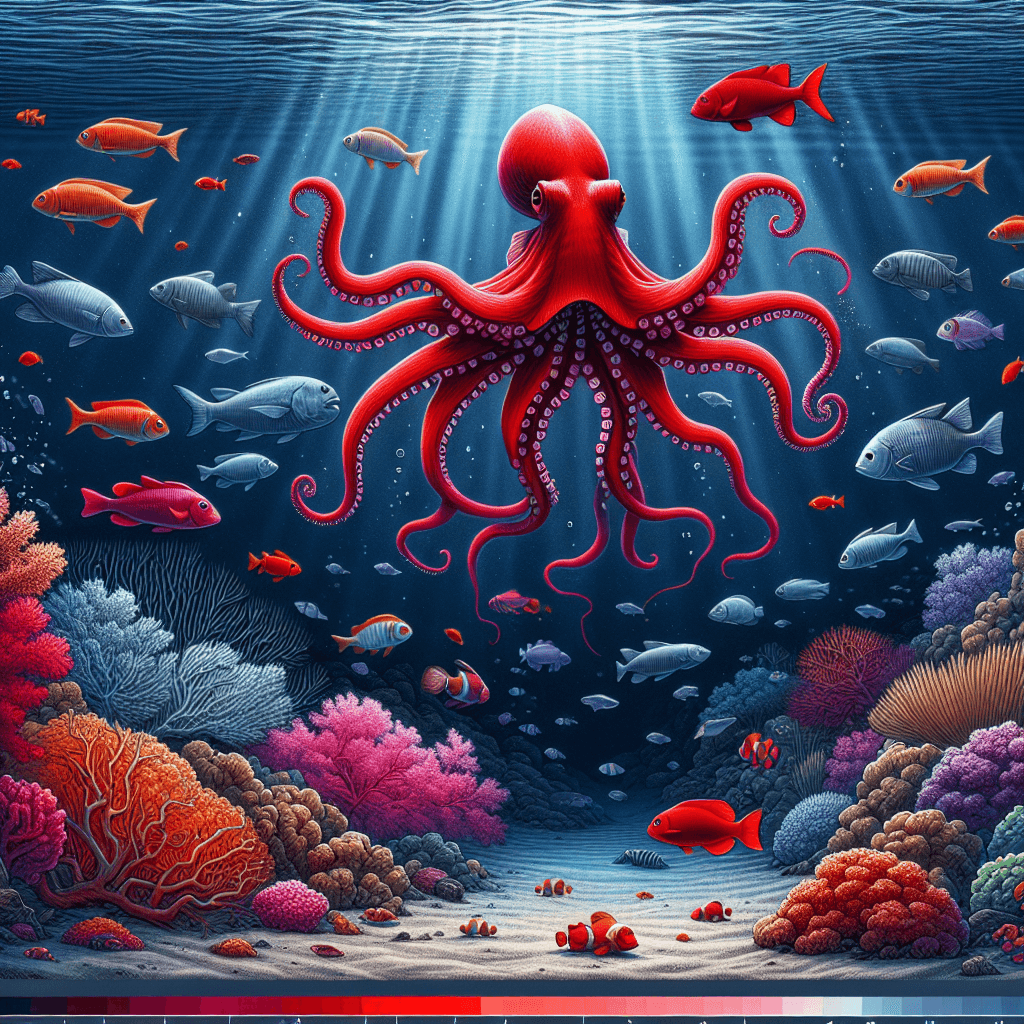
Too Long; Didn't Read
Water absorbs red light first, so it doesn't reach the deep sea. Since red creatures can't reflect any red light, they appear black and are camouflaged in the darkness.
Hiding in Plain Sight: Why is Red the Color of Invisibility in the Deep Sea?
Imagine a fire-engine red sports car. It’s designed to be seen, to grab your attention instantly. Now, picture that same vibrant red car at the bottom of the ocean. Instead of standing out, it would vanish into the crushing darkness. This paradox is a daily reality for deep-sea creatures. On land, red screams “look at me,” but in the deep ocean, it’s the ultimate cloak of invisibility. This fascinating adaptation is a masterclass in physics and evolution. This post will dive into the science of light, water, and biology to explain why so many deep-sea animals have evolved to be red to survive.
The Disappearing Act of Light
To understand why red animals disappear in the deep, we first need to understand how light behaves in water. Sunlight is made up of a spectrum of colors, famously remembered by the acronym ROYGBIV (Red, Orange, Yellow, Green, Blue, Indigo, Violet). Each color corresponds to a different wavelength of light.
- Long Wavelengths: Red and orange light have the longest wavelengths.
- Short Wavelengths: Blue and violet light have the shortest wavelengths.
As sunlight penetrates the ocean, water molecules act as a natural filter, scattering and absorbing these wavelengths at different rates. The long-wavelength colors are the first to go. Red light is almost completely absorbed within the first 10-20 meters (about 30-65 feet) of water. By the time you descend to 100 meters, virtually all red light is gone, leaving a world illuminated only by the more resilient, shorter-wavelength blue and green light.
No Red Light, No Red Color
Our perception of color depends entirely on light. We see an object as red because it absorbs all other colors of the light spectrum and reflects red light back to our eyes. But what happens when there is no red light to begin with?
In the deep sea’s “twilight zone” (the disphotic zone, roughly 200 to 1,000 meters down), the environment is a monochromatic blue. A red-pigmented animal in this environment has no red light to reflect. Instead, its skin absorbs the only available light—the dim blue-green wavelengths. By absorbing this ambient light instead of reflecting it, the creature appears black or a ghostly, dark gray. It effectively blends into the perpetual darkness, becoming invisible to predators and prey alike. It’s the perfect camouflage, created not by matching a background pattern, but by manipulating the physics of light itself.
Red as a Survival Strategy
This principle has made red a wildly successful evolutionary strategy for countless deep-sea inhabitants. In a world where hiding is key to survival, being functionally black is a significant advantage.
Many creatures leverage this deep-sea superpower:
- Deep-sea Shrimp: Species like the Systellaspis debilis are a brilliant crimson, but in their native habitat, they are practically invisible.
- Vampire Squid: Despite its menacing name, the Vampire Squid (Vampyroteuthis infernalis) uses its velvety reddish-brown coloration to disappear in the oxygen-minimum zone it calls home.
- Jellyfish and Ctenophores: Many deep-sea jellies, such as the bloody-belly comb jelly (Lampocteis cruentiventer), have deep red guts. Researchers believe this helps mask the glow of any bioluminescent prey they've just eaten, preventing them from becoming a beacon for their own predators.
By being red, these animals are betting on the fact that nothing around them can see red light. It's an evolutionary gamble that has paid off, allowing them to thrive in one of the most hostile environments on Earth.
Conclusion
The vibrant red of a deep-sea creature is one of nature’s most brilliant illusions. What appears flashy and conspicuous to us in full-spectrum light is a highly effective survival tool in the deep ocean. By understanding that water filters out long-wavelength red light, we can see that a red animal in a blue world is, for all intents and purposes, wearing an invisibility cloak. This interplay between physics and biology is a powerful reminder of how life adapts in remarkable ways to its environment. So, the next time you see a scarlet shrimp in an aquarium, remember that in its true home, it’s a master of disguise, hidden perfectly in the deep blue sea.


