
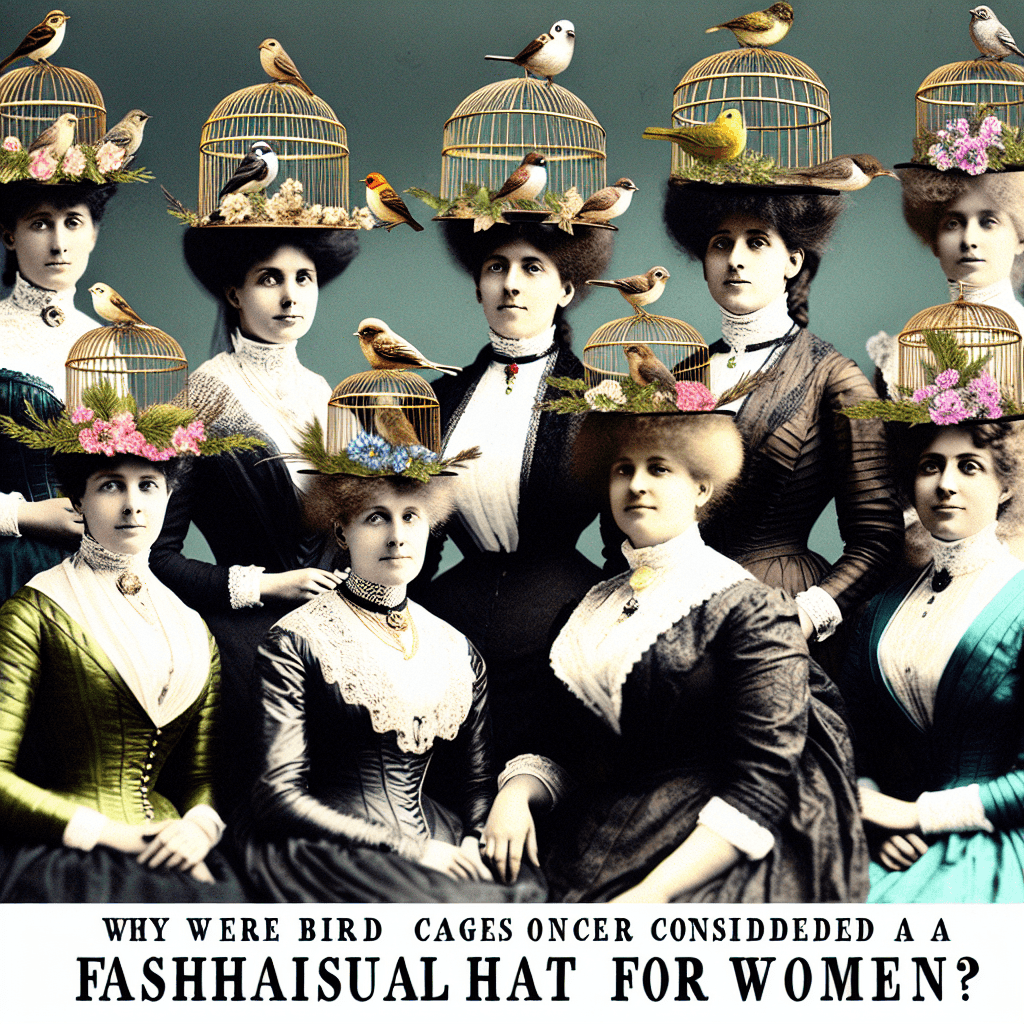
Why were bird cages once considered a fashionable hat for women
Uncover the bizarre chapter in fashion history when a woman's status wasn't measured by her handbag, but by the literal birdcage she wore as a hat—sometimes with a live bird still inside.

Too Long; Didn't Read
TLDR: Influenced by the Surrealist art movement in the early 20th century, birdcage hats were an extravagant and whimsical fashion statement for wealthy women to display their avant-garde taste and status, taking the trend of nature-themed millinery to its most absurd extreme.
Flights of Fancy: Why Were Bird Cages Once Considered a Fashionable Hat for Women?
Imagine strolling down a high-fashion street in the 1930s. Amidst the cloche hats and elegant silhouettes, you spot something truly astonishing: a woman wearing a miniature, ornate bird cage perched atop her head. This wasn't a costume for a play; it was the height of avant-garde fashion. While it seems utterly bizarre to us today, the bird cage hat represents a fascinating intersection of art, social commentary, and historical excess. This post will uncage the history behind this peculiar trend and explore the cultural forces that allowed a symbol of captivity to become a celebrated fashion statement.
An Era of Avian Adornment
The idea of placing bird-related objects on one's head was not entirely new. The trend’s roots can be traced back to two distinct historical periods.
First, the extravagant court of 18th-century France, led by style icon Marie Antoinette, saw the rise of enormous, narrative hairstyles called "poufs." These towering hair sculptures were decorated with everything from model ships to pastoral scenes, and sometimes included small cages with birds inside, establishing a precedent for whimsical, story-telling headwear.
Later, during the late 19th and early 20th centuries, millinery reached a fever pitch of opulence. The "plume trade" was a massive industry where hats were decorated with exotic feathers, wings, and even entire taxidermied birds. This practice became so widespread and destructive to bird populations that it spurred the creation of early conservation groups like the Audubon Society. This era normalized the presence of birds in millinery, setting the stage for an even more conceptual take on the theme.
Surrealism Takes Flight
The bird cage hat truly came into its own in the 1930s, thanks to the powerful influence of the Surrealist art movement. Artists like Salvador Dalí and René Magritte delighted in taking everyday objects and placing them in strange, dreamlike contexts to challenge perception.
This artistic spirit was famously channeled into fashion by the iconic designer Elsa Schiaparelli. A close collaborator with Dalí, Schiaparelli was known for her witty, shocking, and thought-provoking designs. She created pieces like the "Lobster Dress" and the "Shoe Hat," blurring the line between clothing and art. The bird cage hat fit perfectly within this philosophy. It was a literal interpretation of a Surrealist idea—a familiar object made strange and beautiful through its new context. For the daring, fashion-forward woman, wearing a Schiaparelli-inspired bird cage hat was a way to signal her connection to the modern, intellectual art world.
Decoding the Gilded Cage: A Symbol of the Times
Beyond being an artistic statement, the bird cage hat was rich with symbolic meaning, interpreted differently by the wearer and the observer. Its popularity stemmed from its ability to convey multiple, often contradictory, ideas:
- A Statement on Femininity: For many, the hat was a clever commentary on the social position of women. The "gilded cage" has long been a metaphor for a life of luxury that comes at the cost of freedom. A woman wearing a bird cage on her head could be making a subtle, ironic statement about the societal expectations that confined her.
- Whimsical Escape: The 1930s were marked by the economic hardship of the Great Depression. In this context, fantastical and whimsical fashion provided a much-needed form of escapism. A bird cage hat was playful and absurd, offering a moment of levity in a difficult time.
- An Undeniable Status Symbol: This was not an accessory for the faint of heart or the light of wallet. It was a piece of high-fashion, an avant-garde choice that immediately set the wearer apart. It communicated sophistication, a modern sensibility, and the confidence to embrace the bizarre.
Conclusion
The bird cage hat was far more than a fleeting, quirky trend. It was a cultural artifact born from a history of opulent millinery, supercharged by the intellectual energy of Surrealism, and loaded with the complex social symbolism of its era. It captured the tension between confinement and freedom, reality and fantasy, and art and fashion. While we are unlikely to see this particular style return to our city streets, its story serves as a perfect reminder that fashion is not just about what we wear, but about the ideas we choose to express, no matter how wild or whimsical they may seem.


