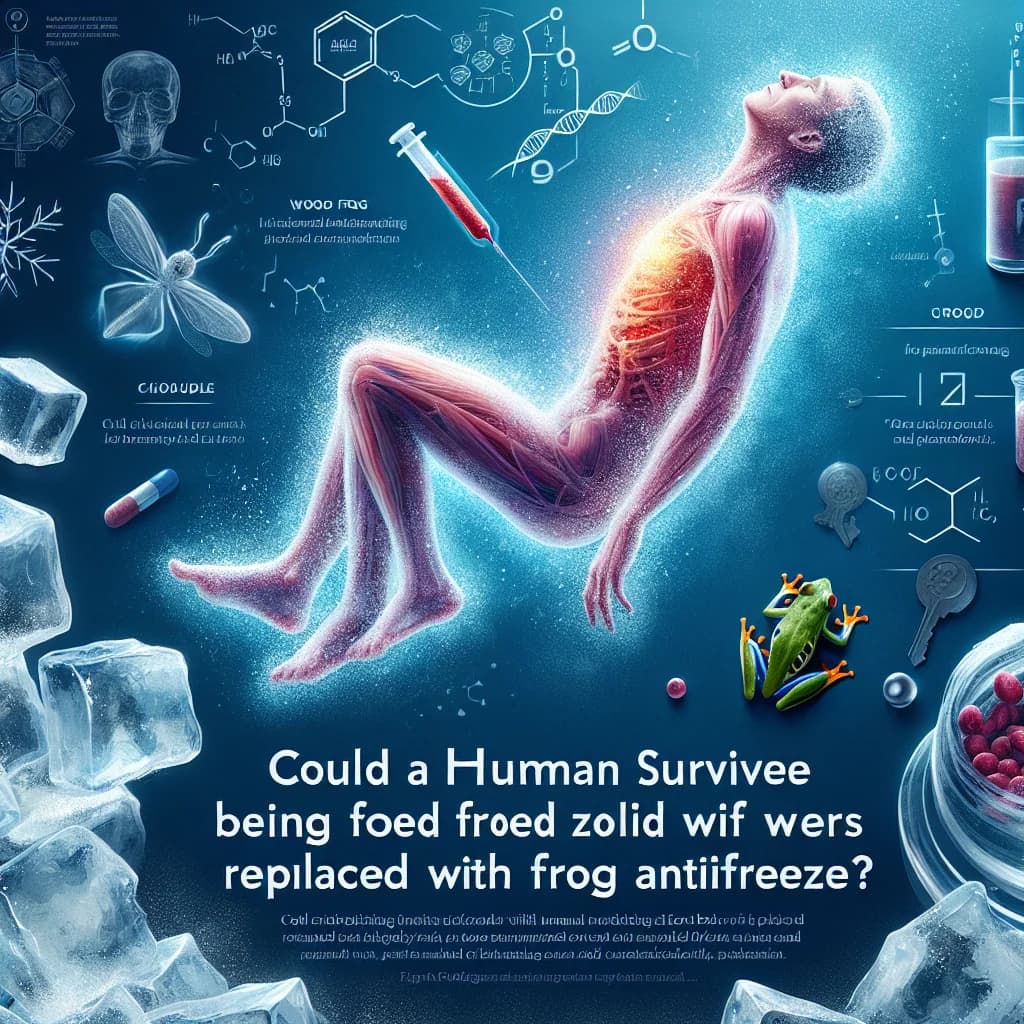
Could a human survive being frozen solid if their blood were replaced with wood frog antifreeze
Imagine freezing solid and waking up unscathed—all thanks to a biological hack borrowed from a tiny woodland frog. We’re diving into the mind-bending science of cryonics to see if wood frog "antifreeze" could truly unlock the secret to human suspended animation.

Too Long; Didn't Read
No. While wood frogs use high glucose levels to survive freezing, human biology is too complex. Our organs would still suffer fatal structural damage and oxygen deprivation, as we lack the specific cellular adaptations required to withstand total ice formation.
From Frog to Popsicle: Could Humans Survive Deep Freeze with Wood Frog Antifreeze?
The idea of suspended animation has long been a staple of science fiction, from starship crews sleeping through centuries to accidental time travelers waking up in the distant future. In the natural world, the North American wood frog (Lithobates sylvaticus) actually lives this reality, freezing solid every winter and hopping away in the spring. But could we replicate this feat? If we replaced human blood with the wood frog's specialized "antifreeze," would we become immortal ice sculptures, or would the laws of physics and biology provide a chilly reality check? By analyzing the principles of thermodynamics, osmotic pressure, and cellular biochemistry, we can determine the viability of this amphibious upgrade for the human body.
The Secret Sauce: How Wood Frogs Defy the Freeze
To understand why a human might struggle where a frog succeeds, we must first look at the wood frog’s internal chemistry. When the first ice crystals touch a wood frog’s skin, its liver kickstarts a massive production of glucose (sugar) and urea.
- Cryoprotectants: These substances act as "solutes" that lower the freezing point of the liquid inside cells.
- Selective Freezing: Crucially, the wood frog doesn't prevent freezing entirely. Instead, it allows water outside its cells to freeze while keeping the water inside its cells liquid.
- The Result: The frog becomes roughly 65-70% ice, but its vital cellular machinery remains hydrated and intact in a syrupy, unfrozen state.
The Problem of Scale: The Square-Cube Law
The first major hurdle for a human-sized "frogsicle" is physics. The wood frog is a small creature, typically weighing only a few grams. Humans, averaging 70,000 grams (70 kg), face a much more difficult thermodynamic challenge due to the square-cube law.
As an object increases in size, its volume (and mass) grows much faster than its surface area. A human has much less surface area relative to their mass compared to a frog. This means:
- Heat Transfer Rates: A frog cools down and freezes almost uniformly. A human would freeze from the outside in.
- The Core Issue: By the time a human’s core temperature reached the freezing point, the outer layers of muscle and skin would have been frozen for hours, leading to significant structural stress as ice crystals expand at different rates across the body’s volume.
Metabolic Math and Oxygen Debts
Wood frogs are ectotherms (cold-blooded), meaning their energy needs are relatively low. Humans are endotherms (warm-blooded) with high-octane metabolic requirements.
- Brain Demand: The human brain accounts for only 2% of body mass but consumes roughly 20% of its oxygen and energy.
- The Oxygen Gap: While a wood frog can enter a state of "anaerobic" (oxygen-free) metabolism for months, human neural tissue begins to degrade within minutes of losing blood flow.
- Toxicity Levels: To achieve the same concentration of glucose used by a wood frog (up to 100 times normal levels), a human’s blood would become as thick as maple syrup. This would cause a "hyperosmotic shock," where the sheer concentration of sugar would pull too much water out of the cells, causing them to shrivel and collapse before the first ice crystal even formed.
The Thawing Dilemma: A Fragile Restart
If we managed to freeze a human successfully, the return to life is where the most complex physics occur. Thawing must be perfectly synchronized to avoid "reperfusion injury."
- Thermal Gradients: If the outside of the body thaws while the heart is still a block of ice, the thawed tissues will demand oxygen that the frozen circulatory system cannot provide.
- Mechanical Stress: Think of a frozen pipe. If one section expands while another is rigid, the pipe bursts. Human blood vessels are delicate; uneven thawing would create microscopic fractures throughout the vascular system.
The Verdict: Physics vs. Biology
Ultimately, replacing our blood with wood frog antifreeze would not result in a successful human ice-stasis. The primary scientific barriers include:
- Thermal Inertia: Our large mass prevents the rapid, uniform freezing required to minimize tissue damage.
- Solute Toxicity: The glucose levels required to protect our cells are lethally toxic to human physiology.
- Vascular Complexity: Our circulatory system is too intricate to survive the mechanical stresses of large-scale crystallization and expansion.
While we may not be hopping into a deep freeze anytime soon, studying the wood frog remains incredibly valuable. Scientists are currently using "biomimicry" of frog antifreeze to develop better ways to preserve individual human organs for transplant. By understanding how these tiny amphibians manage their "syrupy" cells, we are learning how to extend the life of hearts, kidneys, and lungs, proving that even if we can't freeze ourselves, we can certainly learn a lot from those who do.