Why would your shadow travel faster than light if cast across the surface of the Moon
Think nothing can outrun the speed of light? Discover how a simple flick of your wrist could send your shadow racing across the lunar surface at "impossible" speeds—all without breaking a single law of physics.

Too Long; Didn't Read
Shadows and light spots can move faster than light because they are not physical objects with mass. When a light source is rotated, the point where the beam hits a distant surface like the Moon can sweep across the landscape at incredible speeds. This does not violate the laws of physics because no matter or information is actually traveling between those distant points; it is simply a sequence of separate photons hitting different locations in rapid succession.
Faster Than a Speeding Photon: Why Your Shadow Could Break the Universal Speed Limit on the Moon
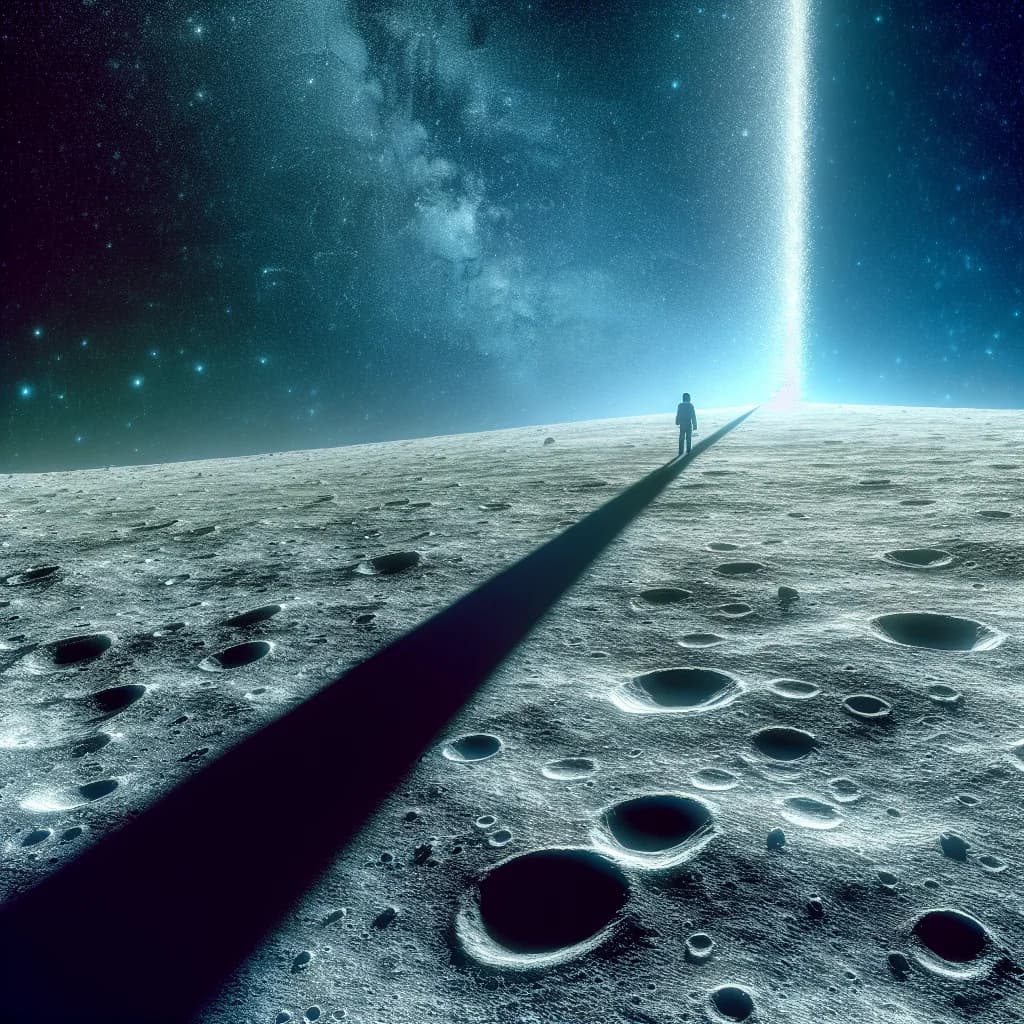
Imagine standing in your backyard with a spotlight so powerful it can reach the Moon. By simply waving your hand in front of the beam, you cast a silhouette onto the lunar surface. If you flick your wrist quickly enough, a startling phenomenon occurs: your shadow appears to race across the craters at a speed exceeding 299,792 kilometers per second—the universal speed limit of light itself. At first glance, this seems to defy everything we know about physics. How can a dark shape outrun the very photons that define the speed of the cosmos? This thought experiment invites us to explore the intersection of Euclidean geometry and Einstein’s Special Relativity to understand why "nothingness" can move faster than "something."
The Geometry of the Great Lunar Flick
To understand how a shadow can achieve such blistering speeds, we must look at the relationship between angular motion and distance. This is a simple matter of geometry. Imagine you are the center of a massive circle, and the Moon is a point on the outer rim.
Calculating the Cosmic Sweep
When you move your finger across a light source, you are creating an angular displacement. Even a tiny movement at the source translates to a massive distance at the destination.
- The Radius: The average distance from Earth to the Moon is approximately 384,400 kilometers.
- The Motion: Suppose you flick your finger across the light source, moving the beam by just 5 degrees in one-tenth of a second.
- The Result: On the Moon’s surface, that 5-degree arc covers roughly 33,500 kilometers. Traveling that distance in 0.1 seconds means your shadow is moving at 335,000 kilometers per second.
Since the speed of light ($c$) is roughly 299,792 kilometers per second, your shadow has officially broken the ultimate speed limit by more than 35,000 kilometers per second.
Why Einstein Isn’t Worried
If Special Relativity states that nothing can travel faster than light, why doesn't the universe collapse when you wave at the Moon? The answer lies in the definition of "nothing."
In physics, the speed limit applies to the transmission of mass, energy, or information. A shadow is none of these. A shadow is a "non-thing"—it is simply the absence of photons. When you move your hand, you aren't "pushing" a dark object across space. Instead, you are sequentially blocking different streams of light.
The Illusion of Motion
Think of a shadow like a sequence of pixels on a computer screen. When an image moves across your monitor, no single pixel is actually traveling from left to right; the pixels are simply turning on and off in a coordinated pattern.
Similarly, the "movement" of a shadow on the Moon is just a sequence of light particles being blocked at different times. The photons leaving your spotlight are still traveling at the standard speed of light. The "shadow" is merely the point where those photons aren't arriving. Because no physical particles are actually traveling laterally across the Moon's surface from point A to point B, no laws of physics are violated.
Consequences of the Shadow Sprint
While the shadow moves faster than light, it carries a strange physical reality: it lacks "causality." If an astronaut were standing on the left side of the Moon and another on the right, the shadow could pass over both of them faster than a laser signal could travel between them.
- Communication Constraints: Even though the shadow "reaches" the second astronaut faster than a light signal could, the first astronaut cannot use the shadow to send a message to the second. The "message" (the act of blocking the light) originates from Earth, not from the first point on the Moon.
- Atmospheric Impact: Because the shadow is not a physical object, it has no mass and generates no friction. It passes over the lunar regolith without disturbing a single grain of dust or causing any atmospheric displacement. It is a ghostly, silent traveler.
Conclusion
The mystery of the superluminal lunar shadow is a beautiful demonstration of how our intuition can be challenged by the scales of the universe. By applying the formula for arc length to the vast distance between Earth and our satellite, we find that "moving" a shadow faster than light is not only possible but mathematically inevitable with a quick enough flick of the wrist.
Ultimately, this experiment reaffirms the core principles of Special Relativity: while the void can appear to move at impossible speeds, the fundamental building blocks of our universe—mass and information—remain bound by the cosmic speed limit. It serves as a fascinating reminder that in the realm of physics, the absence of something can often be just as intriguing as the presence of it.