Why is the daytime sky on Mars pink while the sunsets appear a ghostly shade of blue
On Earth, we’re used to blue days and fiery red sunsets, but on Mars, the cosmic script is flipped. Discover the alien physics behind the Red Planet’s dusty pink atmosphere and why its sun sinks into an eerie, ghostly blue horizon.

Too Long; Didn't Read
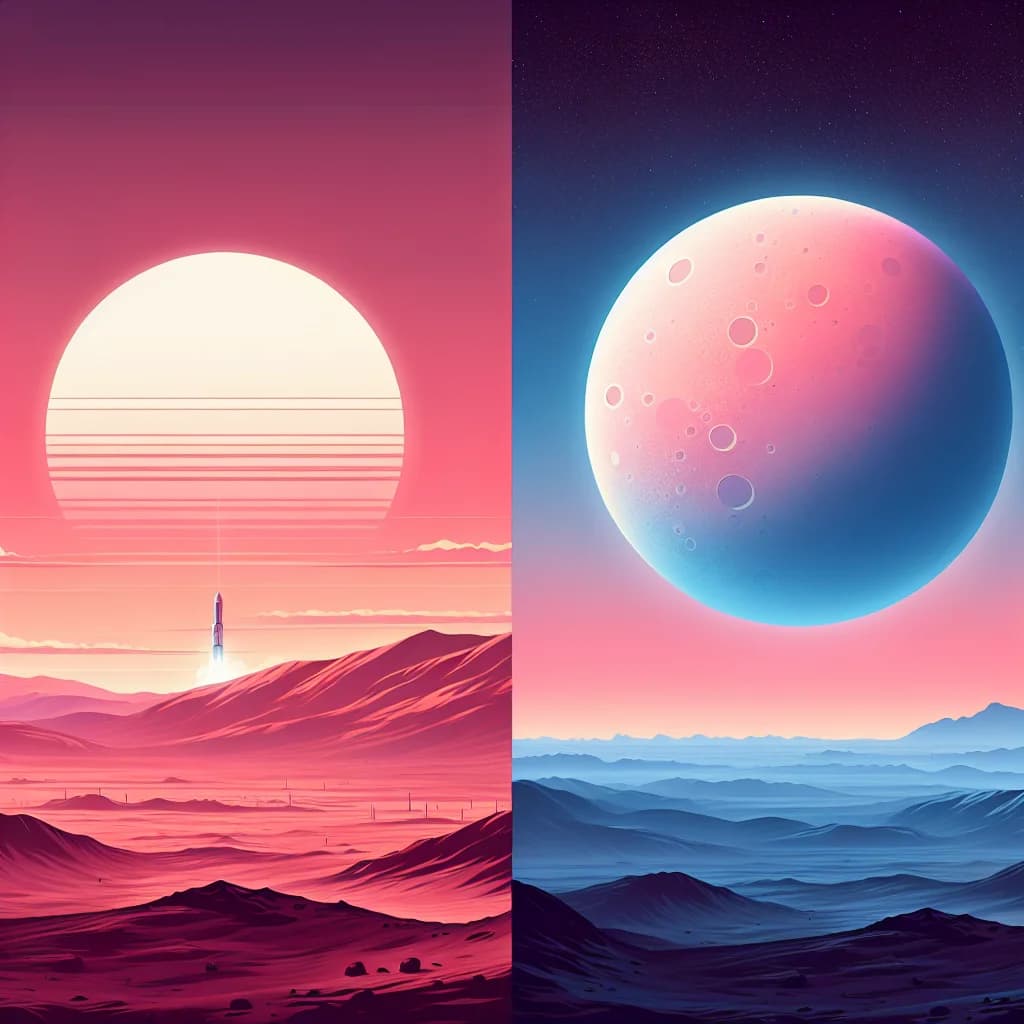
On Mars, the daytime sky appears pink because fine iron-rich dust suspended in the thin atmosphere scatters red light. During sunset, the light must travel through more of the dusty atmosphere, which scatters blue light more effectively toward the observer, resulting in a ghostly blue glow around the sun.
The Martian Color Swap: Why is the Daytime Sky Pink While Sunsets Glow a Ghostly Blue?
Imagine stepping out of a lander onto the dusty surface of the Red Planet. You look up, expecting the familiar azure dome of Earth, but instead, you are greeted by a pale, butterscotch-pink expanse. As evening approaches and the sun dips toward the horizon, the surprise intensifies: the sky around the setting sun begins to glow with a cool, eerie blue. This "alien" color palette feels like a scene from a science fiction film, yet it is a consistent reality captured by our rovers for decades.
This phenomenon isn't a trick of the lens; it is a masterclass in the physics of light. To understand why Mars flips the Earth’s color script, we must look at the foundational parameters of the Martian atmosphere—specifically its density and the suspended particulate matter within it. By applying the principles of atmospheric chemistry and optical physics, we can decode how the Red Planet manipulates the visible spectrum.
The Earth Baseline: Why Our Sky is Blue
To understand Mars, we must first understand Earth. Our atmosphere is thick and composed primarily of tiny gas molecules like nitrogen and oxygen. These molecules are significantly smaller than the wavelengths of visible light. When sunlight hits them, it undergoes Rayleigh scattering.
- Wavelength Preference: Rayleigh scattering favors shorter wavelengths (blue and violet).
- The Result: Blue light is scattered in every direction, painting our daytime sky blue. At sunset, the light travels through more atmosphere, scattering away the blue and leaving only the longer-reaching reds and oranges.
The Martian Daytime: A Pinkish Haze
Mars has an atmosphere only about 1% as dense as Earth’s, consisting mostly of carbon dioxide. However, what it lacks in gas, it makes up for in dust. Martian air is perpetually filled with fine silicate dust particles, largely rich in iron oxide (rust). These particles are much larger than gas molecules, typically ranging from 0.5 to 1.0 micrometers in diameter.
The Mechanism: Mie Scattering
Because these dust particles are roughly the same size as the wavelength of visible light, they interact with it via Mie scattering. Unlike Rayleigh scattering, which prefers blue, Mie scattering on Mars is more efficient at redirecting longer wavelengths.
- Color Absorption: The iron oxide in the dust absorbs blue light and reflects red and orange tones.
- The Outcome: During the day, the suspended dust scatters the reddish-pink light across the sky, creating that iconic salmon-colored glow. If you were to remove the dust, the Martian sky would appear almost black because the thin gas alone isn't enough to scatter much light at all.
The Ghostly Blue Sunset
The most striking feature of Martian meteorology is the sunset. While an Earth sunset turns the sky red, a Martian sunset turns the area around the sun blue. This happens due to a phenomenon called forward scattering.
How the Blue Light Wins
As the sun approaches the horizon, the sunlight must travel through a significantly longer path of dust-laden atmosphere.
- Filtering: The red-tinted dust filters out the longer red wavelengths through wide-angle scattering.
- Forward Scattering: The specific size of Martian dust particles allows blue light to be scattered at a very narrow, forward-facing angle.
- The Visual: If you are looking toward the sun, the blue light is redirected toward your eyes more effectively than other colors. This creates a localized blue "halo" around the solar disk that contrasts sharply with the pinkish hue of the rest of the sky.
Comparing the Scales
To put this into perspective, consider these metrics:
- Particle Size: Earth’s scattering molecules are nanometers in size; Martian dust is roughly 1,000 times larger.
- Luminosity: Because Mars is farther from the sun, the daytime sky is only about 40% as bright as Earth's, contributing to a muted, pastel appearance rather than a vibrant saturation.
Conclusion
The surreal colors of the Martian sky are the logical result of a thin atmosphere dominated by mineral dust rather than gas molecules. While Earth uses Rayleigh scattering to create a blue canopy and red sunsets, Mars utilizes Mie scattering and the unique properties of iron oxide to create a pinkish day and a ghostly blue evening.
These celestial displays remind us that the "natural" colors we see on Earth are merely one possible outcome of planetary physics. By studying the way light dances through the dust of another world, we gain a deeper appreciation for the delicate atmospheric balance that colors our own. On Mars, the sky isn't just a backdrop; it is a visible record of the planet's dry, dusty, and fascinating chemical history.