Could scientists turn a jar of peanut butter into a real diamond using extreme tectonic pressure
From your pantry to the jewelry box: discover the mind-blowing science behind how researchers are using tectonic-level pressure to squeeze real diamonds out of ordinary peanut butter.

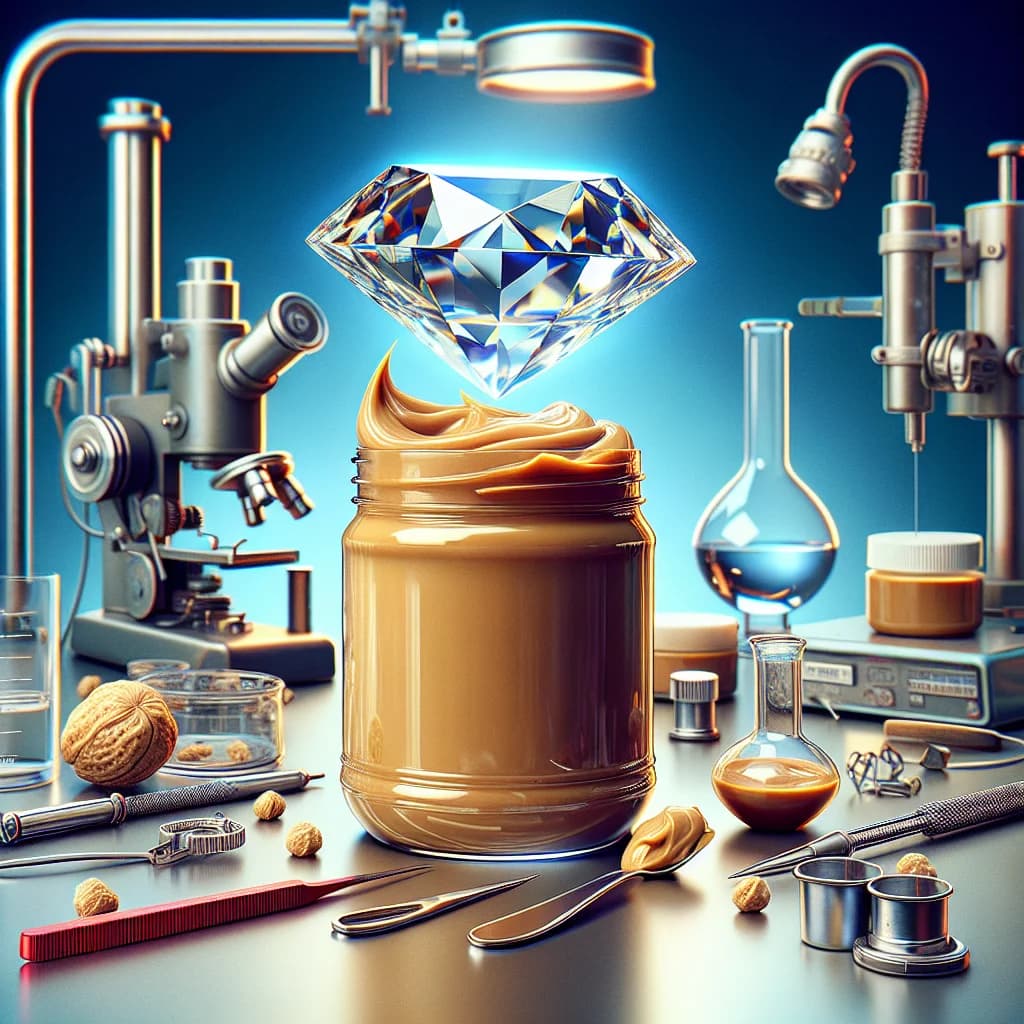
Too Long; Didn't Read
Yes, scientists can turn peanut butter into diamonds by subjecting its carbon-rich molecules to extreme heat and pressure that mimics the Earth's mantle. While the process works, it is incredibly slow and yields small, often discolored gems, proving that almost any organic substance can be transformed into a diamond under the right conditions.
From Pantry to Pendant: Could Scientists Really Turn Peanut Butter into a Diamond?
Most people view a jar of peanut butter as a simple sandwich staple, but to a geophysicist, it is a dense reservoir of carbon atoms waiting for a makeover. The idea of transforming a creamy snack into a sparkling gemstone sounds like alchemy or a Saturday morning cartoon plot. However, in the realm of high-pressure physics, this "nutty" transformation is not only a theoretical possibility—it has actually been demonstrated in a laboratory setting.
To understand how this works, we must look at the foundational parameters of carbon chemistry and the extreme tectonic forces that govern our planet’s interior. This blog post will analyze the scenario through the lens of thermodynamics and material science, exploring how scientists use specialized equipment to mimic the Earth’s mantle and reorganize the molecular structure of our favorite legumes into a crystalline lattice.
The Carbon Connection: Why Peanut Butter?
At its most basic level, a diamond is a solid form of the element carbon with its atoms arranged in a crystal structure called a diamond cubic. While we usually think of diamonds coming from coal, most natural diamonds were formed long before land plants even existed. They formed from carbon trapped deep within the Earth.
Peanut butter is an ideal candidate for this experiment because it is incredibly carbon-rich. It is packed with proteins, fats, and carbohydrates—all of which are organic molecules built around carbon backbones. In a laboratory setting, the goal is to strip away the hydrogen, oxygen, and nitrogen that make peanut butter "food" and leave behind only the carbon to be pressurized into a "gem."
Recreating Tectonic Forces in the Lab
To turn a snack into a stone, scientists must replicate the conditions found approximately 150 to 200 kilometers (93 to 124 miles) below the Earth's surface. This requires two specific variables: extreme heat and staggering pressure.
The 1.3 Million PSI Challenge
In the Earth's mantle, diamonds form at pressures of roughly 5 to 6 gigapascals (GPa). To put that into perspective, 6 GPa is approximately 1.3 million pounds per square inch (psi). This is the equivalent of:
- Balancing roughly 80 adult African elephants on a single postage stamp.
- The pressure exerted at the bottom of an ocean nearly 400 miles deep (if such an ocean existed).
Scientists achieve this in a laboratory using a "multi-anvil press." This device uses a series of heavy-duty pistons to squeeze a tiny sample from all sides simultaneously. In 2014, researcher Dan Frost at the Bayerisches Geoinstitut successfully used such a press to turn peanut butter into a diamond.
Managing the Molecular "Mess"
The process isn't as simple as putting a jar in a vice. Peanut butter contains a significant amount of hydrogen bonded to its carbon. When the pressure is applied, the chemical bonds break, releasing the hydrogen. In Frost’s experiments, the hydrogen often caused small, localized "explosions" or "burps" within the equipment. To succeed, the scientist must apply heat—upwards of 2,200 degrees Fahrenheit—to help the carbon atoms migrate and bond into the rigid, tetrahedral structure of a diamond.
The Scale of the Transformation
If you were to take a standard 16-ounce jar of peanut butter and subject it to these tectonic forces, you would not end up with a 16-ounce diamond. The physical transition involves a massive loss of mass and volume.
- Mass Reduction: About 50-70% of the weight of peanut butter consists of water, oils, and gasses that are expelled during the process.
- Density Increase: Peanut butter has a density of roughly 1.1 g/cm³, while a diamond has a density of 3.51 g/cm³. This means the remaining carbon is compressed into a much smaller space.
- The Result: From a full jar, you might only yield a few small, likely discolored crystals. Because peanut butter is high in nitrogen (the element that gives diamonds a yellowish tint), your "PB-Diamond" would likely look more like a dark Citrine than a clear brilliant-cut stone.
Conclusion
The scientific verdict is a resounding "yes": scientists can, and have, turned peanut butter into real diamonds. By applying the laws of thermodynamics and utilizing multi-anvil presses to simulate the crushing weight of the Earth's crust, the organic carbon in the spread is forced to abandon its "creamy" state and adopt the most rigid structure known to man.
While the process is far too slow and expensive to replace traditional diamond mining—it can take weeks to grow even a microscopic crystal—it serves as a brilliant demonstration of the Earth's transformative power. It reminds us that the difference between a lunchbox snack and a crown jewel is often just a matter of how hard you squeeze. The next time you make a sandwich, remember: you’re holding the raw materials of a geological masterpiece.