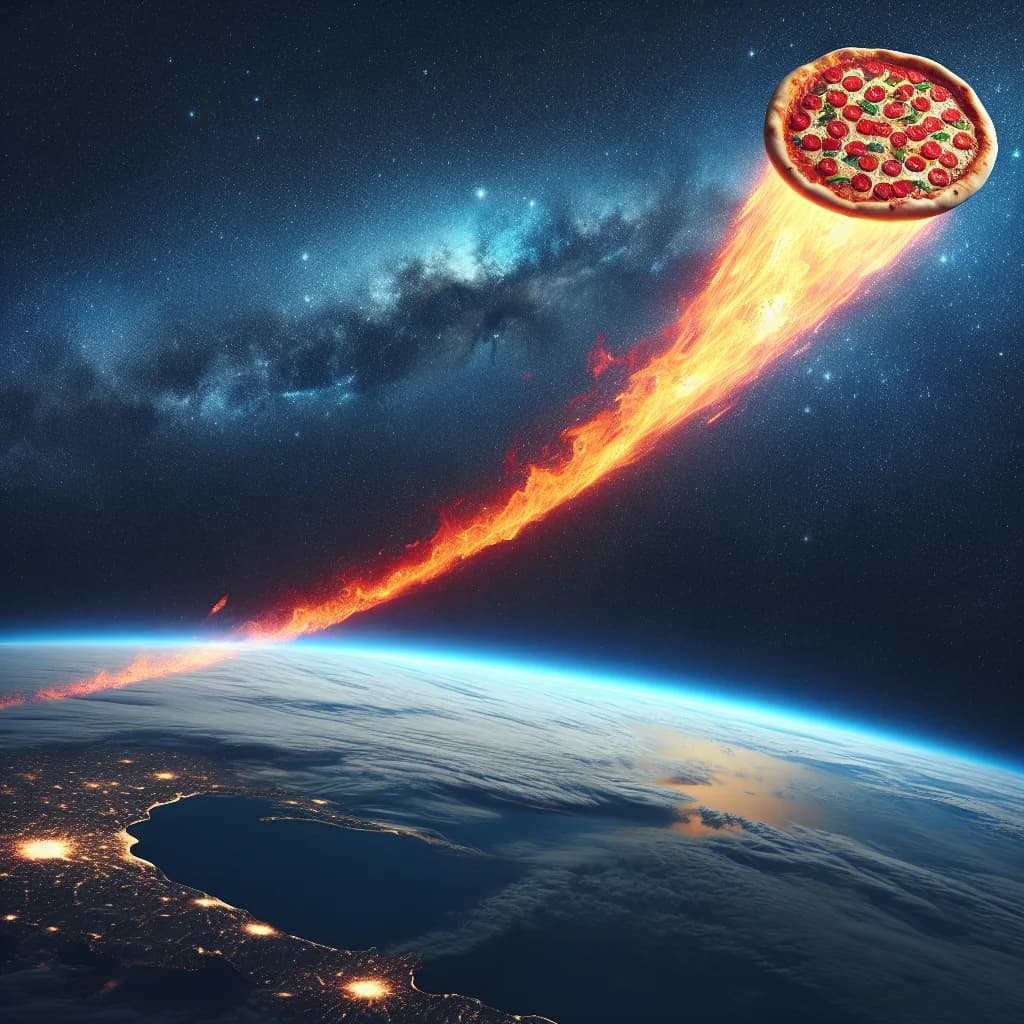
Could you cook a frozen pizza by dropping it through the atmosphere from the edge of space
From the sub-zero vacuum of space to the searing heat of re-entry, we dive into the physics of whether a high-altitude drop could actually deliver a perfectly cooked crust. Is this the ultimate "fast food" delivery, or just a recipe for a supersonic charcoal briquette?

Too Long; Didn't Read
No. The extreme heat of atmospheric re-entry would incinerate the outside of the pizza to charcoal while the inside remains frozen, causing it to disintegrate long before it reaches the ground.
The Ultimate Air Fryer: Could You Cook a Frozen Pizza by Dropping It from Space?
Imagine standing at the edge of space, 100 kilometers above the Earth’s surface at the Kármán line. In your hand is a standard, store-bought frozen pepperoni pizza. Your goal? To drop this pizza through the atmosphere and have it arrive on a plate at sea level, perfectly cooked, crispy, and ready to eat. While it sounds like the ultimate delivery method, the physics governing such a feat are as complex as they are chaotic. To determine if this culinary experiment is a "go" for launch, we must analyze the scenario through the lenses of fluid dynamics, thermodynamics, and atmospheric science. This thought experiment explores whether the intense heat of re-entry can replace a conventional oven, or if the laws of physics have a different recipe in mind.
The Physics of the Fall: Terminal Velocity and Air Density
When you release the pizza from the edge of space, it doesn't immediately start "cooking." For the first several miles, the atmosphere is so thin that the pizza acts like a stone in a vacuum, accelerating rapidly due to gravity. However, as it enters the denser layers of the stratosphere, it encounters air molecules.
The defining factor here is the ballistic coefficient, which measures an object's ability to overcome air resistance. A pizza is essentially a flat, low-density disc. Because it has a high surface area relative to its mass (typically about 0.5 kilograms), it behaves more like a falling leaf than a sleek spacecraft.
- Terminal Velocity: Unlike a heavy capsule, a pizza will reach its terminal velocity—the point where gravity and air resistance balance out—quite high in the atmosphere.
- Deceleration: Because the pizza is light, it slows down significantly in the upper atmosphere, where the air is still relatively thin.
Friction vs. Compression: Where Does the Heat Come From?
A common misconception is that objects "burn up" in the atmosphere due to friction. In reality, the heat is generated by adiabatic compression. As the pizza falls at supersonic speeds, it pushes the air in front of it so fast that the air molecules cannot move out of the way. This creates a high-pressure shockwave.
On a returning Space Shuttle, temperatures in this shockwave can exceed 1,500°C (2,732°F). For our pizza to cook, we need a steady temperature of roughly 200°C (400°F). However, the pizza’s low mass is its culinary undoing. Because it slows down so quickly in the upper, thinner atmosphere, it never reaches the sustained hypersonic speeds necessary to generate high-intensity heat in the lower, denser atmosphere. By the time it reaches the "thick" air where compression heating is most effective, it has already slowed down to a gentle terminal velocity.
The Thermodynamic Reality: The Cold Trap
Even if the pizza managed to generate some heat, it faces a formidable opponent: the "Cold Trap." The mesosphere and upper stratosphere are incredibly cold, with temperatures dropping as low as -90°C (-130°F).
- Flash Freezing: Before the pizza hits the denser air, it spends several minutes tumbling through sub-zero temperatures.
- Short Heat Window: The window of time where compression heating occurs is measured in seconds, not minutes.
- Heat Distribution: Even if the shockwave reaches the desired temperature, it would likely char the pepperoni to carbon while leaving the dough beneath it frozen solid—a phenomenon known as the "baked Alaska" effect, but in reverse.
The Structural Integrity of a Pepperoni Disc
Beyond the temperature, we must consider the mechanical stresses. A frozen pizza is not an aerodynamic vehicle. As it hits the atmosphere at thousands of miles per hour, it would likely experience "structural failure." Without a heat shield, the aerodynamic pressure would cause the pizza to tumble and oscillate. Centrifugal force would likely strip the cheese and toppings from the base, scattering frozen snacks across a several-mile radius of the desert floor.
Conclusion
The scientific verdict is clear: you cannot cook a frozen pizza by dropping it from space. The core principles of thermodynamics and aerodynamics dictate that the pizza is simply too light to maintain the necessary speed for consistent heating. Instead of a delicious meal, your experiment would result in a frozen, likely fragmented disc that has been blast-chilled by the upper atmosphere and then lightly buffeted by lukewarm air during its final descent.
While the "Orbital Oven" remains a fantasy, this thought experiment highlights the incredible precision required to return objects from space. The atmosphere acts as a protective shield, slowing down low-mass objects before they can burn up. For now, if you want the perfect crust, it is best to keep your kitchen experiments grounded and stick to the reliable physics of the household oven.