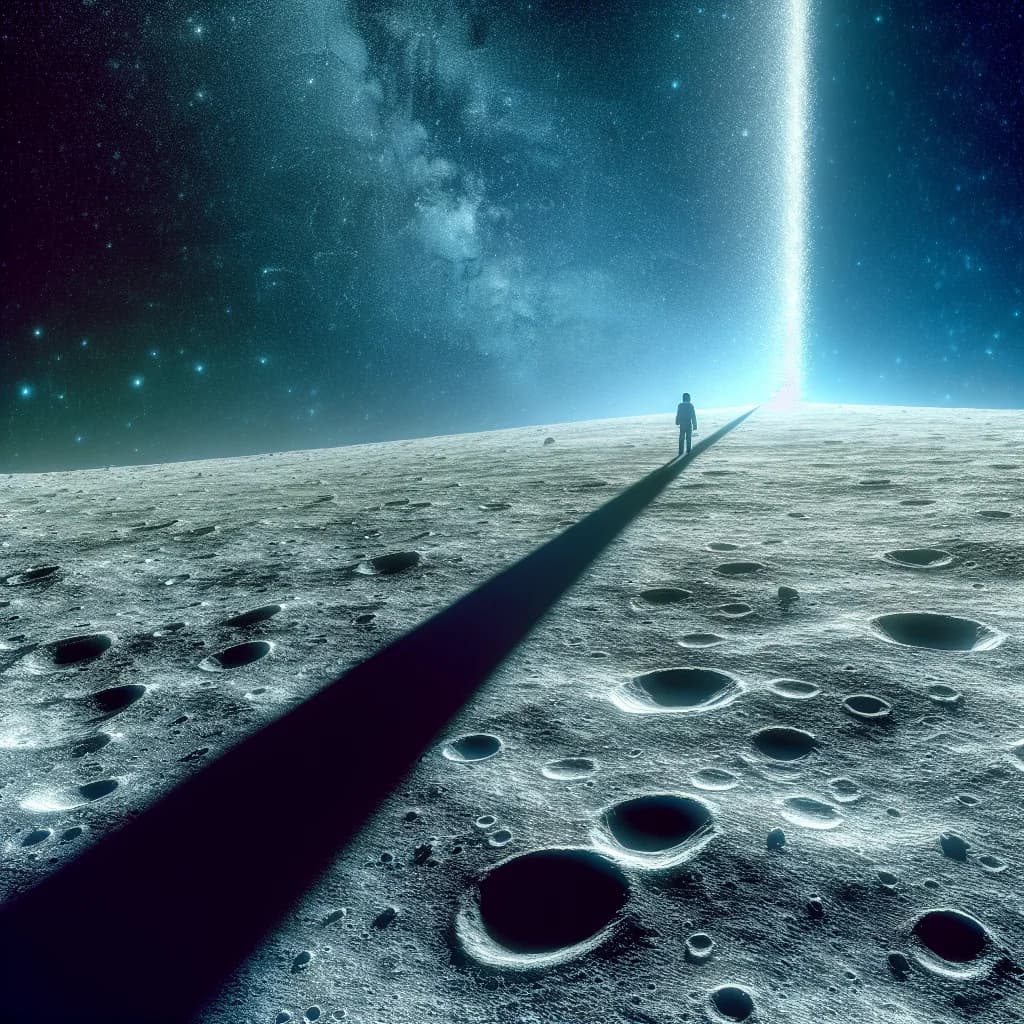
Could you fly on Saturn’s moon Titan by simply strapping wings to your arms and flapping
With gravity weaker than the Moon’s and an atmosphere thick enough to swim in, Titan is the only place in the solar system where you could truly soar by simply flapping your arms. Strap on your wings and discover the mind-bending physics that turn this sci-fi dream into a scientific reality.


Too Long; Didn't Read
Yes, humans could fly on Titan by flapping wings attached to their arms. Because the moon has very low gravity and an extremely dense atmosphere, the physical effort required to generate lift is low enough that human muscle power would be sufficient to achieve flight.
Could You Fly on Saturn’s Moon Titan by Simply Flapping Your Arms?
Imagine standing on a shoreline where the "rocks" are made of water ice and the "oceans" are ripples of liquid methane. You look up through a thick, tangerine haze and realize that despite being millions of miles from Earth, you might be closer to fulfilling the ancient human dream of flight than ever before. Saturn’s largest moon, Titan, is often called the most hospitable place in the solar system for a very specific reason: its unique combination of low gravity and a thick atmosphere.
To determine if a human could truly take to the skies by simply strapping wings to their arms and flapping, we must look at the foundational parameters of fluid dynamics and gravitational physics. This analysis will explore how Titan’s environmental metrics redefine the requirements for lift and whether human biology could generate the power necessary to achieve true "muscular flight."
The Physics of Flight: Gravity vs. Atmosphere
To understand flight on Titan, we have to look at two competing forces: how hard the moon pulls you down (gravity) and how much "stuff" there is in the air to push against (atmospheric density). On Earth, these variables are stacked against us. Our gravity is relatively strong, and our air is thin enough that human muscles simply cannot generate the lift required to overcome our weight.
On Titan, the scales are flipped in our favor:
- Low Gravity: Titan’s surface gravity is only about 1.352 m/s², which is roughly 14% of Earth’s gravity. For a 180-pound person, standing on Titan would feel like weighing only about 25 pounds.
- Thick Atmosphere: Despite its smaller size, Titan’s atmosphere is 4.5 times denser than Earth’s. It is thick, sluggish, and heavy—composed primarily of nitrogen.
- Surface Pressure: The atmospheric pressure is about 1.45 times that of Earth, providing a "meaty" medium for wings to interact with.
The "Flight Factor" Calculation
When we combine these two factors, we find that flying on Titan is approximately 30 to 40 times easier than flying on Earth. In scientific terms, the power required to maintain level flight is significantly reduced because the air provides more resistance (lift) for every flap, while the downward pull of gravity is negligible.
Designing the Titan Wings
On Earth, human-powered flight attempts—like the famous Gossamer Albatross—require massive, fragile wingspans exceeding 90 feet just to stay aloft for a short duration. On Titan, the requirements are drastically different.
Wing Surface Area
Because the air is so dense and the gravity so low, you wouldn't need a massive aeronautical engineering marvel. A pair of wings roughly the size of two large doors (about 1.5 to 2 square meters each) would likely be sufficient. If you strapped these to your arms and gave them a sturdy, lightweight frame, you would essentially be transformed into a human-sized bird.
The Power of Human Muscle
An average healthy human can produce roughly 100 to 200 watts of sustained power. On Earth, this is barely enough to power a few lightbulbs. On Titan, however, this output is more than enough to achieve lift-off. You wouldn't even need to be an Olympic athlete; a brisk, steady flapping motion would generate enough force to propel your 25-pound "Titan weight" into the hazy sky.
Environmental Consequences and Constraints
While the physics says "yes," the environment adds a few clinical complications.
- Extreme Cold: Titan’s surface temperature is a frigid -179° Celsius (-290° Fahrenheit). To survive, your "flight suit" would need to be a high-tech, vacuum-sealed, and heated pressure suit.
- Increased Drag: The same density that makes lift easy also makes moving forward harder. It would feel like "swimming" through the air. Your top speed would be limited by the resistance of the thick nitrogen atmosphere.
- The Suit’s Mass: While the suit would add mass, the low gravity compensates for this. Even a heavy life-support system would only weigh a fraction of its Earth value, keeping the dream of flapping flight firmly within the realm of possibility.
Conclusion
The scientific verdict is clear: if you were to stand on the surface of Titan today with a pair of artificial wings, you could indeed fly by simply flapping your arms. The synergy of Titan’s 0.14g gravity and its 5.9 kg/m³ atmospheric density creates the perfect "low-energy" flight environment.
This thought experiment highlights the incredible diversity of our solar system. While Earth is our home, its physical constants make us terrestrial creatures by necessity. Titan, however, represents a rare celestial anomaly where the laws of physics invite us to transcend our biological limits. It serves as a fascinating reminder that "impossible" is often just a matter of which planet you happen to be standing on.