Could you ignite Jupiter's entire hydrogen atmosphere by tossing a single lit match into its clouds
Jupiter is a massive ball of hydrogen fuel just waiting for a spark—or is it? Discover the surprising cosmic chemistry that prevents the solar system’s largest planet from turning into a giant fireball.

Too Long; Didn't Read
No, you cannot ignite Jupiter with a match because fire requires oxygen to burn. Since Jupiter’s atmosphere lacks an oxidizer, the match would simply go out, as there is no chemical partner for the hydrogen to react with.
Matchstick vs. Gas Giant: Could a Single Flame Ignite Jupiter’s Hydrogen Atmosphere?
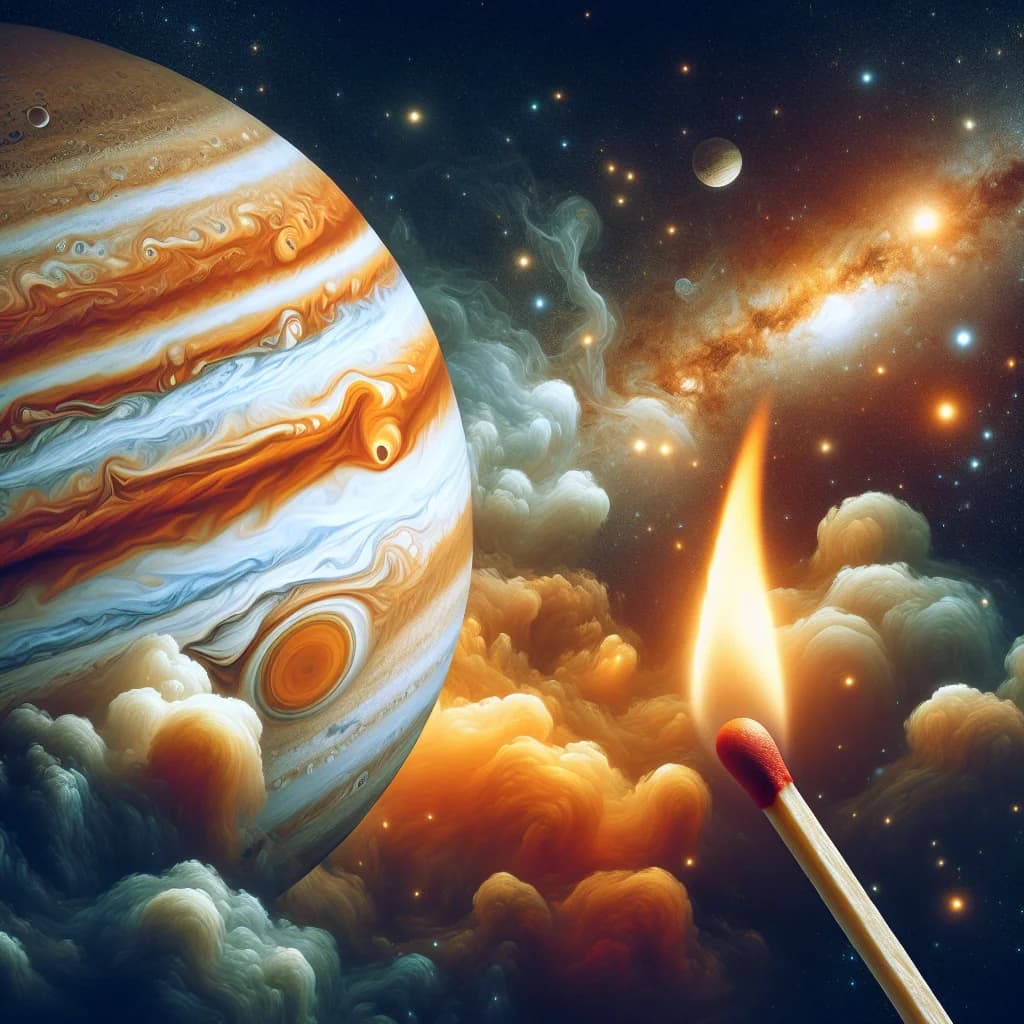
Jupiter is the undisputed heavyweight champion of our solar system, a swirling colossus of colorful clouds and violent storms. To the casual observer, the fact that Jupiter is a "gas giant" primarily composed of hydrogen—the same stuff we use for rocket fuel—suggests a terrifying possibility. If the planet is one giant ball of flammable gas, could a single spark, perhaps from a lone lit match, transform the entire planet into a celestial bonfire? It is an evocative image that leans into our fascination with the sheer scale of the cosmos. However, to understand why Jupiter remains a peaceful (if stormy) giant rather than a second sun, we must look toward the fundamental laws of chemistry and planetary thermodynamics. This analysis will demonstrate why your match is far less dangerous than it seems.
The Missing Ingredient: The Fire Triangle
To understand why Jupiter doesn't explode, we first have to look at the "Fire Triangle." On Earth, starting a fire requires three specific ingredients:
- Fuel: Something to burn (like hydrogen).
- Heat: An ignition source (like your match).
- Oxidizer: A chemical agent that reacts with the fuel (usually oxygen).
Jupiter has an abundance of fuel. Approximately 90% of its atmosphere is molecular hydrogen, with most of the remainder being helium. You are providing the heat with your match. However, the experiment fails immediately because Jupiter lacks the third ingredient: oxygen. While Earth’s atmosphere is a comfortable 21% oxygen, Jupiter’s atmosphere is almost entirely devoid of it in a free, molecular form.
Without an oxidizer, combustion simply cannot happen. If you were to strike a match in Jupiter’s upper atmosphere, the flame would go out the instant the match head's internal oxidizing chemicals were spent. The surrounding hydrogen wouldn't ignite; it would actually act as a cooling agent, extinguishing the flame.
The Stoichiometry of a Planetary Fire
Let’s indulge the fantasy for a moment. Suppose you didn't just bring a match; suppose you wanted to bring enough oxygen to actually burn Jupiter's hydrogen. How much would you need?
To burn hydrogen into water ($2H_2 + O_2 \rightarrow 2H_2O$), you need one oxygen molecule for every two hydrogen molecules. Given that Jupiter’s mass is approximately $1.9 \times 10^{27}$ kilograms, the math becomes staggering:
- The Oxygen Requirement: To "ignite" Jupiter, you would need to transport an amount of oxygen roughly equal to half the mass of the planet itself.
- A Comparison of Scale: The amount of oxygen required would weigh about 150 times more than the entire Earth.
- The Solar System Context: There is nowhere near enough free oxygen in the entire solar system to facilitate such a reaction.
Even the massive impacts we have witnessed, such as the fragments of Comet Shoemaker-Levy 9 hitting Jupiter in 1994, prove this point. Those impacts released more energy than the world’s combined nuclear arsenals, creating fireballs larger than Earth. Yet, the "fire" was localized to the heat of the impact and died out quickly because there was no atmospheric oxygen to sustain a chain reaction.
Why Jupiter Isn't a Star
Some wonder if the match might trigger a nuclear reaction instead of a chemical one, turning Jupiter into a star. While stars are also primarily hydrogen, they don't "burn" via chemical combustion; they function through nuclear fusion.
- Gravity Over Heat: To start nuclear fusion, you don't need a match; you need immense pressure and gravity.
- The Mass Gap: Jupiter is huge, but it is a "lightweight" in the stellar world. To trigger the fusion of hydrogen, a celestial body needs to be about 75 to 80 times more massive than Jupiter.
- The Result: Without that extra mass to crush atoms together at its core, Jupiter will remain a planet. No amount of external heat from a match can overcome the lack of gravitational pressure.
Conclusion
Ultimately, the hypothetical scenario of igniting Jupiter with a match results in a very quiet fizzle. The laws of chemistry are absolute: without a significant source of oxygen, the "gas giant" is effectively fireproof. The experiment serves as a brilliant reminder of how unique Earth’s oxygen-rich atmosphere is in the cosmic neighborhood.
While Jupiter may be composed of the same fuel that powers our most advanced rockets, it lacks the chemical partners necessary to burn. This thought experiment highlights the delicate balance of elements required for the phenomena we take for granted on Earth. Jupiter remains a beautiful, frigid, and remarkably stable giant, proving that in the vastness of space, scale is often secondary to the simple rules of the periodic table.