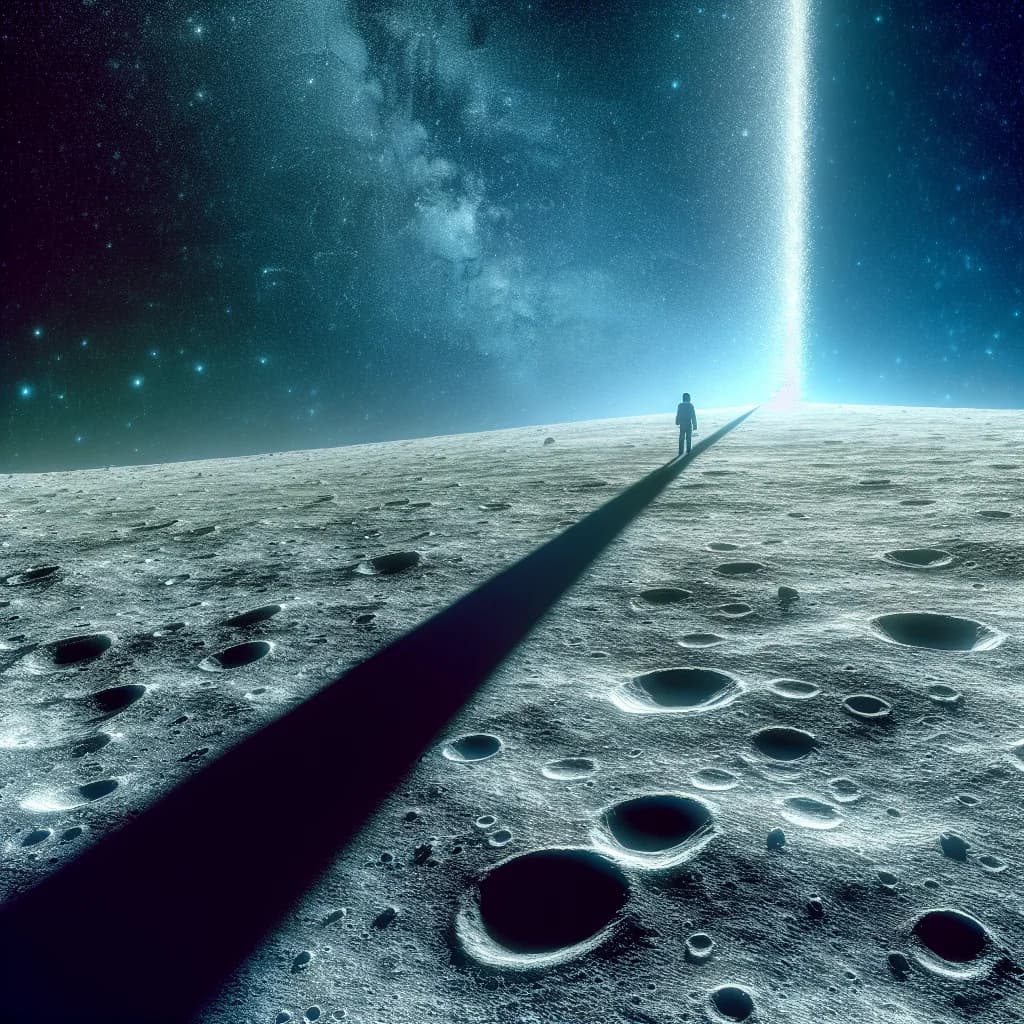
Could you push a small sailboat across a lake using only the light from a powerful enough laser
It sounds like a sci-fi dream, but could a beam of pure light actually replace the wind and propel a boat across open water? Discover the mind-bending physics of radiation pressure and whether "laser-sailing" is a high-tech reality or just a brilliant fantasy.

Too Long; Didn't Read
Technically yes, light exerts force through radiation pressure, but it is practically impossible. Moving a small sailboat would require a laser so powerful it would vaporize the sail and boil the water before the boat moved a noticeable distance.
The Photon Push: Could You Power a Sailboat Using Only a Laser Beam?
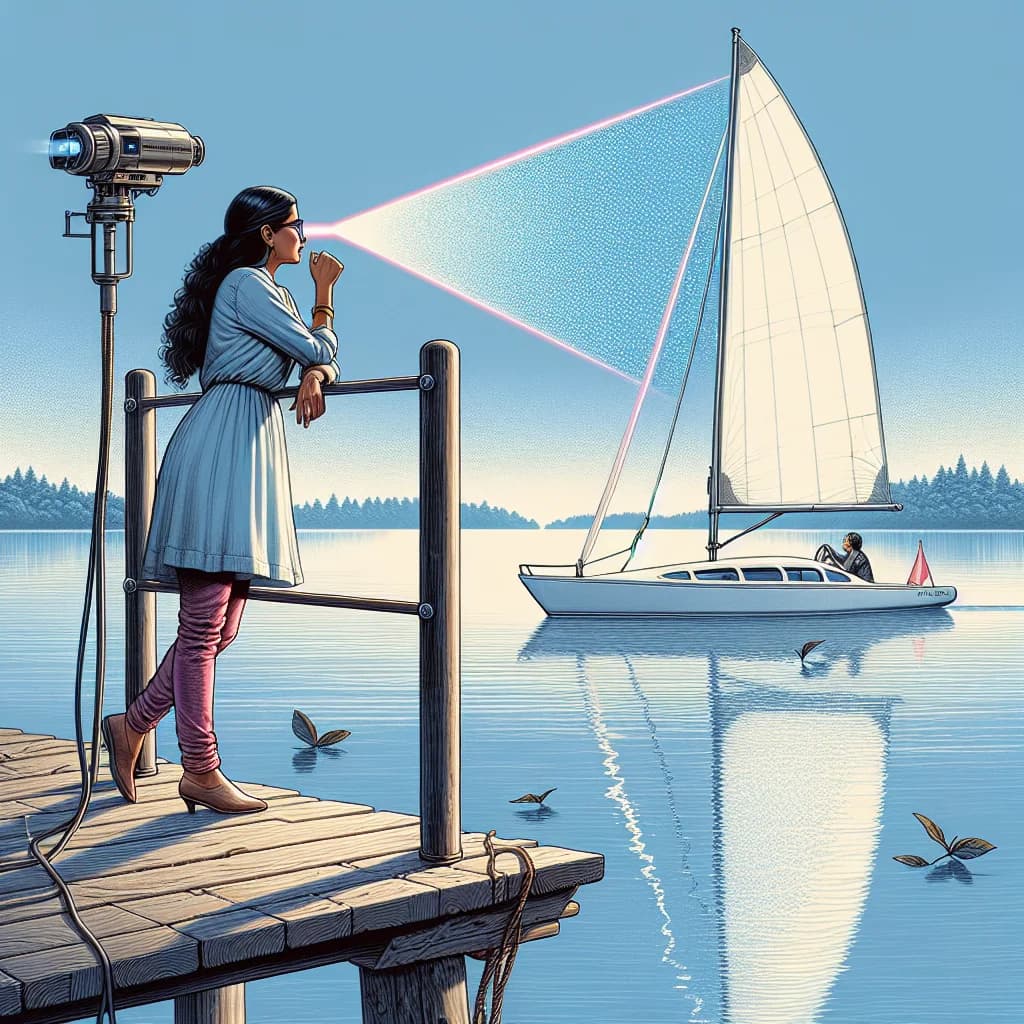
Imagine standing on the shore of a mirror-still lake. Instead of waiting for a breeze, you point a massive, high-tech laser at the sail of your small boat. With a flick of a switch, does the vessel glide gracefully across the water, propelled by nothing but pure light? This thought experiment takes us into the fascinating world of radiation pressure and the fundamental momentum of the universe.
To determine if this "photon push" is feasible, we must look at the intersection of classical mechanics and electromagnetism. Specifically, we will analyze the relationship between energy and momentum as defined by Maxwell’s equations and Einstein’s relativity. While light has no mass, it most certainly has momentum, and in this post, we will calculate exactly how much "oomph" a laser provides and whether your boat would move—or simply vanish in a cloud of steam.
The Physics of the Invisible Nudge
At the heart of this scenario is a concept called radiation pressure. Photons, the elementary particles of light, carry momentum. When a photon hits a surface, it transfers that momentum to the object. If the surface is reflective (like a mirror-finish sail), the photon bounces back, transferring twice the momentum it would if it were merely absorbed.
The formula for the force ($F$) exerted by light is $F = 2P/c$, where $P$ is the power of the laser in Watts and $c$ is the speed of light (approximately 300,000,000 meters per second). Because the speed of light is such a massive denominator, the resulting force is incredibly tiny.
Crunching the Numbers: From Milli-Newtons to Megawatts
Let’s apply this to a real-world scale. Suppose you have a small sailboat with a total mass of 250 kilograms (including a very brave passenger). To get this boat moving at a modest acceleration of 0.1 meters per second squared—enough to notice the movement—you would need a force of 25 Newtons.
Using our formula ($F = 2P/c$), we can solve for the required laser power ($P$):
- To generate just 25 Newtons of force, you would need a laser outputting roughly 3.75 Gigawatts.
To put that into perspective, a 3.75-gigawatt laser is not a handheld pointer. For context:
- The DeLorean's Flux Capacitor: Required 1.21 Gigawatts (this laser needs three times that).
- Nuclear Power Plants: A large nuclear reactor typically produces about 1 Gigawatt of electricity. You would need the dedicated output of nearly four nuclear power plants to give your sailboat a gentle nudge.
The Thermal Hurdle: Propulsion vs. Vaporization
While the physics says you can push the boat, the engineering says you might run into a "thermal phase transition" issue. Even the most efficient mirrors are not 100% reflective. If your sail is 99.9% reflective, it still absorbs 0.1% of that 3.75-gigawatt beam.
- Heat Absorption: 0.1% of 3.75 Gigawatts is 3.75 Megawatts.
- The Result: Absorbing 3.75 Megawatts of energy would cause a standard sail material to undergo rapid molecular excitation. In simpler terms, the sail would reach temperatures sufficient to vaporize most known materials almost instantly.
Instead of a boat ride, you would likely create a high-energy plasma event. Furthermore, the air between the laser and the boat would become "optically thick" as the intense energy ionized the nitrogen and oxygen in the atmosphere, potentially creating a glowing tunnel of plasma across the lake.
Atmospheric and Environmental Consequences
If you managed to build a perfectly reflective sail that didn't vaporize, the environment would still feel the effects. A multi-gigawatt beam passing through the air would cause significant "thermal blooming." The laser would heat the air, changing its refractive index and causing the beam to spread out, making it harder to stay focused on the sail. Additionally, the sheer brightness of the reflected light would be equivalent to several thousand suns, requiring the sailor to wear more than just standard sunglasses to prevent immediate optical saturation.
The Final Verdict
Theoretically, yes: you can push a sailboat with a laser. The laws of physics allow for the transfer of momentum from photons to a physical object. However, the practical requirements are staggering. To achieve the same push as a gentle summer breeze, you would need an energy infrastructure equivalent to a small nation’s power grid.
While laser-pushing a boat across a lake remains firmly in the realm of high-energy science fiction, the principle is already being used in the "real world." Solar sails, like those tested by the Planetary Society’s LightSail 2, use the same radiation pressure from the sun to maneuver in the vacuum of space. In the frictionless environment of orbit, that tiny "photon nudge" is enough to travel between planets, proving that even the lightest touch can eventually move mountains—or at least sailboats.