Could you shatter a virus like a wine glass by playing a note at its resonant frequency
Could a single, perfectly tuned note do what medicine can’t? Discover the mind-bending physics of resonant frequencies and whether we can literally vibrate viruses until they shatter like glass.

Too Long; Didn't Read
Scientists believe it is theoretically possible to destroy viruses using resonant frequencies, but the extreme speeds required and the dampening effect of bodily fluids make it difficult to achieve outside of controlled laboratory settings.
Shattering the Microscopic: Can You Break a Virus with Its Own Resonant Frequency?
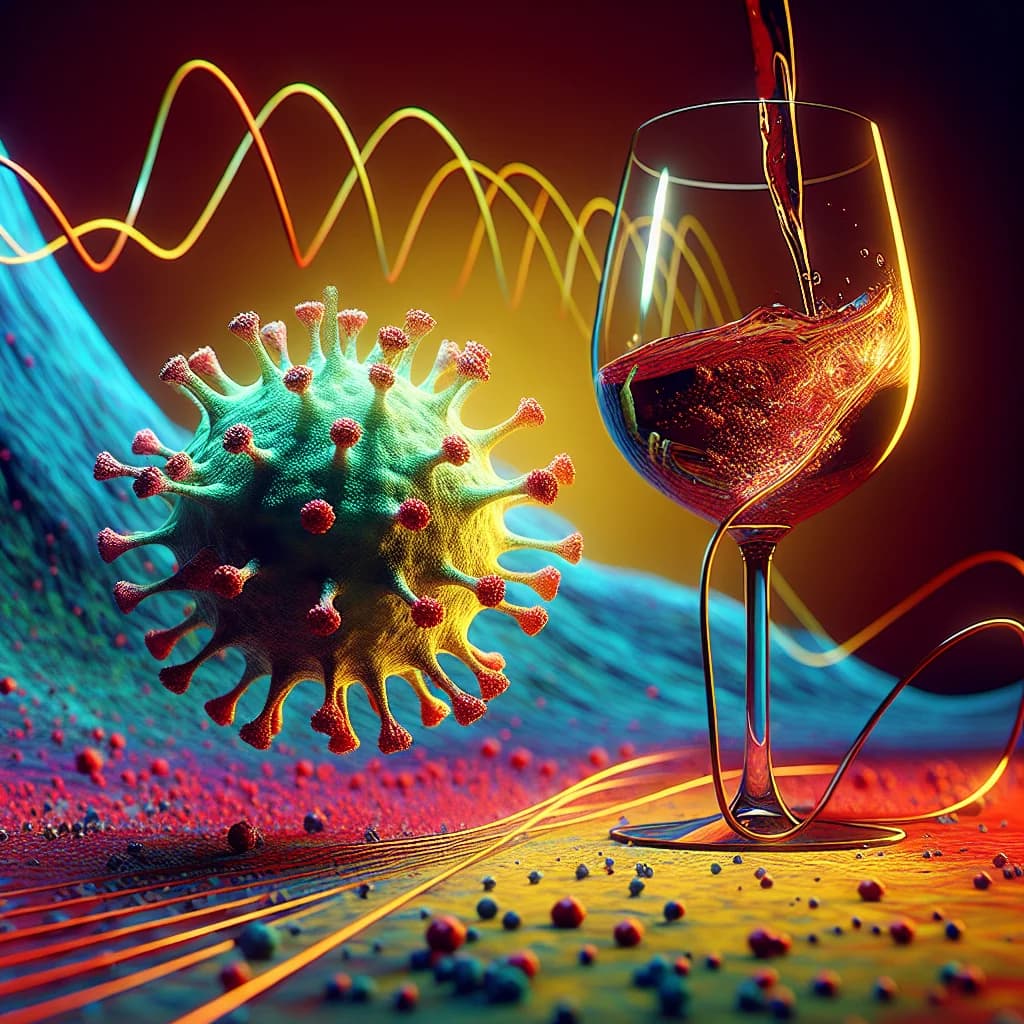
Imagine a world-class opera singer hitting a piercing, crystalline note that causes a wine glass across the room to vibrate, craze, and finally explode into shards. It is a classic demonstration of resonance—the phenomenon where an object absorbs energy from an external force vibrating at its natural frequency. Now, shrink that scenario down several million times. Could we play a specific "note" to shatter a virus, effectively neutralizing a pathogen without the need for traditional medicine?
This thought experiment sits at the fascinating intersection of biomechanics, acoustics, and nanotechnology. To determine if we can vibrate a virus to death, we must analyze the structural integrity of viral capsids, the physics of high-frequency oscillations, and the dampening effects of the microscopic environments where these pathogens reside. By applying the laws of harmonic motion to the nanoscale, we can uncover whether "sonic medicine" is a viable future or a beautiful physical impossibility.
The Mechanics of the Microscopic "Glass"
To understand if a virus can shatter, we first have to look at its "packaging." Most viruses are encased in a protein shell called a capsid. These capsids are remarkably geometric, often forming icosahedral (20-sided) structures that are both incredibly light and surprisingly rigid.
In the world of physics, every object has a resonant frequency—a specific rate at which it naturally "wants" to vibrate. When you provide energy at exactly that frequency, the amplitude of the vibrations increases. In a wine glass, this stress eventually exceeds the molecular bonds of the silicon dioxide, and the glass fails. Viruses, while made of proteins rather than silica, behave similarly to tiny, hollow spheres. Theoretically, if you push a capsid’s walls back and forth fast enough, the structural proteins should undergo mechanical failure.
Calculating the "Note" of a Pathogen
The first hurdle is the sheer scale of the "music" required. The resonant frequency of an object is inversely proportional to its size. A large bell rings with a deep bass; a small handbell tinkles with a high pitch. A virus, however, is roughly 20 to 300 nanometers in diameter.
To find the resonant frequency ($f$) of a virus like the Satellite Tobacco Necrosis Virus, scientists use the formula:
- $f \approx v / D$
- Where $v$ is the speed of sound through the viral protein (roughly 1,000–1,500 meters per second).
- And $D$ is the diameter of the virus.
For a 100-nanometer virus, the math points toward a frequency in the Gigahertz (GHz) range—that is, billions of cycles per second. For context, the highest note a human can hear is 20,000 Hertz. The "note" required to shatter a virus is millions of times higher than any sound a loudspeaker could ever produce. These are essentially "hypersound" waves or ultra-short electromagnetic pulses.
The Damping Dilemma: Why the "Song" Might Fail
In the famous wine glass experiment, the glass is surrounded by air, which provides very little resistance (damping). Viruses, however, do not exist in a vacuum; they live in the crowded, viscous fluids of biological organisms.
- Viscous Drag: Imagine trying to ring a bell while it is submerged in a vat of honey. The surrounding liquid absorbs the energy of the vibration before it can build up enough power to cause damage.
- Energy Dissipation: For a virus to shatter, the energy we pump into it must exceed the energy it loses to the surrounding water molecules.
Current biophysical models suggest that the damping effect of cellular fluid is immense. To overcome this "biological honey," the intensity of the vibration would need to be significant.
Lasers vs. Loudspeakers
Since traditional sound waves cannot reach the Gigahertz range effectively, researchers have turned to femtosecond lasers. Instead of using sound, these lasers fire ultra-short pulses of light that create mechanical vibrations in the viral capsid.
Experimental data has shown that:
- Low-power laser pulses can cause the capsid to vibrate.
- If the frequency is tuned correctly, these vibrations can break the weak bonds holding the capsid together.
- The virus doesn't necessarily "explode" into dust; rather, it deactivates, becoming a harmless shell unable to inject its genetic material.
The Scientific Verdict
Ultimately, while you cannot "shatter" a virus with a literal musical note from a singer or a stereo, the principle of resonant energy transfer is scientifically sound. The outcome of our hypothetical scenario is a "soft" mechanical failure rather than a violent explosion.
By applying the laws of harmonic oscillation to the nanoscale, researchers have discovered that viruses are vulnerable to specific frequencies. The core principle—that physical structure dictates mechanical vulnerability—remains a cornerstone of biophysics. While we won't be curing the common cold with a choir anytime soon, the reality of using light and frequency to disarm pathogens is a burgeoning field that proves the "absurd" ideas of today often become the specialized medicine of tomorrow.