Could you stop a falling elevator using only magnets if the shaft were made of solid copper
Imagine plummeting down an elevator shaft only to find yourself slowing to a supernatural crawl just inches from the floor. It isn’t magic—it’s the mind-bending physics of eddy currents, and it might just be the ultimate high-tech emergency brake.

Too Long; Didn't Read
Yes, electromagnetic braking makes this possible. As magnets fall through a copper shaft, they induce eddy currents that create an opposing magnetic field, naturally slowing the elevator to a safe crawl without needing power or friction.
The Copper Shaft Conundrum: Could You Stop a Falling Elevator with Magnets Alone?
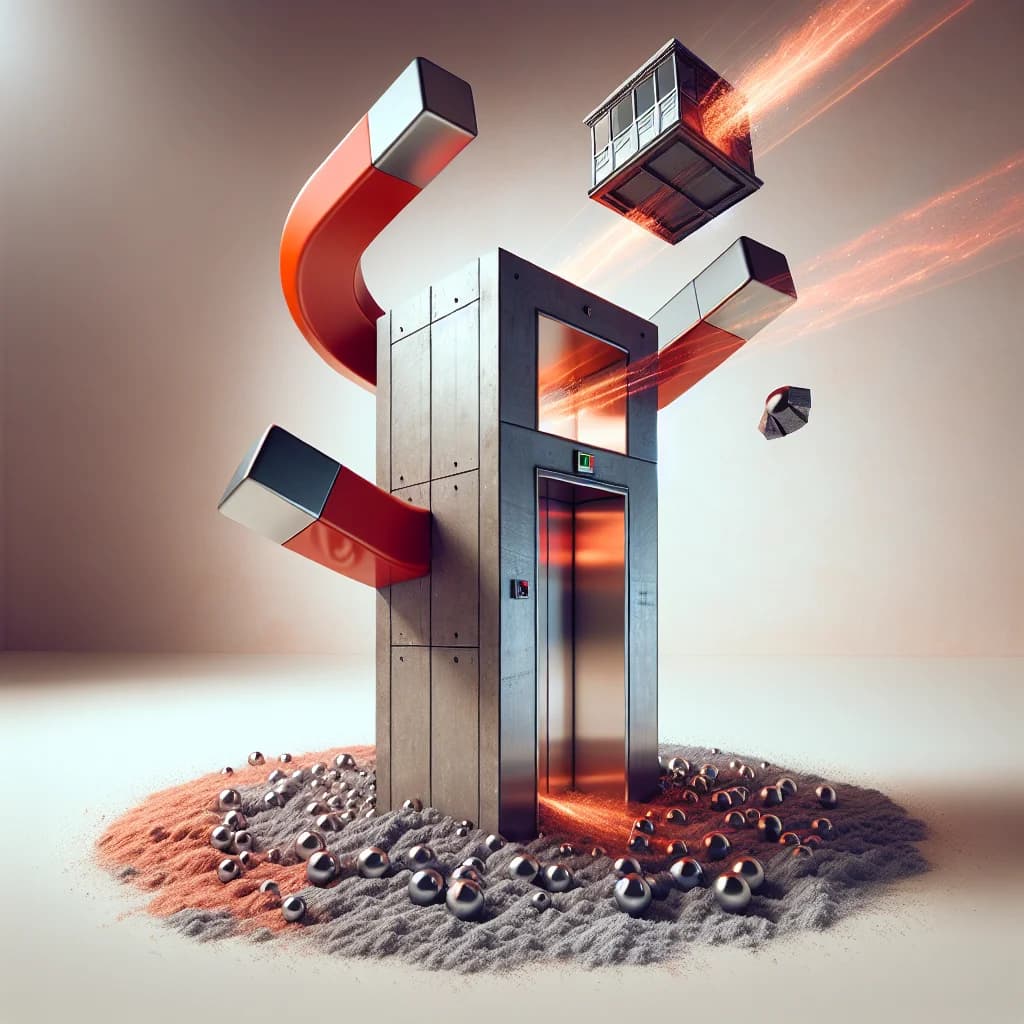
Imagine you are standing in an elevator when, suddenly, the unthinkable happens: the primary cable snaps. In a standard building, mechanical brakes would immediately clamp onto the rails. But in our thought experiment, we have replaced the steel and concrete with something much more conductive. Imagine the entire elevator shaft is a hollowed-out pillar of solid, high-purity copper, and the bottom of your elevator car is lined with incredibly powerful permanent magnets.
As the car begins its descent, you aren't just falling; you are participating in a massive demonstration of electromagnetic induction. This scenario explores the boundaries of Lenz’s Law and the practical limits of magnetic braking. By analyzing the interaction between moving magnetic fields and stationary conductors, we can determine whether physics would grant you a gentle landing or if gravity would still have the final say.
The Science of the "Invisible Brake"
The primary physical principle at play here is Lenz’s Law, a cornerstone of electromagnetism. When a magnet moves relative to a conductor (like our copper shaft), it induces electrical loops called Eddy currents within the metal.
These circulating currents are not just passing through; they create their own magnetic field. According to Lenz's Law, this induced field will always oppose the change that created it. In simpler terms: the copper shaft generates a magnetic "push" upward that tries to stop the magnets from falling downward.
- No Friction Required: Unlike traditional brakes, there is no physical contact.
- The Velocity Variable: The strength of this upward push is directly proportional to how fast the elevator is moving. The faster you fall, the harder the magnets push back.
Crunching the Numbers: Gravity vs. Electromagnetism
To understand if this would actually work, we have to look at the scale of the forces involved. Let’s assume a standard passenger elevator weighs roughly 1,000 kilograms (2,200 lbs) when empty.
- Gravitational Force: The Earth pulls this elevator down with a force of approximately 9,800 Newtons.
- Magnetic Drag: The braking force ($F$) generated by Eddy currents can be estimated using the formula $F = \sigma v B^2$, where $\sigma$ is the conductivity of the copper, $v$ is the velocity, and $B$ is the magnetic field strength.
- The Copper Advantage: Copper is one of the most conductive non-precious metals on Earth (with a conductivity of about $5.96 \times 10^7$ Siemens per meter). This makes it an ideal "track" for magnetic braking.
In a solid copper shaft, the magnetic drag would be immense. Calculations suggest that with high-grade neodymium magnets, the elevator would quickly reach a terminal velocity. This is the point where the upward magnetic drag exactly equals the downward pull of gravity. Instead of accelerating toward the basement at 9.8 m/s², the car would reach a steady, slow crawl—potentially moving only a few centimeters per second.
The Heat Factor: Where Does the Energy Go?
One of the most fascinating consequences of this scenario involves the Law of Conservation of Energy. The kinetic energy of the falling elevator cannot simply disappear; it must be transformed. In this system, the energy is converted into thermal energy within the copper shaft.
- The "Toaster" Effect: As the Eddy currents flow through the copper, the metal's electrical resistance causes it to heat up.
- Massive Heat Sink: Because the shaft is made of solid copper, it acts as a massive heat sink. A 50-story shaft of solid copper would weigh millions of kilograms. The heat generated by a single falling elevator would be absorbed so efficiently that the temperature rise in the copper would be nearly imperceptible to a human touch.
The Catch: Why You Can’t Quite "Stop"
While magnets and copper are excellent at slowing things down, they suffer from a fundamental paradox: the force only exists if there is motion.
If the elevator were to come to a complete, dead stop, the magnetic field would no longer be moving relative to the copper. The Eddy currents would cease to flow, the upward magnetic force would vanish, and gravity would immediately start the elevator falling again.
Consequently, you would never "stop" mid-shaft using only magnets. Instead, you would experience a permanent, ultra-slow-motion descent. You would eventually reach the bottom of the shaft, but your impact would be no more violent than a gentle tap.
Conclusion
So, could you stop a falling elevator using magnets and a copper shaft? While you wouldn't achieve a stationary hover, you would effectively nullify the danger of the fall. Through the elegant mechanics of Lenz’s Law, the elevator would transform a high-stakes freefall into a leisurely, controlled glide.
The core principles of electromagnetic induction ensure that the faster gravity tries to pull you down, the harder the copper shaft pushes back. This thought experiment highlights why magnetic braking is already used in the real world—from the ultra-smooth stops of modern roller coasters to the high-speed braking systems of Maglev trains. Physics, it seems, is the ultimate safety net.