Could you swim in a spent nuclear fuel pool because the water acts as an incredible radiation shield
It sounds like a suicide mission, but thanks to the incredible physics of water, you might actually receive *less* radiation swimming above spent fuel than walking down a city street. Dive into the counterintuitive science of why a nuclear cooling pool could be the safest—and strangest—swim of your life.

Too Long; Didn't Read
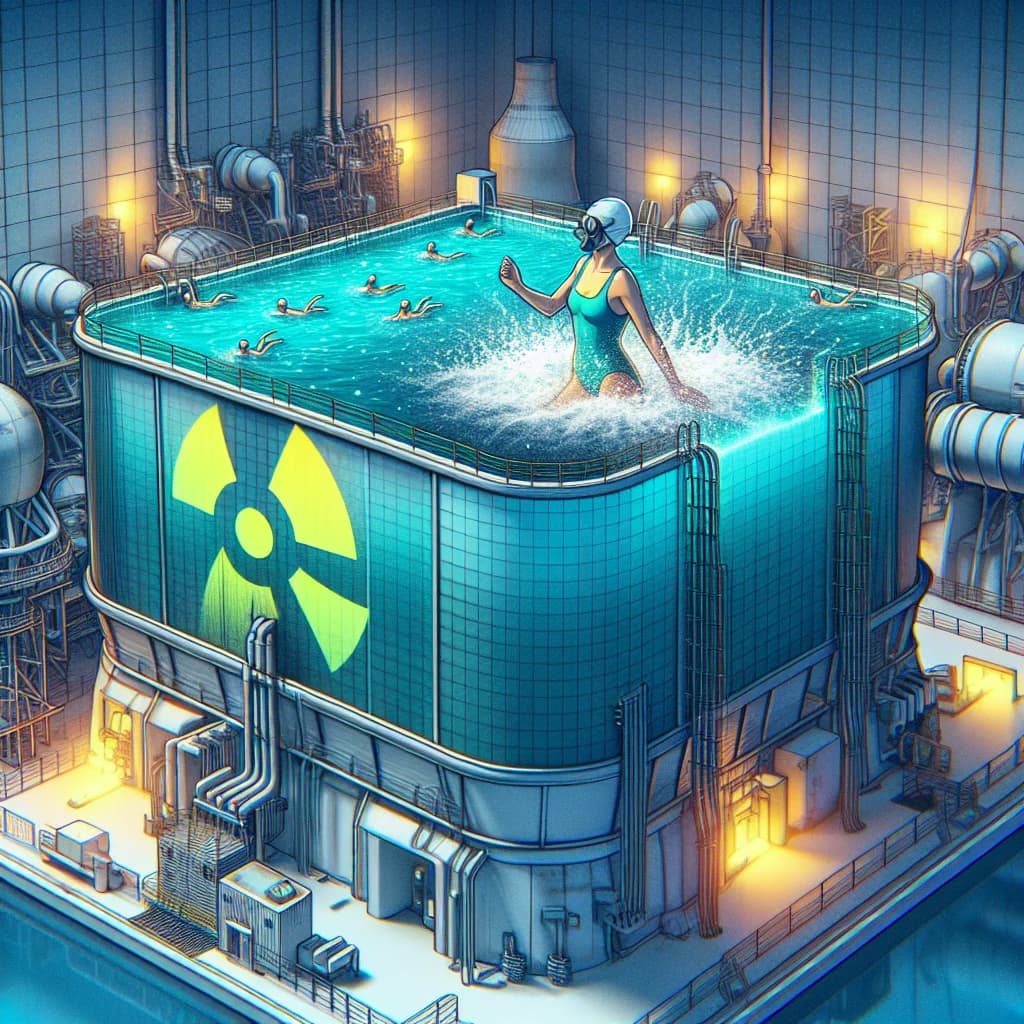
Yes, you can safely swim in a spent nuclear fuel pool because water is an incredible radiation shield. As long as you stay near the surface and do not touch the fuel rods, the water blocks so much radiation that you would actually receive a lower dose than you do from natural background sources on land. Just avoid diving to the bottom, where the concentrated radiation remains lethal.
The Ultimate Deep Dive: Is it Scientifically Safe to Swim in a Spent Nuclear Fuel Pool?
Imagine a swimming pool filled with crystal-clear water, radiating a serene, ethereal blue glow from its depths. It looks like the ultimate luxury spa, yet at the bottom sit racks of spent nuclear fuel assemblies, fresh from a reactor core. In the popular imagination, nuclear material is a glowing green sludge of certain doom. However, physics tells a much more nuanced—and surprisingly counterintuitive—story.
The question is simple: Could you safely take a lap in a spent nuclear fuel pool? To answer this, we must dive into the fascinating world of particle physics, high-level radiation shielding, and thermal dynamics. By analyzing the "half-value layer" of water and the mechanics of Cherenkov radiation, we can determine exactly how the laws of physics would protect (or fail to protect) a daring swimmer in this high-tech environment.
Water: Nature’s Premier Radiation Shield
The primary reason you wouldn't immediately perish in a fuel pool is that water is an incredible radiation shield. When it comes to blocking ionizing radiation, mass is the deciding factor, and water is quite dense. Specifically, water is highly effective at slowing down neutrons and absorbing gamma rays.
In the world of radiological protection, we use a metric called the "half-value layer." This is the thickness of a material required to reduce the intensity of radiation by half. For the high-energy gamma rays emitted by spent fuel:
- Approximately every 7 centimeters (2.7 inches) of water cuts the radiation dose in half.
- If you move 70 centimeters away, the radiation is reduced to about 1/1000th of its original strength.
Spent fuel pools are typically 20 to 30 feet deep. If you were swimming near the surface, there would be several meters of water between you and the fuel. Mathematically, the shielding provided by those meters is so robust that you would actually receive a lower dose of radiation than you would standing on a city street, where you are constantly pelted by cosmic rays from space.
The Cherenkov Glow: A Physics Light Show
The most striking feature of these pools is the "Cherenkov radiation"—that hauntingly beautiful blue light. This occurs when charged particles (like electrons) travel through a medium (like water) faster than the speed of light in that medium.
While nothing can travel faster than the speed of light in a vacuum, light slows down when it passes through water. Electrons emitted by the spent fuel, however, are still moving at near-vacuum light speed. As they outpace the local light waves, they create an electromagnetic "shockwave," similar to a sonic boom, which manifests as blue light. While the glow indicates high energy, as long as you remain in the upper layers of the pool, the water successfully absorbs the actual particles long before they reach you.
The Practicalities of the "Nuclear Spa"
Beyond the radiation, what would the experience actually feel like? Surprisingly, it might be quite comfortable, though not without its quirks.
- Temperature: Spent fuel continues to generate "decay heat." To prevent the water from boiling, it is constantly circulated through heat exchangers. This keeps the pool at a steady, balmy temperature—usually between 25°C and 35°C (77°F to 95°F). It would feel like a heated competition pool.
- Water Purity: This water is incredibly pure. It is demineralized to prevent corrosion of the fuel cladding. If you were to jump in, you would actually be the "dirty" element in the system, introducing oils and skin cells into a highly controlled environment.
- The Safety Margin: In most scenarios, you could swim for hours without any measurable biological impact from radiation, provided you stayed within the top few meters.
The Critical "Don't Touch" Rule
The safety of this experiment relies entirely on distance. Radiation follows the Inverse Square Law, meaning the intensity drops off exponentially as you move away. However, the inverse is also true: as you get closer, the dose increases dramatically. If you were to dive down and touch a fresh fuel assembly, the shielding effect of the water would vanish. At that range, the cellular interference would be so intense that it would lead to immediate and irreversible biological failure.
Conclusion
Scientifically speaking, you could absolutely swim in a spent nuclear fuel pool. Thanks to the physics of attenuation, the water acts as a nearly perfect barrier, shielding you from the volatile energy below. As long as you remain a "surface swimmer," the laws of nuclear physics are on your side, providing a environment that is, ironically, one of the most radiation-shielded spots on Earth.
However, while the physics may say "yes," the security guards and the law would say a very firm "no." This thought experiment highlights the incredible properties of common substances like water. It serves as a powerful reminder that in science, the most dangerous things in the world can often be rendered harmless by the simplest of barriers, provided we understand the mathematics behind them.