If a giant mirror were placed fifty light-years away, could we see 100 years into our own past
Imagine peering through a telescope and seeing the world exactly as it was a century ago. By placing a massive mirror 50 light-years away, the laws of physics might just turn the cosmos into the ultimate time machine.

Too Long; Didn't Read
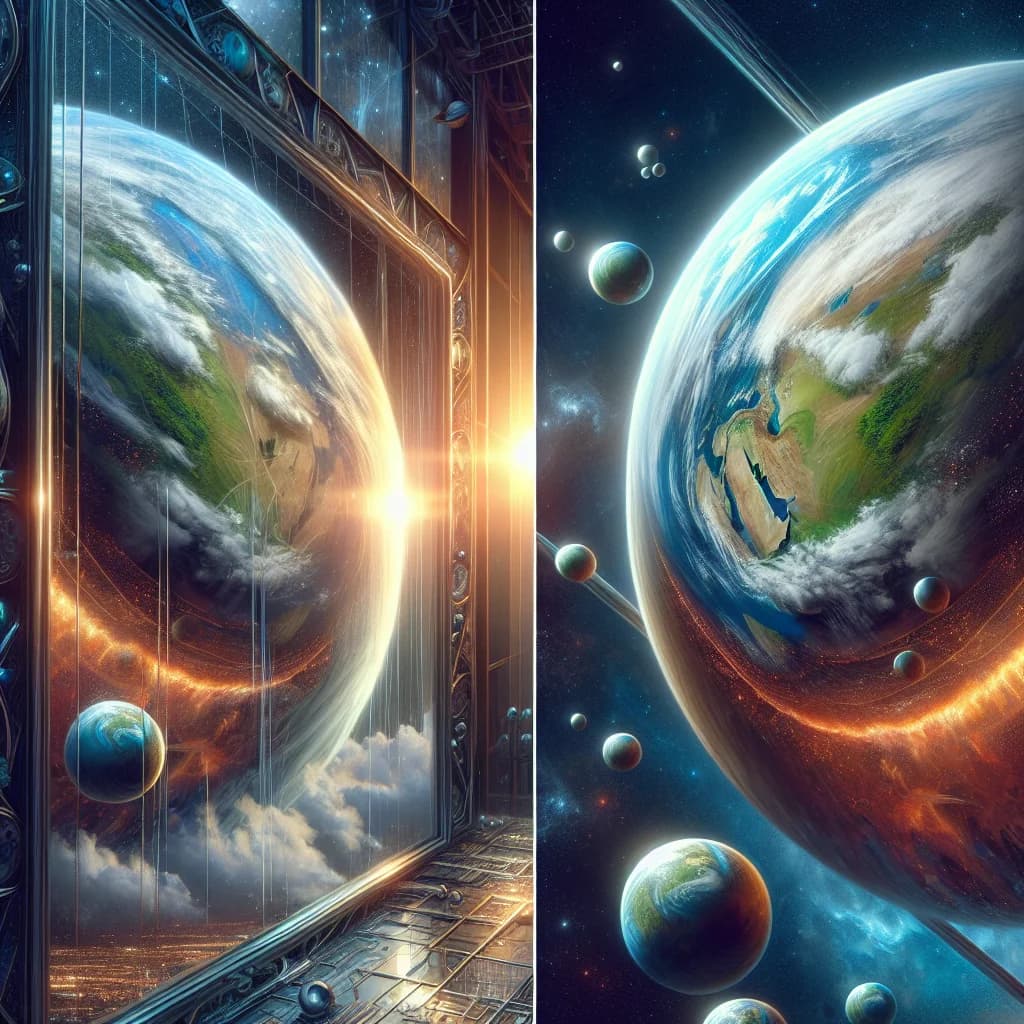
Theoretically yes, because light would take 50 years to reach the mirror and 50 years to return, reflecting the Earth as it was a century ago. However, building a mirror large and precise enough to capture a clear image from that distance is currently impossible with modern technology.
The Fifty Light-Year Selfie: Could a Giant Mirror Show Us the Past?
Imagine stepping out onto your balcony, pointing a massive telescope at a specific point in the cosmos, and seeing your great-grandparents waving back at you from a century ago. It sounds like the plot of a high-concept science fiction novel, yet it is rooted in a fascinating question about the fundamental nature of light and time. If we were to place a gargantuan, perfectly reflective mirror exactly fifty light-years away from Earth, could we literally watch our own history unfold?
This thought experiment allows us to explore the boundaries of special relativity, the physics of light propagation, and the staggering scales of the universe. By applying the laws of optics and the constant speed of light, we can determine whether this "cosmic rearview mirror" is a scientific possibility or a mathematical daydream.
The Cosmic Round Trip: Why 100 Years?
The foundational principle behind this scenario is the finite speed of light. In a vacuum, light travels at approximately 299,792 kilometers per second (about 186,282 miles per second). While this seems instantaneous on Earth, the vast distances of space reveal its limitations.
A "light-year" is not a measure of time, but the distance light travels in one Julian year—roughly 9.46 trillion kilometers. If we place a mirror 50 light-years away, any light leaving Earth today would take 50 years to reach the mirror’s surface. Once it reflects, that same light must travel another 50 years to return to our eyes.
- Departure: Light from the year 1924 leaves Earth.
- Arrival at Mirror: That light reaches the mirror in 1974.
- Return Trip: The reflected light travels back, reaching Earth in 2024.
Mathematically, the delay is always double the distance. Therefore, looking into a mirror 50 light-years away would indeed allow us to see Earth as it appeared 100 years ago.
The Resolution Revolution: How Big is "Giant"?
While the timing works out perfectly, the physical requirements for such a mirror are where the experiment meets the "diffraction limit." To see meaningful detail—like the streets of London in the 1920s or even the outline of a continent—the mirror would need to be incomprehensibly large.
The Problem of Light Spreading
As light travels, it spreads out. By the time the light from a single streetlamp on Earth reaches a point 50 light-years away, its photons are scattered across a massive area of space. To capture enough of these photons to form a recognizable image, our mirror cannot just be the size of a skyscraper or even a planet.
Calculating the Diameter
According to the Rayleigh Criterion, which determines the resolving power of an optical instrument, the size of the "lens" (or mirror) must increase as the distance increases. To resolve an object the size of a human being from 50 light-years away, the mirror would need to be roughly the diameter of the Earth’s orbit around the sun—approximately 300 million kilometers wide.
To put that in perspective:
- The Moon’s Diameter: 3,474 km.
- The Sun’s Diameter: 1.39 million km.
- Our Hypothetical Mirror: 300,000,000 km.
Engineering the Impossible
Constructing a mirror of this magnitude introduces physical consequences that would alter the local environment of any star system it inhabits. A solid structure of that size would possess a gravitational pull so immense that it would likely collapse into a sphere under its own weight or begin attracting nearby planets and asteroids, effectively acting as a cosmic vacuum cleaner.
Furthermore, we must consider "reflectivity." No mirror is 100% efficient. Over a 100-light-year journey, photons would be absorbed by interstellar dust or diverted by the gravitational fields of passing stars (a phenomenon known as gravitational lensing). The "past" we would see would likely be an incredibly faint, blurry smudge rather than a high-definition broadcast of history.
Conclusion: A Window into Yesterday
Ultimately, the science confirms that the "time delay" of a mirror 50 light-years away would indeed show us 100 years into the past. The laws of physics support the temporal math; light is a reliable messenger that carries images of the past across the vacuum of space. However, the engineering requirements—specifically the need for a mirror millions of kilometers wide to achieve any visual clarity—place this experiment firmly in the realm of theoretical wonder.
This thought experiment highlights a beautiful truth: we are already looking into the past every time we gaze at the night sky. The starlight we see today began its journey years, centuries, or even millennia ago. While we may not have a giant mirror to see our own reflections, the universe itself acts as a vast, living library of history, written in the very light that travels across the stars.