If Earth stopped rotating, would the oceans migrate to the poles and leave the equator dry
Imagine a world where the equator becomes a massive, dry landmass while the poles are swallowed by rising seas. Without its daily spin, Earth’s oceans would embark on a global migration that would permanently and dramatically rewrite the map of our planet.

Too Long; Didn't Read
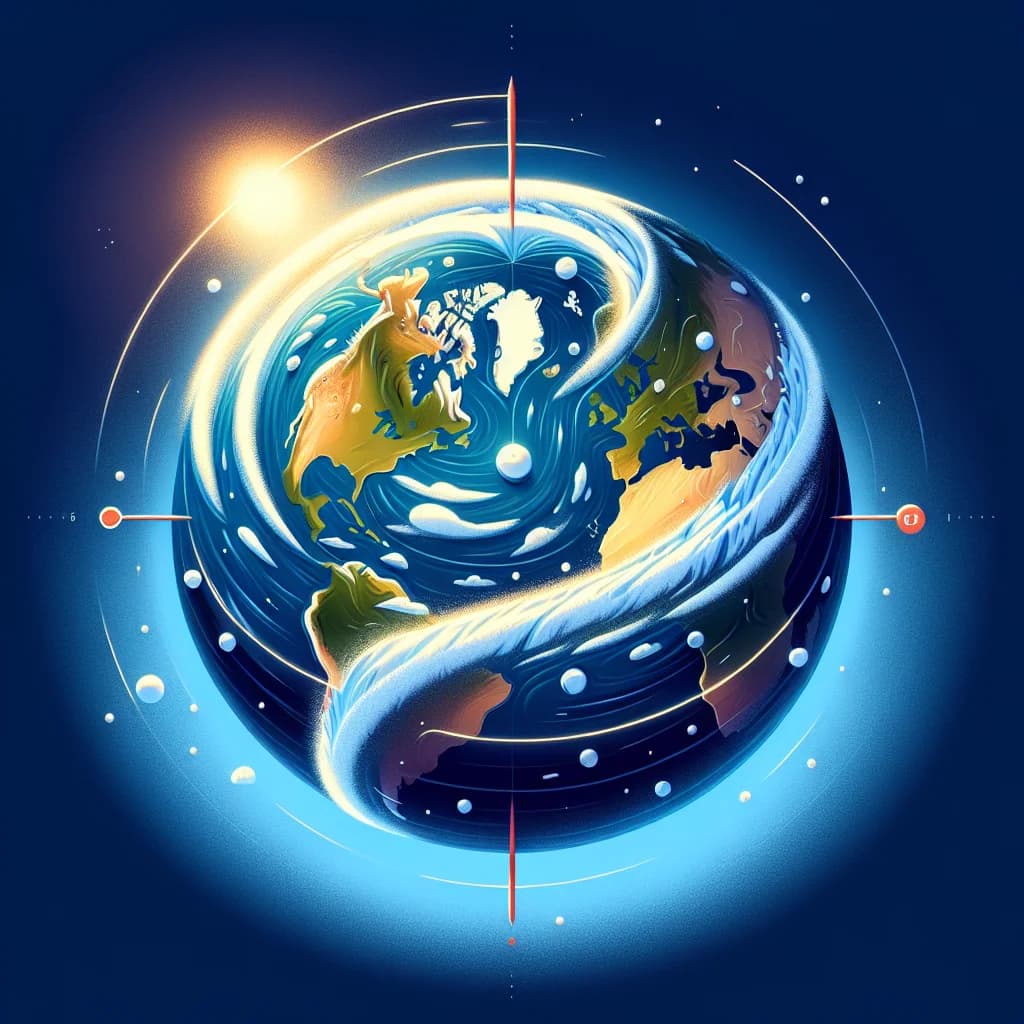
Yes. Without the centrifugal force generated by Earth’s rotation, gravity would pull the oceans toward the poles, flooding those regions and leaving a massive supercontinent of dry land encircling the equator.
The Great Water Migration: What Would Happen to Our Oceans if Earth Stopped Spinning?
Imagine a world where the familiar map on your wall becomes entirely obsolete. No, we aren’t talking about shifting political borders, but a fundamental restructuring of the planet’s physical geography. While we often take the Earth’s 24-hour rotation for granted, this constant spin is the silent architect of our world’s shape and sea levels. If that rotation were to gradually cease, we would witness one of the most dramatic physical transformations in planetary history. This thought experiment invites us to look past the "how" and focus on the "what"—specifically, how the laws of geophysics and fluid dynamics would conspire to pull our oceans away from the equator and toward the poles, leaving a ring of dry land in their wake.
The Secret Shape of Our Planet
To understand why the oceans would move, we first have to recognize that the Earth isn’t a perfect sphere. Because it rotates at roughly 1,000 miles per hour at the equator, the planet acts like a spinning ball of soft clay, slightly flattening at the poles and bulging at the middle. This is known as an oblate spheroid.
This "equatorial bulge" is significant; the Earth’s radius at the equator is approximately 21 kilometers (13 miles) greater than at the poles. Currently, our oceans stay "piled up" around the equator because the centrifugal force of Earth's rotation pushes the water outward, counteracting gravity's desire to pull everything into a perfect circle.
The Great Polar Migration
If the Earth stopped spinning, that centrifugal force would vanish. Without the outward "push" of rotation, gravity would become the sole director of the world's water. Gravity seeks the closest point to the center of the Earth’s mass. Because the solid crust of the Earth is also bulged at the equator, the center of the Earth is actually "deeper" relative to the surface at the poles.
The consequences would be orderly but massive:
- A Two-Ocean World: The water currently held at the equator would begin a slow, inevitable march toward the North and South Poles. Eventually, the world’s oceans would divide into two massive, isolated polar seas.
- The Rise of the Mega-Continent: As the water drains away from the center of the globe, a single, continuous band of dry land would emerge around the equator. This "Circumequatorial Megacontinent" would bridge the gap between South America, Africa, and Indonesia, creating a terrestrial ring around the planet.
- Depth and Altitude: In this scenario, the new polar oceans would become incredibly deep, swallowing northern territories like Canada, Siberia, and Northern Europe under kilometers of water. Conversely, the equatorial regions would become high-altitude highlands, as the "bulge" of the solid Earth remains behind even after the water departs.
Calculating the Shift
How much water are we talking about? The volume of Earth's oceans is approximately 1.3 billion cubic kilometers. Currently, the "height" of the ocean at the equator is held about 8 kilometers higher than it would be on a non-rotating Earth.
If we apply the principles of hydrostatic equilibrium—the state where gravity is balanced by pressure—the water would redistribute until the surface of the ocean follows a line of equal gravitational potential. This means the water would fill the "lowest" points (the poles) first. The equatorial bulge of the solid Earth, no longer covered by water, would tower like a massive mountain range, effectively separating the Northern and Southern Hemispheres by a wall of rock thousands of feet high.
Atmospheric Ripples
The migration wouldn't just affect the water; the atmosphere would follow a similar logic. Air is a fluid, too. Without rotation, the atmosphere would also migrate toward the poles, becoming much denser and thicker over the new polar oceans. At the new equatorial highlands, the air would become incredibly thin—much like the air at the summit of Mount Everest today—making the center of the world a place of pristine, high-altitude silence.
A New Perspective on a Moving World
The ultimate outcome of a stationary Earth is a planet of extremes: two vast polar oceans separated by a global desert of towering equatorial peaks. This transformation would be dictated by the unwavering laws of gravity and the removal of centrifugal force, proving that our planet’s current layout is a delicate balance of motion and mass.
While this scenario remains firmly in the realm of the hypothetical, it highlights a fascinating reality: the Earth’s rotation is more than just a clock. It is a physical force that maintains the very boundaries of our continents and the depths of our seas. We aren't just living on a rock; we are living on a dynamic, spinning system where every wave and tide is a testament to the planet's constant journey through space.