If human eyes were the size of dinner plates, could we see the moons of Jupiter without telescopes
Imagine swapping your eyes for dinner-plate-sized lenses and peering deep into the cosmos. Could this biological superpower finally reveal the moons of Jupiter to the naked eye, or does nature have a hidden limit on what we’re allowed to see?

Too Long; Didn't Read
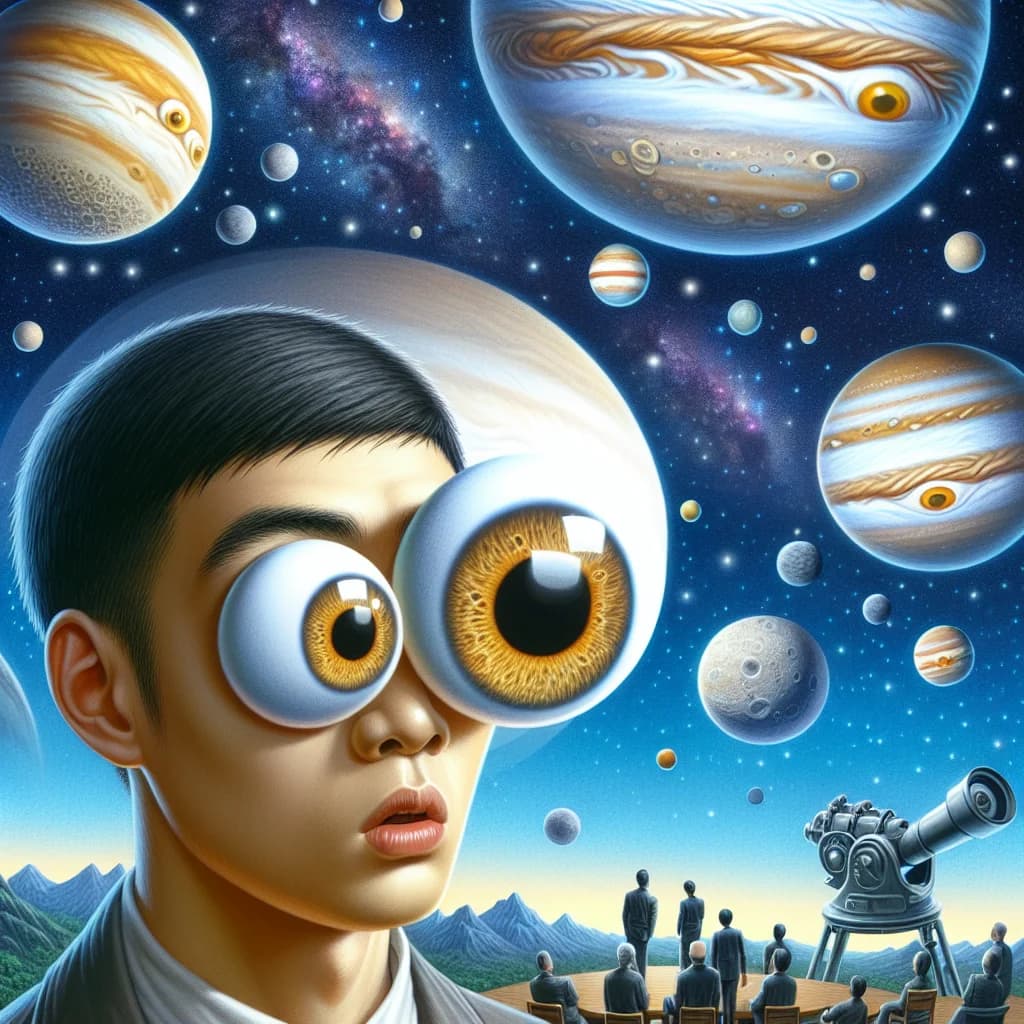
If human eyes were the size of dinner plates, their increased resolution would theoretically allow us to see the four largest moons of Jupiter without a telescope. The larger aperture would provide the necessary clarity to distinguish the moons from the planet's intense glare.
Big Eyes, Big Skies: Could Dinner-Plate Pupils Reveal the Moons of Jupiter?
Imagine waking up, looking in the mirror, and seeing two shimmering, 10-inch disks staring back at you. If human eyes were the size of dinner plates, our faces would be dominated by massive optical sensors capable of capturing light in ways our current biology can only dream of. This whimsical thought experiment isn’t just a lesson in surreal anatomy; it’s a gateway into the fascinating worlds of optical physics and planetary science. To determine if these gargantuan "dinner-plate eyes" would grant us a telescope-free view of Jupiter’s Galilean moons, we must analyze the scenario through the lenses of angular resolution, light-gathering power, and atmospheric interference. By applying the Rayleigh Criterion and the inverse-square law, we can uncover whether our hypothetical giant eyes would turn the night sky into a high-definition masterpiece.
The Power of the Aperture: Resolution and the Rayleigh Criterion
In optics, the size of the opening that lets in light—the aperture—is the single most important factor for seeing detail. For the human eye, the pupil serves as this aperture. In our current state, a human pupil expands to a maximum of about 7 millimeters in the dark. If we scale that up to a 25-centimeter (roughly 10-inch) dinner plate, the physics of sight change dramatically.
The primary constraint on seeing the moons of Jupiter is "angular resolution," or the ability to distinguish two close objects as separate points rather than one blurry blob. This is governed by the Rayleigh Criterion. Mathematically, the resolution improves linearly with the diameter of the aperture.
- Current Resolution: A standard human eye has a resolution of about 1 arcminute (1/60th of a degree).
- Giant Eye Resolution: An eye with a 250mm aperture would theoretically have a resolution roughly 35 times sharper than a normal eye, reaching approximately 1.7 arcseconds.
Jupiter’s four largest moons—Io, Europa, Ganymede, and Callisto—are separated from the planet by distances ranging from 2 to 10 arcminutes. Since our dinner-plate eyes could resolve details down to 1.7 arcseconds, the physical "gap" between Jupiter and its moons would be cavernous. We wouldn't just see the moons; we would see them as distinct, sharp pinpricks of light easily separated from the planet's glow.
Collecting the Light: Magnitude and Contrast
While we have the resolution to separate the moons from Jupiter, we also need enough light-gathering power to perceive them. The moons of Jupiter are actually bright enough to be seen with the naked eye (ranging from magnitude 5.0 to 5.6) if Jupiter itself weren't there. However, Jupiter is about 1,500 times brighter than its moons, creating a "glare" that overwhelms our tiny pupils.
By expanding our eyes to 25 centimeters, we increase the surface area of our light-collection zone exponentially.
- Surface Area Calculation: The area of a circle is $\pi r^2$. A 7mm pupil has an area of about 38.5 square millimeters. A 250mm "dinner plate" eye has an area of about 49,000 square millimeters.
- Light Increase: This represents a nearly 1,300-fold increase in light-gathering capacity.
With this massive influx of photons, the moons would appear incredibly bright. More importantly, the increased resolution mentioned earlier would shrink the "diffraction disk" of Jupiter—the fuzzy halo of light caused by the bending of waves—preventing the planet's brightness from washing out the much dimmer moons nearby.
The Biological and Environmental Consequences
While the physics of a 10-inch eye are impressive, the biological "hardware" would face significant challenges. An eye this large would require a massive increase in the number of photoreceptor cells (rods and cones) and a significantly larger optic nerve to transmit the vast amount of data to the brain.
Furthermore, we would still have to contend with Earth’s atmosphere. Even with giant eyes, we are looking through miles of turbulent air. This turbulence causes "scintillation," or the twinkling effect of stars. On a night with poor "seeing" (atmospheric stability), the image might shimmer or blur, though the sheer size of the 25cm aperture would still provide a view vastly superior to our current biological equipment, functioning essentially like a high-end amateur telescope built directly into the skull.
Conclusion
The scientific verdict is clear: if human eyes were the size of dinner plates, the moons of Jupiter would be easily visible to the naked eye. The massive increase in aperture would provide the necessary angular resolution to separate the moons from Jupiter's glare and the light-gathering power to make them shine brilliantly. We would likely see the four Galilean moons as steady, bright lights dancing around the giant planet every night.
This experiment highlights the elegant relationship between scale and perception. Our eyes are perfectly evolved for life on Earth—navigating terrain and spotting movement—but they are modest tools for celestial observation. By mentally expanding our biological limits, we can better appreciate how the laws of physics, such as the Rayleigh Criterion, dictate how much of the vast universe we are allowed to witness. While we don't have dinner-plate eyes, we have something perhaps even better: the ingenuity to build telescopes that do the heavy lifting for us.