If humans had photosynthetic skin like a leaf, how many hours would you need to sunbathe to skip lunch
Imagine swapping your lunch break for a tanning session and letting your skin do the cooking. We crunched the numbers to see if humans could actually survive on sunlight, and the reality of "solar-powered" living is far more bizarre than you think.

Too Long; Didn't Read
Due to high caloric demands and limited skin surface area, a human would need to sunbathe for roughly 75 to 100 hours just to replace a single meal, making photosynthesis an impractical substitute for lunch.
Sunlight for Supper: Calculating the Hours Needed for Humans to Photo-Synthesize a Sandwich
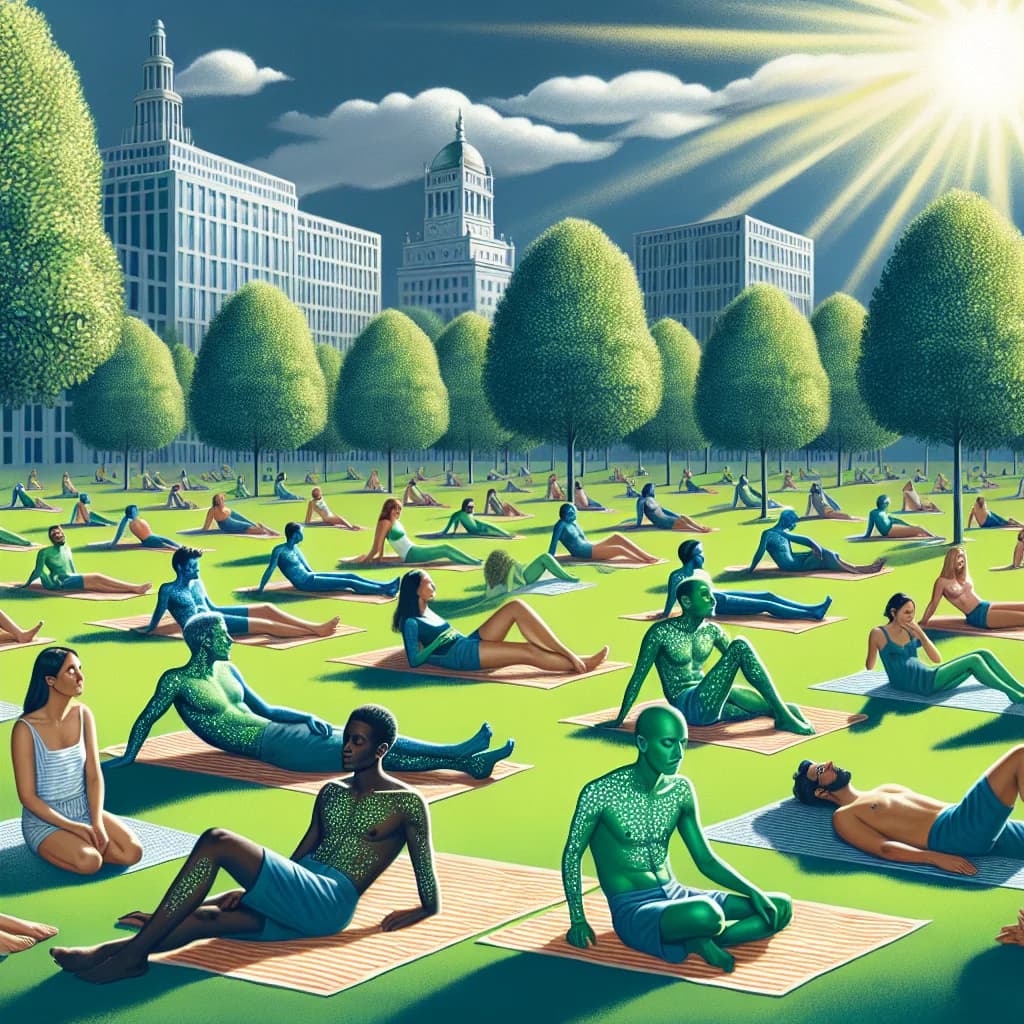
Imagine a world where the lunchtime rush doesn’t involve queuing at a deli, but rather finding a comfortable patch of grass and stretching out your arms. If humans possessed the same emerald-hued, photosynthetic skin as a maple leaf, could we simply bask our way to a full stomach? This whimsical scenario invites us to bridge the gap between botany and human physiology. To determine if we could truly "skip lunch" by sunbathing, we must apply the rigors of thermodynamics, metabolic biology, and solar physics. By calculating human surface area against the efficiency of chlorophyll, we can discover if our dreams of becoming solar-powered primates are scientifically sound or if we are destined to remain hungry in the shade.
The Metabolic Math: What Does Lunch Cost?
Before we can calculate how much sun we need, we have to understand the energy "bill" we are trying to pay. The average adult requires approximately 2,000 to 2,500 kilocalories (kcal) per day to maintain basic functions like breathing, thinking, and moving. If we consider a standard lunch to be roughly 700 kcal—about the size of a hearty turkey sandwich and a side—that is the target our skin needs to hit.
In physics, a kilocalorie is a unit of energy equal to 4,184 Joules. Therefore, to replace a 700-kcal lunch, our photosynthetic skin needs to generate approximately 2.9 million Joules of chemical energy.
The Solar Harvest: Surface Area and Efficiency
To collect this energy, we need "solar panels." In this scenario, that is our skin. The average adult human has a total surface area of about 1.9 square meters (m²). However, unless you are floating in a vacuum with mirrors, you cannot expose your entire body to the sun at once. Even when lying flat, only about 40-50% of your surface area (~0.9 m²) would be directly intercepting sunlight.
Next, we look at the efficiency of photosynthesis. While plants are life-sustaining wonders, they are surprisingly inefficient energy converters. Most plants convert only about 1% to 3% of the sunlight hitting their leaves into usable chemical energy. For this experiment, let’s be generous and grant our hypothetical "Leaf-Man" an optimistic efficiency of 5%.
Crunching the Numbers
- Solar Constant: On a clear day, the sun delivers about 1,000 Watts (Joules per second) per square meter.
- Energy Capture: With 0.9 m² of exposed skin at 5% efficiency, we capture:
- 1,000 W × 0.9 m² × 0.05 = 45 Watts.
- The Time Requirement: To reach our lunch goal of 2,928,800 Joules:
- 2,928,800 Joules ÷ 45 Joules/second = 65,084 seconds.
- 65,084 seconds ÷ 3,600 seconds/hour ≈ 18 hours.
To skip a single lunch, you would need to sunbathe for roughly 18 hours. Given that most places on Earth only receive about 10 to 12 hours of usable daylight, you would be falling behind on your caloric debt before the sun even set.
Biological Barriers and Cascading Consequences
The physics of light is only the first hurdle. If humans were photosynthetic, our entire biology would undergo a radical shift.
The Water Problem
Plants "breathe" through tiny pores called stomata. To take in the carbon dioxide (CO2) necessary for photosynthesis, they must open these pores, which leads to massive water loss through evaporation. For a human to absorb enough CO2 to fuel a 700-kcal "meal," they would need to lose several liters of water through their skin. We would essentially turn into human raisins before we ever finished "eating."
The Mobility Tax
The primary reason plants can survive on photosynthesis is that they don't do much. They don’t have brains that consume 20% of their daily energy, nor do they have muscles that require constant fuel to move. To live on sunlight, a human would likely have to remain completely stationary, becoming a literal "couch potato" in the sun to lower their metabolic rate to a point where the math actually works.
Conclusion: The Reality of the Green Dream
While the idea of skipping the grocery store in favor of a sunny afternoon is charming, the scientific reality is clear: a human would need to sunbathe for nearly 18 hours just to replace a single meal. Our high-energy, warm-blooded lifestyles simply demand more fuel than our relatively small surface area can provide via photosynthesis.
Ultimately, this experiment highlights the incredible efficiency of the natural world. Plants have mastered the art of "living on thin air," while humans have evolved to be high-performance machines that require dense, caloric fuel. While we won't be evolving green skin anytime soon, we can certainly appreciate the sun for providing the energy that grows the lunch we actually get to eat.