If our eyes were a thousand times more sensitive, why would we see every human body glowing in the dark
You aren’t just moving through the darkness—you are actively illuminating it with a hidden, biological radiance. Discover the startling science behind why every human is secretly a living lantern, shimmering with a light our eyes were never meant to see.

Too Long; Didn't Read
Human bodies emit heat in the form of infrared radiation. If our eyes were sensitive enough to detect this specific spectrum, everyone would appear to glow in total darkness due to the thermal energy generated by our internal metabolic processes.
The Invisible Radiance: Why Would Humans Glow if Our Eyes Were 1,000 Times More Sensitive?
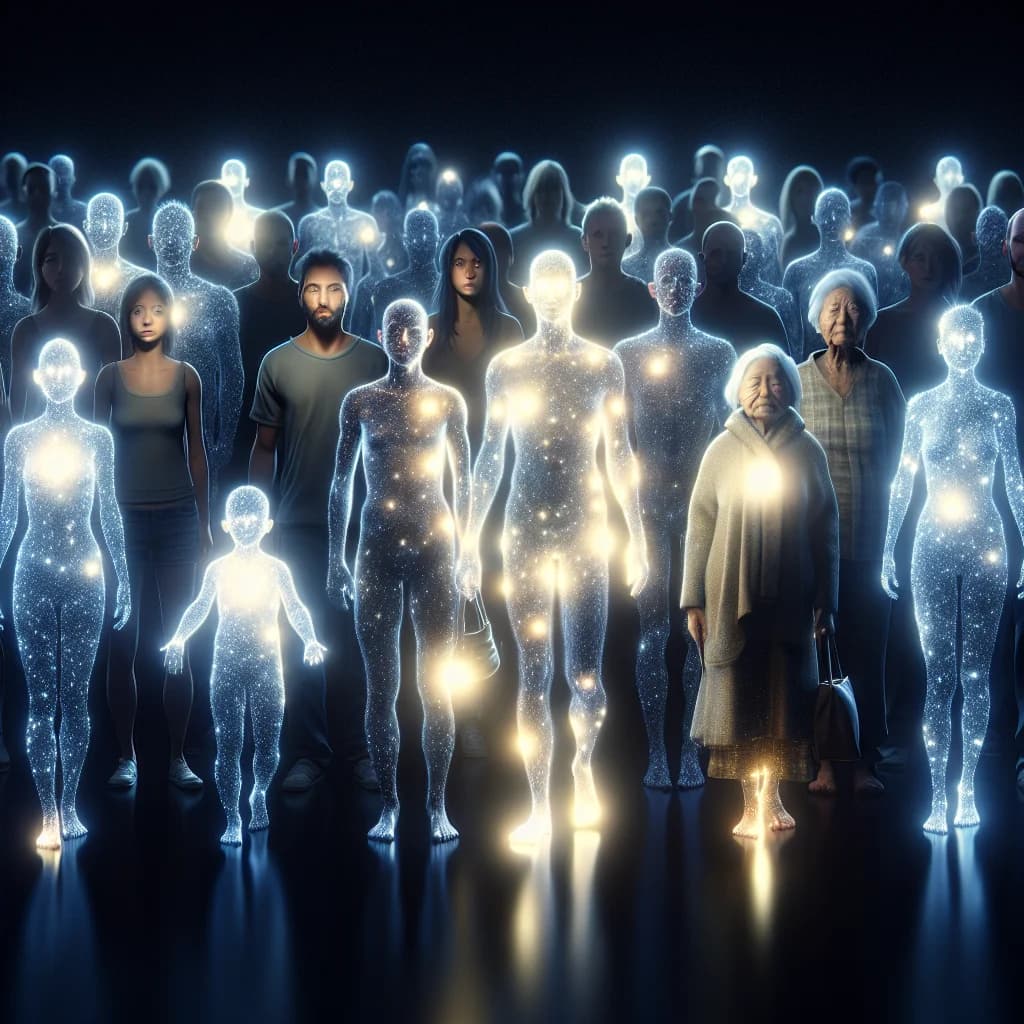
Imagine walking into a perfectly sealed, windowless room in the middle of the night. To your current eyes, it is a void of absolute darkness. But what if your vision were dialed up? What if your retinas were a thousand times more sensitive to the energy surrounding you? Suddenly, the room wouldn't be dark at all. Instead, every person in that room would appear as a soft, shimmering lantern, radiating a gentle light into the shadows.
This isn't science fiction; it is a fundamental consequence of how thermodynamics and biology intersect. To understand why a thousand-fold increase in sensitivity would turn us into walking neon signs, we must look at the physics of blackbody radiation and the curious phenomenon of "biophotons." This thought experiment allows us to explore the hidden energy of the human body through the lenses of thermal physics and quantum biology.
The Human Lightbulb: 100 Watts of Energy
Every object in the universe with a temperature above absolute zero emits electromagnetic radiation. This is known as blackbody radiation. As a biological machine, the human body is constantly converting food into energy to maintain a core temperature of approximately 310 Kelvin (37°C or 98.6°F).
In terms of raw output, the average human body produces about 100 Joules of thermal energy per second—which is exactly 100 Watts. In a sense, you are walking around with the energy output of an old-fashioned incandescent lightbulb. Most of this energy is emitted in the long-wave infrared part of the spectrum. While our eyes are currently tuned to the "visible light" range (roughly 400 to 700 nanometers), a massive increase in sensitivity would allow us to perceive the fringes of this thermal output, effectively seeing the heat "glow" leaking from our skin.
Crossing the Threshold of Biophotons
While infrared heat is the primary way we "glow," there is an even more fascinating reason we would appear luminous: we actually emit visible light right now. Research in the field of quantum biology has confirmed that human cells emit "biophotons"—ultra-weak light particles produced by metabolic chemical reactions.
- The Intensity Gap: These biophotons are about 1,000 times weaker than the sensitivity threshold of the human eye.
- The Metabolic Glow: These emissions are the result of free radicals reacting with lipids and proteins within our cells.
- The Daily Cycle: Interestingly, our "glow" isn't constant; it fluctuates with our biological clock, peaking in the late afternoon.
If our eyes were 1,000 times more sensitive, we wouldn't just see heat; we would see the actual chemical shimmer of our own metabolism. We would essentially be bioluminescent creatures, similar to fireflies or deep-sea jellyfish, though our light would be more of a subtle, ghostly aura than a bright flash.
A New Visual Reality: Seeing Through the Dark
In this hypothetical scenario, the environment would undergo a radical transformation. Here is how the world would look with such heightened sensitivity:
- No More Shadows: Because every human, animal, and even warm piece of furniture would be a light source, "shadows" as we know them would disappear indoors. You would be illuminated by the person standing next to you.
- The Atmosphere as a Filter: At 1,000x sensitivity, the air itself might appear slightly "thick" or hazy due to the scattering of thermal energy and the reflection of biophotons off water vapor.
- Visual Temperature Maps: We would instantly see if someone had a fever or had recently exercised. Areas of high blood flow, like the face and torso, would shine brighter than the extremities, turning every social interaction into a display of thermal dynamics.
Conclusion
If we were to increase our ocular sensitivity by a factor of one thousand, the "dark" would simply cease to exist. We would discover that we have been living in a world of constant radiance all along. This shift in perspective reveals the core scientific truth that humans are not just passive observers of light, but active participants in the electromagnetic environment.
Ultimately, this thought experiment reminds us that our senses provide only a narrow keyhole through which we view the universe. Behind the veil of our biological limitations lies a world where every living thing is a source of energy, shimmering with the heat of life and the subtle sparks of cellular chemistry. We may not see it with our naked eyes, but we are all, quite literally, glowing.