If the atmosphere of Venus were clear, would the extreme pressure let you see your own back
Imagine standing on a world so dense that light itself begins to curve, turning the horizon into a giant, cosmic mirror. Step into the mind-bending physics of Venus to see why its crushing atmosphere might just allow you to stare at the back of your own head.

Too Long; Didn't Read
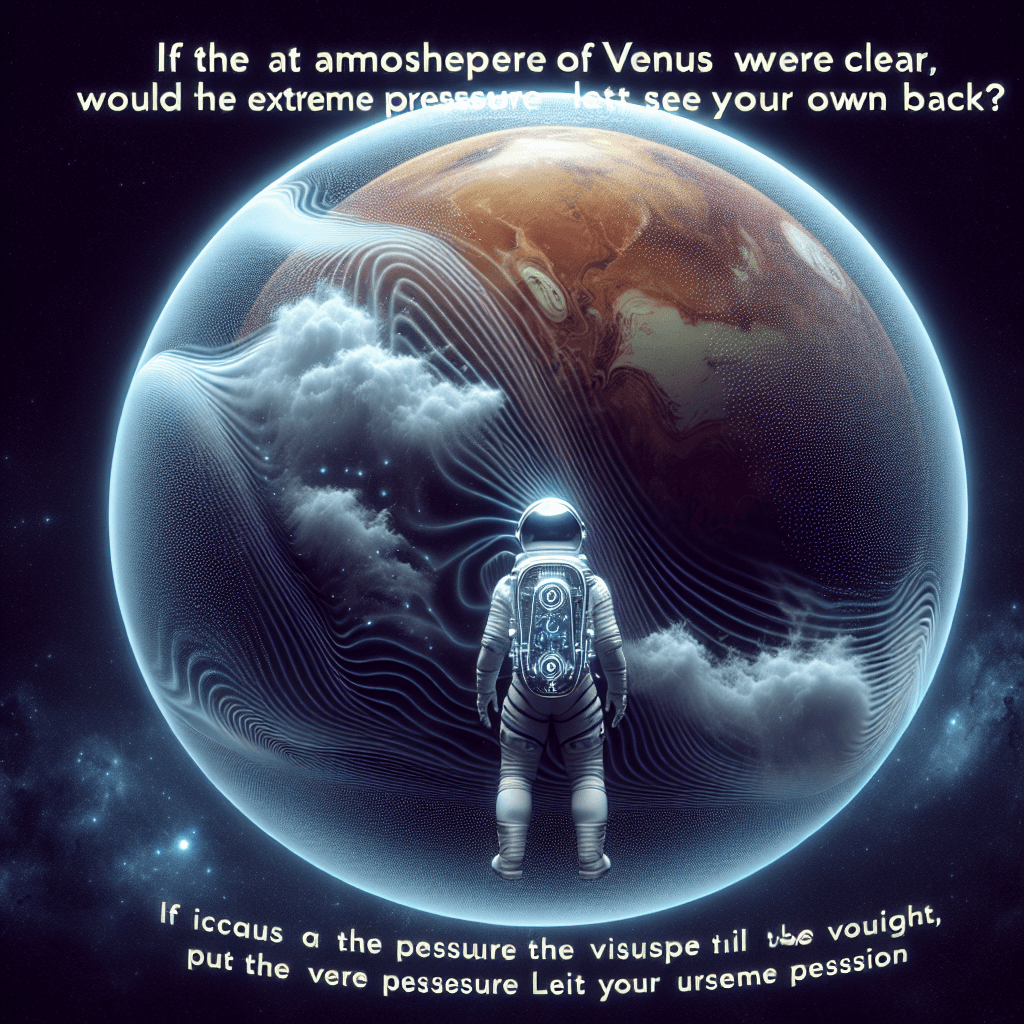
Venus's extreme atmospheric density creates a high refractive index that bends light rays to follow the planet's curvature. If the air were perfectly clear, light reflecting off your back would travel around the entire globe and return to your eyes, theoretically allowing you to see yourself from behind.
Seeing Double on Venus: Would the Extreme Pressure Let You See Your Own Back?
Imagine standing on the surface of Venus. Usually, this is a feat of pure science fiction; the planet is blanketed in thick, choking clouds of sulfuric acid and a carbon dioxide atmosphere so dense it behaves almost like a fluid. But let’s adjust the dial on our cosmic telescope and perform a thought experiment: what if we could peel back those clouds while keeping the atmospheric pressure exactly the same? In this crystal-clear, high-pressure world, would light bend so intensely that it travels all the way around the planet, allowing you to stare at the back of your own head?
To answer this, we must look at the fascinating intersection of atmospheric science, fluid dynamics, and optical physics. Specifically, we will explore how the index of refraction changes under extreme pressure and whether the Venusian "lens" is powerful enough to loop light around a sphere 38,000 kilometers in circumference.
The Physics of Bending Light: Refraction and Density
The core principle at play here is refraction. You’ve seen this in action when a straw looks "broken" in a glass of water. Light changes speed and direction when it moves from one medium to another of a different density.
On Earth, our atmosphere is relatively thin, with a refractive index of approximately 1.0003. This is close enough to a vacuum (1.0000) that light moves in mostly straight lines. However, Venus is a different beast entirely. Its surface pressure is 92 times that of Earth—roughly equivalent to being 900 meters (3,000 feet) underwater.
The Index of Refraction on Venus
The index of refraction ($n$) of a gas is directly related to its density. Because the CO2 on Venus is squeezed so tightly, the atmosphere becomes much "thicker" for light to travel through.
- Earth’s Air Density: ~1.2 kg/m³
- Venus’s Air Density: ~67 kg/m³
In these conditions, the refractive index of the Venusian air at the surface is roughly 1.02. While that 0.02 difference might seem small, in the world of planetary optics, it is massive.
The "Looming" Effect: A World That Curves Upward
In a clear Venusian atmosphere, you wouldn't see a flat horizon. Instead, you would experience an extreme version of a phenomenon called looming. Because the air is densest at the surface and thins out as you go higher, light rays traveling horizontally are constantly bent downward toward the ground.
Creating a Giant Bowl
If you were standing on this "clear" Venus, the light reflecting off the ground far away would be bent back toward your eyes. To your brain, which assumes light travels in straight lines, the ground would appear to curve upward in all directions. Instead of standing on a sphere, it would feel as though you were standing at the very bottom of a vast, shallow bowl that stretches to the sky.
The Ultimate Question: Can Light Complete a Circle?
For you to see the back of your head, a light ray would have to leave your body, travel parallel to the ground, and be bent by the atmospheric density gradient at a rate that exactly matches the curvature of the planet.
- The Planetary Curvature: Venus has a radius of about 6,052 kilometers.
- The Refractive Gradient: For light to "orbit" the planet, the atmosphere would need to bend the light ray by about 1 degree for every 100 kilometers of travel.
Mathematical models of the Venusian atmosphere suggest that the bending of light is indeed extreme. Under the right temperature and pressure gradients, the curvature of a light ray can actually exceed the curvature of the planet itself. This means that, theoretically, light could "loop" around.
The Reality of "Scattering"
However, even if the atmosphere were perfectly clear of clouds, we run into a problem called Rayleigh scattering. This is the same reason Earth’s sky is blue; gas molecules scatter light. In an atmosphere as dense as Venus’s, light would be scattered so many times that it would likely blur into a thick, orange haze long before it completed a trip around the globe. Furthermore, even "clear" CO2 absorbs certain wavelengths of light, meaning the image of your back would likely dim into nothingness within a few dozen kilometers.
Conclusion: A Surreal Optical Frontier
So, would you see your own back? From a strictly geometric standpoint, the extreme pressure on Venus creates a refractive environment where light curves so sharply that the horizon "disappears" into the sky. While the physical bending of light might allow for such a loop, the sheer density of the gas molecules would likely scatter the image into a golden fog before it could reach your eyes from behind.
Ultimately, the thought experiment reveals that Venus is more than just a hot planet; it is a world where the very laws of perspective are rewritten by gravity and pressure. It reminds us that our perception of "straight lines" is a luxury of our thin, Earthly air—a reminder of how unique our own atmospheric window to the universe truly is.