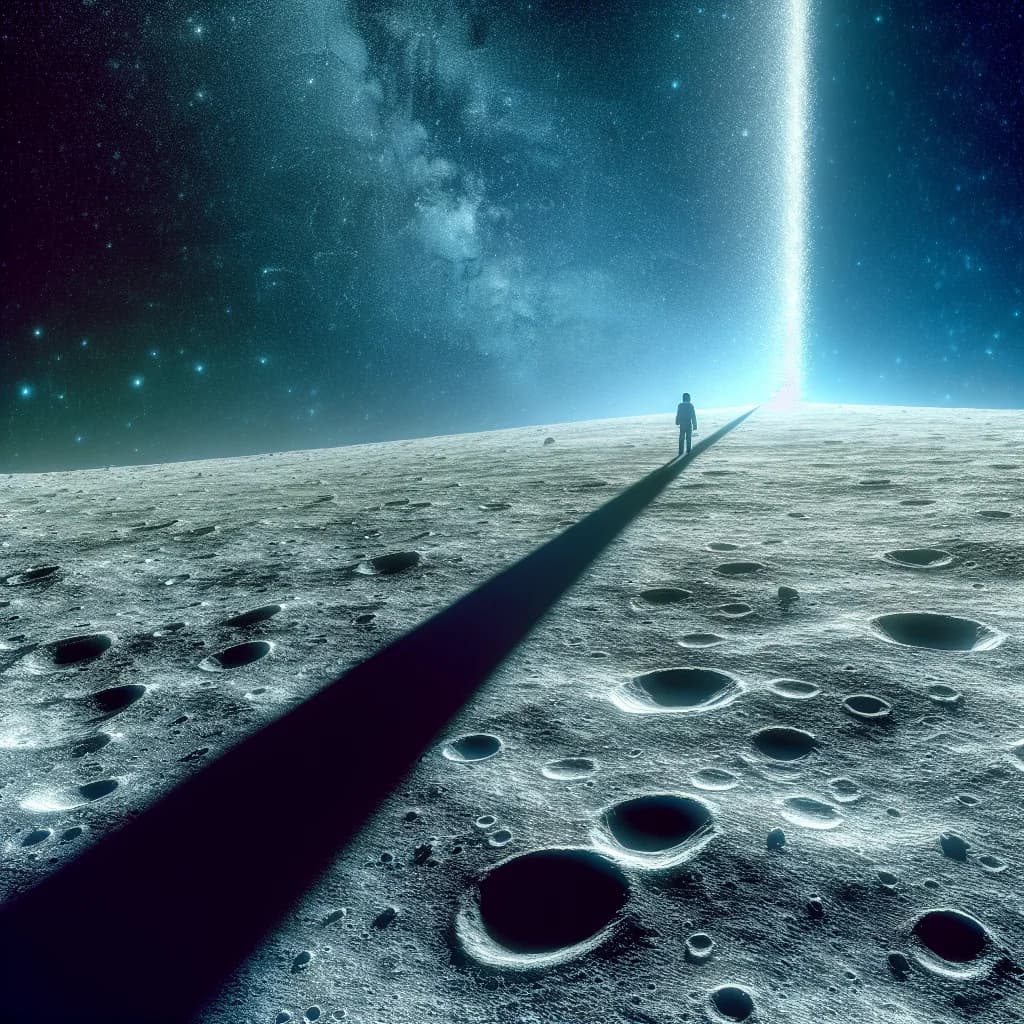
If the Earth had a ring like Saturn, why would it appear as a thin line from the equator
Imagine looking up to see a razor-sharp beam of light slicing the midnight sky perfectly in half. Discover the fascinating celestial geometry that would turn Earth's hypothetical rings into a mysterious, glowing thread for anyone standing on the equator.

Too Long; Didn't Read
From the equator, you would be positioned directly within the same plane as the rings. Because they align with the Earth's midline, you would view them edge-on, making the massive structure appear as a singular, razor-thin line bisecting the sky.
A Ringed Earth: Why Would Our Celestial Crown Look Like a Thin Line from the Equator?
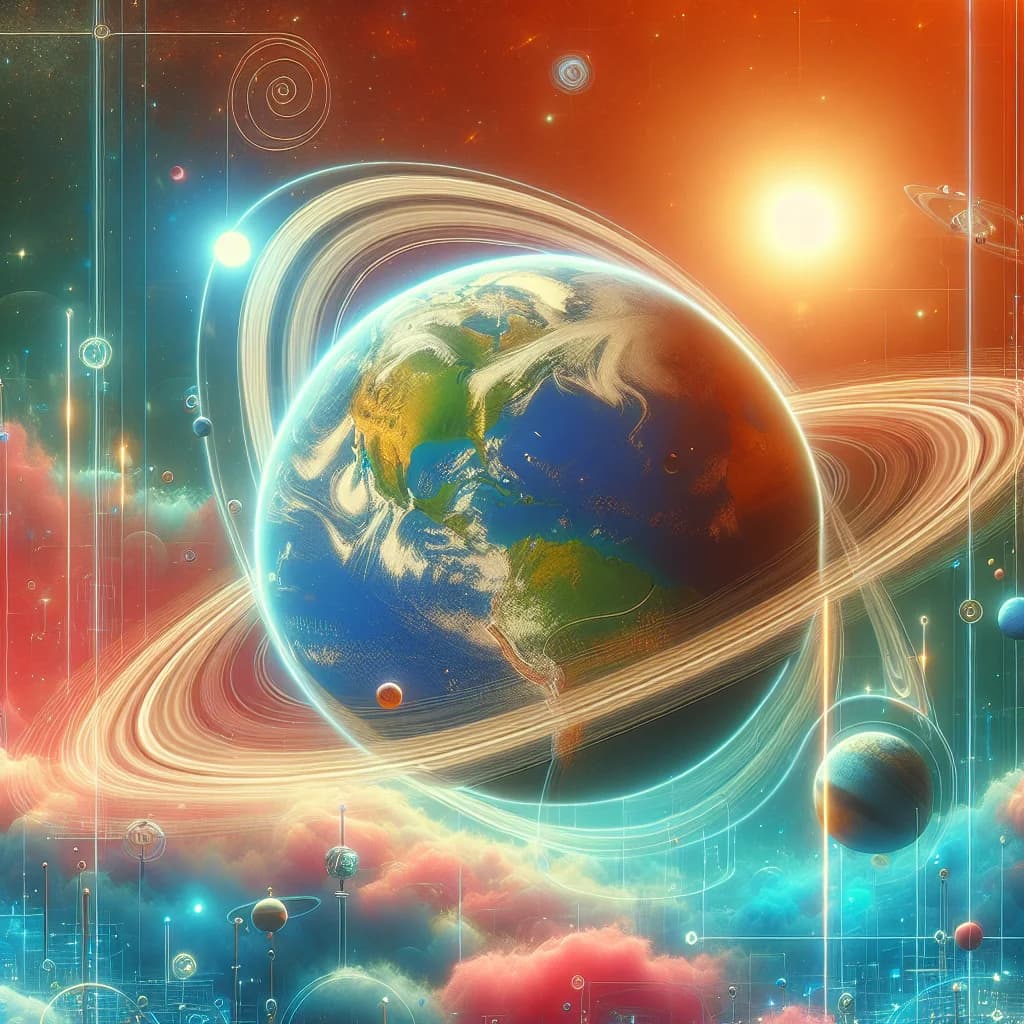
Imagine stepping outside at twilight to see a shimmering, translucent arch stretching from horizon to horizon. For Earth to possess a ring system like Saturn’s, our planet would need to have captured a massive amount of icy debris or seen a small moon wander too close and succumb to tidal forces. While this sounds like the backdrop of a science fiction epic, the physics governing such a system are remarkably grounded. If Earth were adorned with these celestial ribbons, your geographical location would entirely dictate your view. Interestingly, for those living directly on the equator, this massive structure would almost entirely vanish, appearing only as a razor-thin, glowing line bisecting the sky. This phenomenon is a perfect intersection of orbital mechanics, three-dimensional geometry, and the unique gravitational profile of our planet.
The Law of the Equatorial Plane
To understand why the rings would look like a line, we must first understand why they sit where they do. In a rotating system like Earth, gravity isn’t the only force at play. Because the Earth spins, it is not a perfect sphere; it is an "oblate spheroid," meaning it bulges at the center. This equatorial bulge creates a gravitational "sweet spot."
Over millions of years, any debris orbiting at an angle would be tugged by this extra mass at the equator. Through a process of collisions and gravitational settling, the particles eventually move into a stable, circular orbit directly above the equator. In the world of astrophysics, this is known as the equatorial plane. Just as Saturn’s rings are aligned with its equator, Earth’s hypothetical rings would sit like a giant, flat disc surrounding our midsection.
The Geometry of Perspective: The "Edge-On" Effect
The reason the rings would appear as a thin line from the equator is a matter of simple perspective. Think of the rings as a colossal, flat vinyl record or a sheet of paper.
- From the North or South Poles: You wouldn't see the rings at all because they would be hidden below the horizon.
- From Mid-Latitudes (like New York or Paris): You would see a wide, majestic arch filling the sky, as you are looking at the "face" of the disc from an angle.
- From the Equator: You are standing exactly on the same plane as the rings.
When you look straight up from the equator, you are looking at the "edge" of the disc. Because the rings are incredibly wide but remarkably thin, they lose their surface area from your vantage point. It is exactly like holding a piece of paper vertically at eye level; the broad surface disappears, leaving only the thin edge visible.
Calculating the Scale of the Needle
To visualize this, consider the dimensions of Saturn’s rings. While they span roughly 280,000 kilometers in width, they are often as thin as 10 to 100 meters in some places. If we applied a similar ratio to Earth:
- Width: The rings might extend from a few thousand kilometers above the atmosphere out to the Roche Limit (roughly 15,000 to 20,000 kilometers away).
- Thickness: Despite that massive width, the vertical depth would likely be less than the height of a small skyscraper.
If you stood in Quito, Ecuador, and looked up, you would be trying to see a structure that is only a few dozen meters thick but situated thousands of kilometers away. The result would be a blindingly bright, incredibly narrow silver filament that appears to cut the moon and stars in half.
Cascading Consequences of a Ringed World
While the view would be breathtaking, the physical presence of a ring system would introduce fascinating atmospheric and environmental shifts.
- The Great Shadow: The rings would cast a permanent, massive shadow on the hemisphere experiencing winter. This would result in significantly colder winters and might even affect global weather patterns by altering how sunlight hits the atmosphere.
- Navigation and Light: Before the age of electricity, the night sky at mid-latitudes would be much brighter due to "ring-light" (sunlight reflecting off the ice and rock). However, for those at the equator, the "line" would provide very little ambient light.
- Space Travel Challenges: Launching satellites or rockets would become a mathematical gauntlet. To avoid "Kessler Syndrome"—a cascade of high-speed collisions—space agencies would have to navigate through gaps in the rings or launch from polar regions to avoid the debris field.
Conclusion
The transformation of Earth into a ringed planet would turn our sky into a masterclass in geometry. The "thin line" visible from the equator is the ultimate proof of how orbital mechanics forces celestial objects into a state of equilibrium. It reminds us that our perspective of the universe is entirely dependent on where we stand. While we may not have a shimmering crown of ice and dust, understanding the physics of Saturn’s rings allows us to appreciate the delicate gravitational dance that keeps our own moon in orbit and our planet’s orientation stable. Our world remains a place of wonder, whether our beauty comes from a ribbon in the sky or the blue marble beneath our feet.