If the Earth stopped spinning instantly, would everyone at the equator be launched horizontally at supersonic speeds
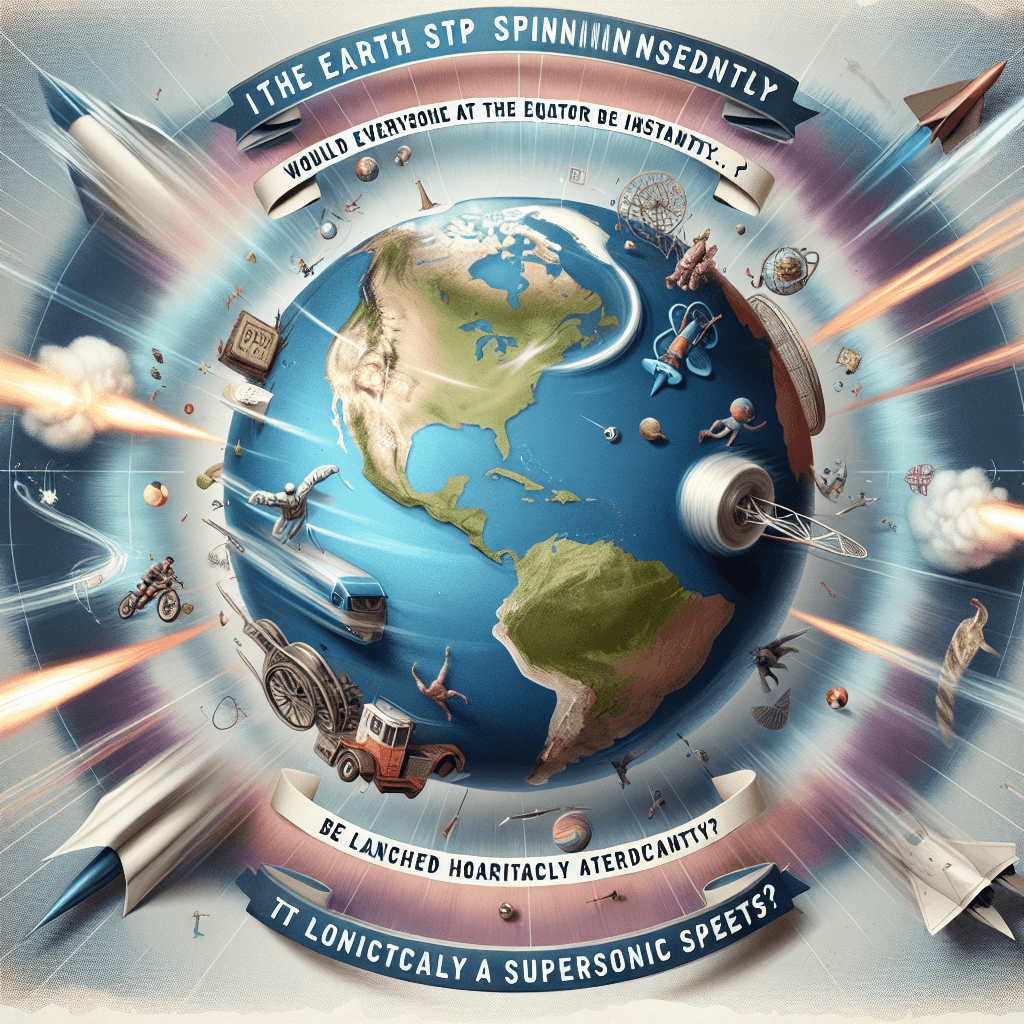
If the Earth hit the brakes today, you wouldn’t just fall over—you’d become a supersonic projectile hurtling toward the horizon at over 1,000 miles per hour. Discover the terrifying reality of Newton’s first law and why a sudden planetary stop would turn the equator into a terminal slingshot.

Too Long; Didn't Read
Yes, because of inertia, everything on the surface would continue moving at the planet's previous rotational velocity. At the equator, people and objects would be flung eastward at roughly 1,000 mph, resulting in supersonic horizontal travel and immediate, catastrophic destruction as the atmosphere and unattached objects slam into the suddenly stationary ground.
The Supersonic Slide: If Earth Stopped Spinning Instantly, Would We Be Launched Into Space?
Imagine, for a moment, that the Earth is a high-speed merry-go-round hurtling through the cosmic playground. We don’t feel the movement because everything—the ground, the air, and even the clouds—is moving at the same steady pace. But what happens if a giant, invisible hand suddenly grabbed the planet and brought its rotation to a dead stop in a single millisecond? This classic scientific "what if" takes us to the intersection of classical mechanics and atmospheric science. In this exploration, we will use the principles of Newtonian physics and kinematics to determine if a person at the equator would truly experience a horizontal, supersonic launch. The answer lies in the relentless power of inertia and the sheer scale of our planet’s rotational velocity.
The Speed of Our Unseen Journey
To understand the consequences of a sudden stop, we must first calculate how fast we are currently moving. While you might feel stationary while reading this, you are actually a passenger on a rotating sphere of massive proportions.
At the equator, the Earth’s circumference is approximately 40,075 kilometers (24,901 miles). Since the planet completes one full rotation every 24 hours, any point on the equator is moving at a speed of roughly 1,670 kilometers per hour (1,037 mph). For context, the speed of sound at sea level is approximately 1,235 km/h (767 mph). This means that every person, tree, and building at the equator is currently traveling at approximately Mach 1.3.
Newton’s First Law: The Great Launcher
The primary scientific principle at play here is Inertia, as defined by Newton’s First Law of Motion: an object in motion stays in motion with the same speed and in the same direction unless acted upon by an external force.
If the Earth stops instantly, the "external force" is acting on the planet’s crust, but not necessarily on the objects resting on top of it. Here is the physical breakdown of that moment:
- Kinetic Energy Transfer: You are currently moving at 1,670 km/h eastward. If the ground beneath you stops, your body—which possesses significant momentum—will continue to move eastward at that same velocity.
- The Trajectory: You wouldn't fly straight up into space. Instead, you would be "launched" horizontally, tangent to the Earth's curve.
- The Comparison: This is exactly what happens when a car traveling at high speed hits a wall; the passengers continue moving forward. In this scenario, the "car" is the Earth, and the "passengers" are everything on its surface.
Atmospheric and Oceanic Chaos
The physical displacement isn't limited to solid objects. The Earth’s atmosphere and oceans also possess momentum. The resulting environmental shifts would be immediate and profound:
- Supersonic Winds: The air would not stop with the ground. It would continue to move at 1,670 km/h, creating winds far more powerful than any recorded hurricane. These winds would cause a massive redistribution of surface features.
- Oceanic Bulge Displacement: Due to the Earth’s rotation, water currently "bulges" at the equator. If the rotation stopped, the oceans would migrate toward the poles where gravity is slightly stronger, resulting in a massive, global-scale aquatic relocation.
- Kinetic Heating: The friction between the stationary ground and the fast-moving atmosphere would generate a significant amount of heat, momentarily altering the thermal profile of the planet's surface.
Why We Wouldn't Reach Orbit
While being launched at Mach 1.3 sounds like a ticket to the stars, it is nowhere near the speed required to leave the planet. To escape Earth’s gravity and enter orbit, an object must reach escape velocity, which is approximately 40,270 km/h (25,020 mph).
Our equatorial launch speed of 1,670 km/h is only about 4% of the speed needed to reach space. Consequently, while any object would be displaced horizontally with incredible force, gravity would quickly pull it back toward the surface, resulting in a very brief, very fast trip across the horizon.
Conclusion
If the Earth stopped spinning instantly, the laws of inertia dictate that everyone at the equator would indeed be launched horizontally at supersonic speeds. Traveling at Mach 1.3, you would briefly become a high-speed projectile moving eastward across a suddenly stationary landscape. This scenario highlights the staggering amount of kinetic energy stored in our planet’s daily rotation—energy that we rarely consider because we are part of the system.
Ultimately, this thought experiment serves as a fascinating reminder of the delicate physical balance that governs our lives. We are constant travelers on a massive, spinning vessel, held in place by gravity and moving in perfect harmony with the atmosphere. It is the steady, unchanging nature of this motion that allows us to perceive our world as still and silent.