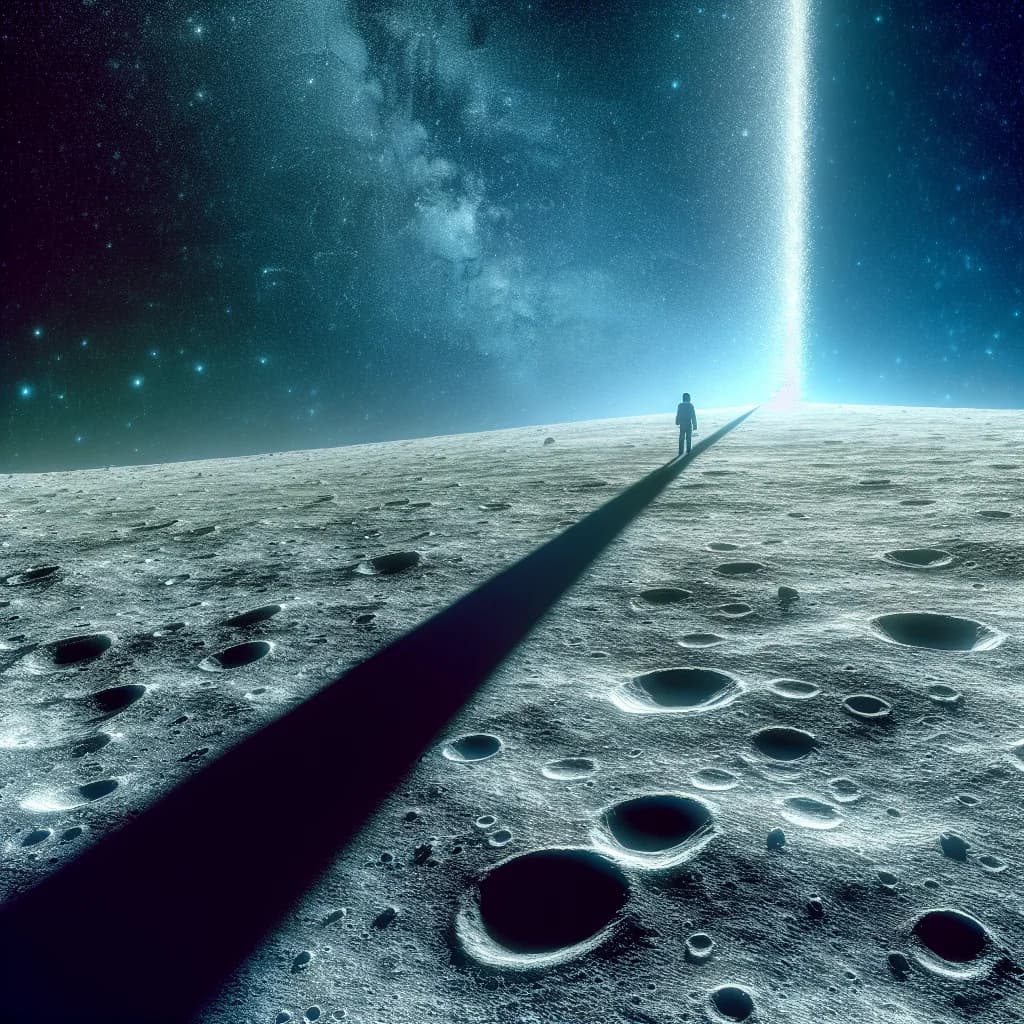
If the Earth were a hollow shell, why would you float weightlessly anywhere inside it
Step inside a hollow Earth and discover why gravity would suddenly lose its grip, leaving you drifting in a weightless void. This mind-bending dive into the "Shell Theorem" reveals why, once you’re on the inside, there is no such thing as down.


Too Long; Didn't Read
According to Newtons shell theorem, the gravitational pull from all sides of a hollow sphere cancels out perfectly. While you are closer to one part of the shell, the smaller amount of mass nearby is exactly balanced by the much larger mass of the more distant side, resulting in a net gravitational force of zero everywhere inside.
The Shell Theorem Mystery: Why Would You Float Weightlessly Inside a Hollow Earth?
Imagine stepping through a hatch in the Earth’s crust and entering a vast, hollow interior. Rather than plummeting toward the distant "floor" or being pulled toward the inner surface, you find yourself drifting effortlessly in a state of perfect weightlessness. This isn't just a scene from a vintage science fiction novel; it is a rigorous conclusion drawn from classical physics.
To explore this scenario, we must assume a "Spherical Shell" model: an Earth that is a perfectly uniform, hollow sphere of mass. In this thought experiment, we will apply the principles of Newtonian mechanics—specifically the Shell Theorem and the inverse-square law of gravity—to explain why the interior of such a world would be the ultimate zero-gravity playground.
The Magic of Newton’s Shell Theorem
In 1687, Sir Isaac Newton published his Principia, where he mathematically proved a phenomenon now known as the Shell Theorem. This theorem describes how spherical objects exert gravitational force. While the theorem confirms that a solid sphere acts as if all its mass is concentrated at its center, it also provides a surprising second conclusion:
Inside a uniform hollow shell of matter, the net gravitational force exerted by the shell on any object inside it is exactly zero.
This means that whether you are floating at the very center of the hollow Earth or drifting just inches away from the inner crust, you would experience complete weightlessness. You wouldn't be "pulled" in any direction; you would simply hover.
The Balancing Act of Geometry
At first glance, this seems counterintuitive. If you are standing closer to the "north wall" of the hollow shell, shouldn't its mass pull you toward it? To understand why this doesn't happen, we have to look at the relationship between mass, distance, and gravity.
- The Inverse-Square Law: Gravity follows an inverse-square law ($F = G \frac{m_1 m_2}{r^2}$). If you double your distance from a mass, its pull becomes four times weaker.
- The Tug-of-War: Imagine you are floating near the inner surface of the shell. Yes, the patch of shell directly "below" you is very close, exerting a strong pull. However, the rest of the entire planet is "above" you.
- Area vs. Distance: Even though the far side of the shell is much further away, there is significantly more of it. Mathematically, the area of the shell on the far side increases at the exact same rate that the gravitational intensity decreases.
The "close" mass pulls you with great intensity but represents a small area. The "far" mass pulls you with low intensity but represents a massive area. In a perfect sphere, these two forces cancel each other out with 100% precision at every single point inside the void.
Visualizing the Scale
To put this in perspective, consider the Earth’s mass, which is approximately $5.97 \times 10^{24}$ kilograms. If all that mass were concentrated into a shell about 50 miles thick, the interior would be a vacuum (or air-filled) space roughly 7,800 miles wide.
- Compared to the ISS: On the International Space Station, astronauts feel weightless because they are in "free fall" while orbiting. Inside our hollow Earth, you would be truly weightless while remaining stationary.
- The Atmosphere: If this hollow shell were filled with air, you would experience a "ball of sky" larger than any ocean. Because there is no gravity to pull the air down, the atmospheric pressure would be uniform throughout the entire interior. You could "fly" from one side of the world to the other simply by swimming through the air.
Physical Consequences and Stability
While you would float weightlessly, the environment would be remarkably calm. Because the net gravitational force is zero, there are no "tides" or "downward" pulls to create weather patterns as we know them. However, this stability only exists because of the perfect symmetry of the sphere. If the Earth were slightly lopsided or if a large mountain range existed on the outer crust, the symmetry would break, and you might feel a very slight, infinitesimal "tug" toward the heavier side.
Conclusion
The thought experiment of a hollow Earth reveals the staggering elegance of physical laws. If our planet were a hollow shell, the internal gravitational forces would engage in a perfect cosmic stalemate, leaving any inhabitant in a state of permanent, graceful buoyancy. This phenomenon is dictated by the Shell Theorem, proving that geometry and gravity are inextricably linked.
While we know our Earth is actually a dense, layered sphere with a molten core, exploring these "what if" scenarios allows us to appreciate the precision of the universe. It reminds us that gravity isn't just a force that pulls us down—it is a complex interaction of mass and distance that, under the right conditions, can let us fly.