If the Earth were made entirely of water, why would the core consist of solid ice hotter than fire
Imagine a planet of pure water where the center isn’t a boiling sea, but a core of solid ice burning hotter than a furnace. Discover the mind-bending physics of exotic matter that defies everything you thought you knew about the relationship between fire and ice.

Too Long; Didn't Read
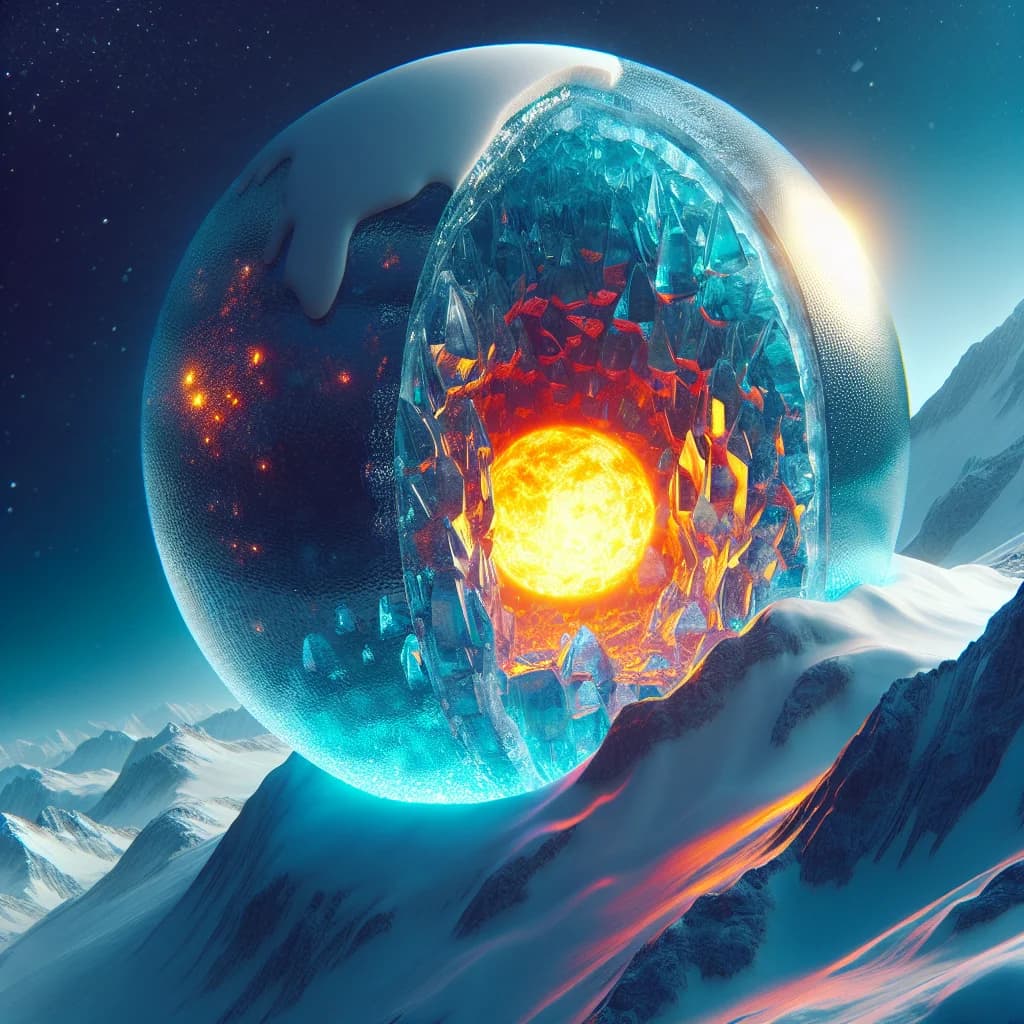
Enormous gravitational pressure at the center of a water-only Earth would compress liquid into a solid crystalline state. This high-pressure ice remains solid despite temperatures reaching thousands of degrees, resulting in a core of hot ice far hotter than fire.
The Water World Paradox: Why Would an Earth of Liquid Water Have a Core of Solid, Glowing Ice?
Imagine a planet with no continents, no mountains, and no seafloor—just a shimmering, blue sphere of pure H2O suspended in the cosmos. At first glance, this "Water Earth" seems like the ultimate tropical paradise. However, as we dive deeper into the physics of this hypothetical world, we encounter a reality that defies our everyday intuition. At the very center of this massive drop of water, we wouldn’t find a liquid abyss; instead, we would find a core of solid ice that is literally hotter than a roaring flame.
To understand this atmospheric anomaly, we must look beyond our kitchen freezer and into the realms of high-pressure physics and thermodynamics. By applying the laws of planetary gravitation and analyzing the phase diagrams of water, we can uncover how nature forces molecules into a solid state even when they are scorching hot.
The Crushing Weight of a Global Ocean
On our actual Earth, the pressure increases as you dive deeper into the ocean. For every ten meters of depth, the pressure increases by about one atmosphere. Now, imagine an ocean that isn't just 11 kilometers deep like the Mariana Trench, but stretches 6,371 kilometers to the very center of the planet.
In a sphere of water the size of Earth, the cumulative weight of the outer layers pressing down on the center would be staggering. Scientists estimate that the pressure at the core of such a world would exceed 2 million atmospheres (over 200 Gigapascals). To put that in perspective:
- It is equivalent to balancing the weight of the entire Great Pyramid of Giza on a single postage stamp.
- It is roughly 2,000 times the pressure found at the bottom of the deepest trench in our current oceans.
The Secret of "Hot Ice": Phase VII and Beyond
In our daily lives, ice only exists at or below 0°C (32°F). If you heat it, it melts. However, water behaves very differently under extreme pressure. Physicists use a phase diagram to map out the state of water under various temperatures and pressures.
When you subject water to the immense gravitational pressure of a planetary core, the molecules are squeezed so tightly together that they can no longer move freely as a liquid. They are forced into a rigid, crystalline structure—a solid.
Meet Ice VII and Ice X
This isn't the fluffy white snow you find on a mountain. Under the conditions of our hypothetical Water Earth, we would likely find exotic forms of ice known as Ice VII or Ice X.
- Ice VII is a cubic crystalline form of water that remains solid even at temperatures above 500°C.
- Ice X (Superionic Ice) is even more extreme. In this state, oxygen atoms form a rigid lattice while hydrogen ions move freely through the structure, allowing it to conduct electricity like a metal.
Why Is the Core Hotter Than Fire?
If the planet is made of water, where does the heat come from? The answer lies in gravitational potential energy.
- Heat of Formation: As this massive sphere of water formed, the gravitational collapse of the water inward would generate incredible amounts of heat.
- Adiabatic Compression: Just as a bicycle pump gets hot when you compress air, the extreme compression of water at the core would raise its temperature significantly.
The temperature at the center of a Water Earth would likely soar to between 2,000°C and 4,000°C (3,600°F to 7,200°F). For context, a typical wood fire burns at about 600°C, and the surface of a blowtorch flame reaches roughly 1,300°C. This core would be a glowing, white-hot solid, held in a crystalline "grip" by the sheer weight of the ocean above it.
The Environmental Consequences of a Water World
A planet made entirely of water would not support a "normal" environment. Without a rocky core to generate a magnetic field (the magnetosphere), the planet would be constantly bombarded by solar radiation. Furthermore, the absence of minerals and land would mean:
- No Nutrient Cycling: Without rocks to erode, the water would lack the essential minerals needed for life as we know it.
- Atmospheric Stability: The vast surface area of water would lead to an incredibly thick atmosphere dominated by water vapor, potentially creating a runaway greenhouse effect.
Conclusion
The hypothetical "Water Earth" serves as a stunning reminder that the laws of physics often produce results that seem like science fiction. While we think of ice as cold and fire as the destroyer of solids, the crushing gravity of a planetary mass flips these rules on their head. The core of such a world would be a testament to the power of pressure: a solid, crystalline heart of ice, glowing with heat that rivals the stars.
This thought experiment isn't just a fantasy; it helps astronomers understand "Ice Giant" exoplanets discovered in far-off solar systems. It reminds us that our own Earth, with its perfect balance of rock, metal, and liquid water, is a truly unique and finely tuned home in a universe of extreme possibilities.