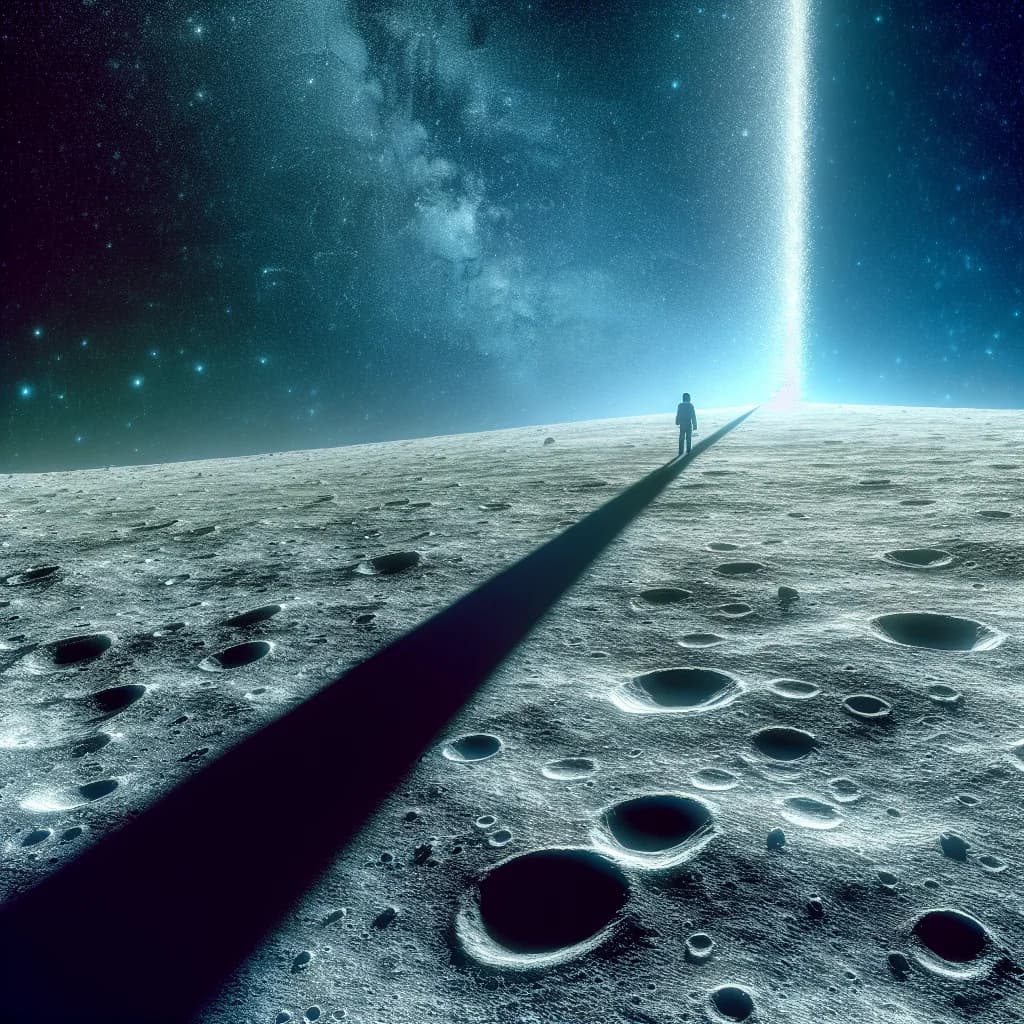
If the Earth were perfectly hollow, would you experience zero gravity at every point inside the cavity
Step inside a perfectly hollow Earth and prepare for a reality where the laws of gravity seem to vanish into thin air. Discover the mind-bending physics behind why you’d find yourself weightlessly floating at any point within the cavity, no matter how close you are to the edge.

Too Long; Didn't Read
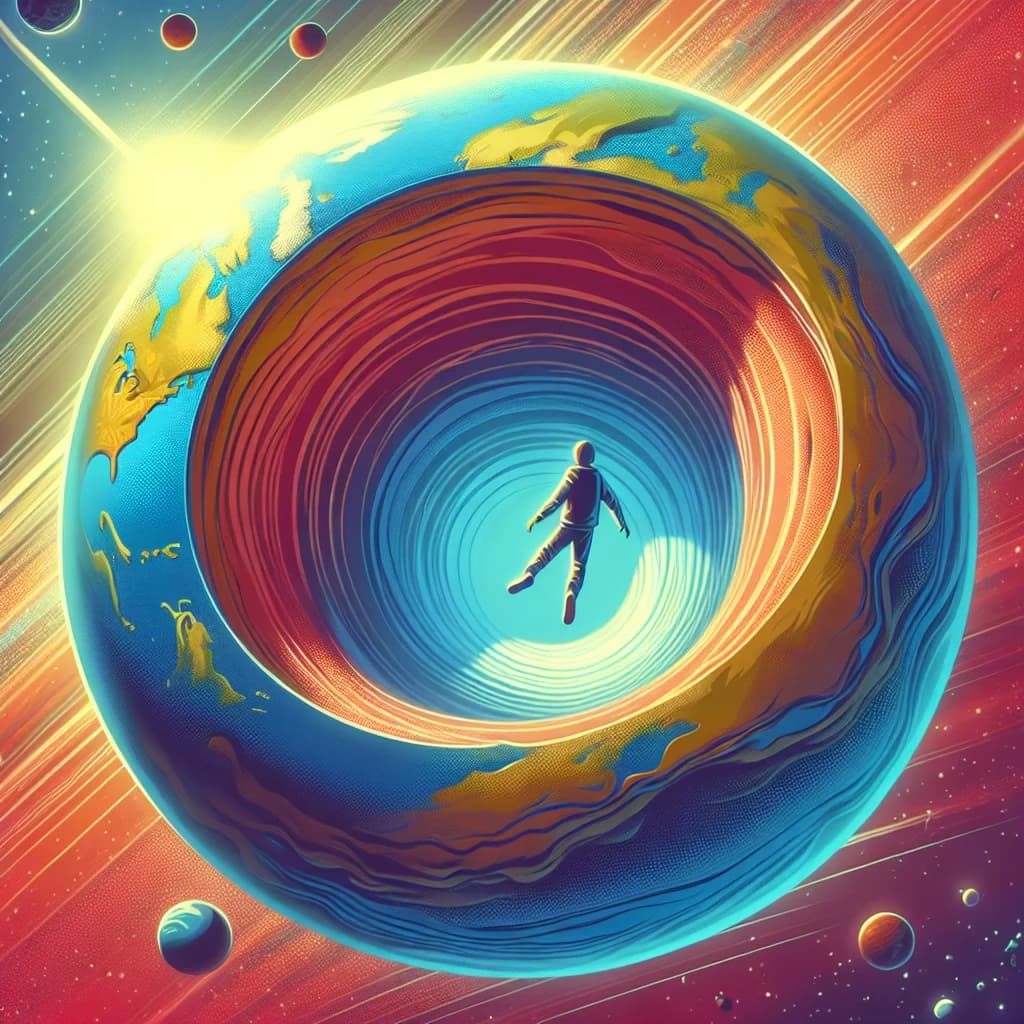
Yes, according to Newton's shell theorem, the gravitational pull from all parts of a uniform spherical shell cancels out perfectly, meaning you would experience zero net gravity at every point inside the hollow interior.
The Weightless Void: Would You Float Anywhere Inside a Perfectly Hollow Earth?
Imagine for a moment that the Earth isn’t a dense ball of iron, nickel, and rock, but rather a giant, cosmic geode—a thin, perfectly spherical shell of matter surrounding a vast, empty interior. If you were to step inside this planetary cavern, would you fall toward the inner surface, or would you drift aimlessly like an astronaut in deep space? While our intuition might suggest that the massive shell would pull you toward its nearest wall, the laws of classical mechanics tell a much more surprising story.
To solve this mystery, we must look to the foundational principles of physics, specifically Newton’s Law of Universal Gravitation and a mathematical gem known as the Shell Theorem. By analyzing these frameworks, we can determine exactly how gravity behaves within a hollowed-out world.
The Shell Theorem: Newton’s Mathematical Masterpiece
The answer to our question lies in a discovery made by Sir Isaac Newton in the 17th century. Newton proved that for a perfectly symmetrical, hollow spherical shell of uniform density, the net gravitational force exerted on any object inside the cavity is exactly zero.
This means that whether you are floating directly in the center of the Earth or hovering just a few inches away from the inner crust, you would experience complete weightlessness. This isn't because gravity has "disappeared," but because the gravitational pulls from every direction are in a state of perfect, mathematical equilibrium.
The Great Gravitational Tug-of-War
It seems counterintuitive. If you are standing near the "inner ceiling" of a hollow Earth, wouldn't that massive wall of rock just above your head pull you toward it?
To understand why it doesn't, we have to look at how gravity changes with distance and mass:
- Proximity vs. Mass: When you are close to one side of the shell, that specific patch of matter exerts a stronger pull on you because you are nearby.
- The Inverse Square Law: Gravity weakens with the square of the distance. However, as you move toward one side of the shell, the amount of mass on the far side of the shell occupies a much larger area of your "gravitational horizon."
- The Perfect Balance: Mathematically, the increase in proximity to one side is perfectly canceled out by the sheer volume of mass on the distant, opposite side. For every kilogram of rock pulling you "up," there is a corresponding distribution of rock on the other side of the planet pulling you "down" with equal total force.
Visualizing the Scale
To put this into perspective, imagine the hollow Earth has a radius of about 6,371 kilometers (3,958 miles). If you were floating 1,000 kilometers away from the center, you would be much closer to one "wall" than the other. In any other scenario, this would result in a massive lopsided pull. But in a perfect sphere, the "far" side of the Earth—thousands of kilometers away—is so much larger in your field of view that its cumulative pull keeps you perfectly suspended. It is a cosmic stalemate that persists at every single point within the void.
Life in the Great Interior
If the Earth were hollow and we were suspended inside it, the environmental consequences would be fascinatingly serene. Without a gravitational "down," there would be no atmospheric layering as we know it.
- Atmospheric Uniformity: Unlike our current atmosphere, which is densest at sea level due to gravity, the air inside a hollow Earth would distribute itself evenly throughout the cavity.
- The Absence of Pressure: Because there is no net gravitational force pulling the air toward a core, the "crushing" pressures found at the center of the real Earth would be non-existent. You would effectively be living in a giant, spherical room of room-temperature, low-pressure air.
- Movement: Moving from one side of the planet to the other would require nothing more than a gentle push off the inner wall, sending you on a long, slow drift across the diameter of the world.
Conclusion
The scientific reality of a hollow Earth is a testament to the elegant balance of the universe. According to Newton’s Shell Theorem, a perfectly hollow, spherical Earth would create a sanctuary of zero gravity throughout its entire interior. The gravitational forces, while massive in their own right, would essentially "delete" one another through a flawless symmetry of distance and mass.
While we know our Earth is solid and bustling with a molten core, this thought experiment highlights the incredible precision of physical laws. It reminds us that gravity isn't just a force that pulls us down; it is a complex interaction of geometry and matter that defines the very shape of our reality. Whether on the surface or in a hypothetical void, we are always subject to the beautiful, balanced math of the cosmos.