If the Earth were suddenly replaced by blueberries, would gravity instantly collapse it into a sphere of jam
Imagine the world suddenly transformed into a giant pile of fruit—only for gravity to instantly crush it into a boiling, pressurized sphere of cosmic jam. Dive into the mind-bending physics of this deliciously catastrophic scenario and find out why a "blueberry Earth" would be anything but sweet.

Too Long; Didn't Read
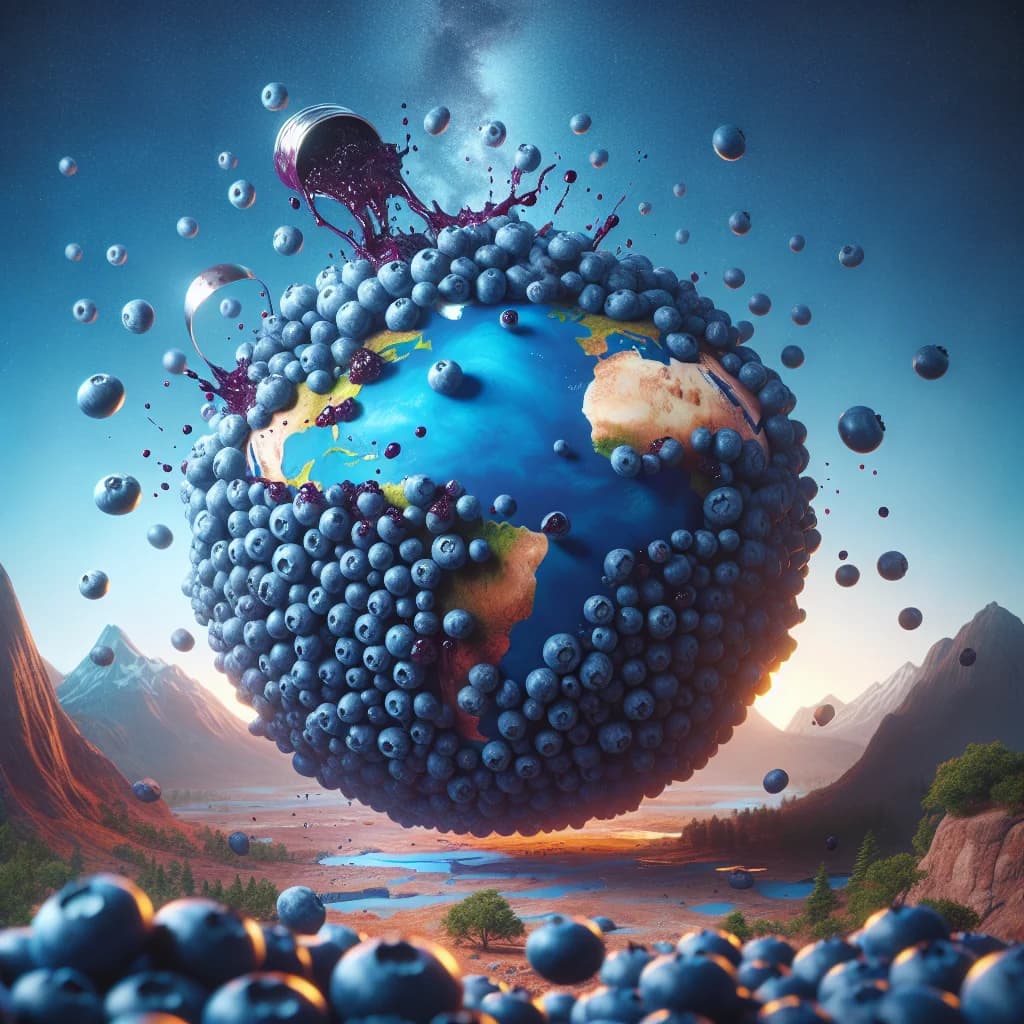
If Earth were suddenly replaced by blueberries, gravity would immediately crush the fruit into a giant sphere of jam. The air trapped between the berries would be forced out to create a massive atmosphere, while the intense internal pressure would generate extreme heat, turning the planet into a boiling, pressurized ocean of berry pulp and juice.
Could the Earth Turn Into a Sphere of Jam? The Physics of a Blueberry Planet
Imagine waking up and finding that every tectonic plate, every mountain range, and even the molten iron core of our planet has been instantaneously replaced by fresh, plump blueberries. While it sounds like the premise of a whimsical children’s book, this scenario offers a fascinating opportunity to apply the rigorous laws of physics to a truly "fruitful" thought experiment. To analyze this transformation, we must step away from biology and look toward planetary science, hydrostatic equilibrium, and thermodynamics. By calculating the mass, density, and gravitational forces of a fruit-based world, we can determine whether our home would remain a giant berry patch or collapse into a cosmic bowl of jam.
The Great Density Deficit
The most immediate change in a blueberry-flavored Earth would be its mass. The Earth is a dense, rocky world composed primarily of iron and silicates, with an average density of about 5,514 kilograms per cubic meter (kg/m³). Blueberries, being mostly water and air, have a density much closer to 1,000 kg/m³, though they are less dense than water because of the air gaps between individual berries.
If we replace the Earth's volume with blueberries while maintaining the same radius, the consequences are staggering:
- Mass Reduction: The new "Blueberry Earth" would possess only about one-fifth the mass of the original planet.
- Gravity Shift: Because gravity is directly proportional to mass, the surface gravity would drop significantly. You would find yourself weighing about 80% less, allowing for spectacular, moon-like leaps across the purple landscape.
- Atmospheric Expansion: With lower gravity to hold it down, the atmosphere would expand outward, becoming much thinner at the surface.
From Fruit to Fluid: The Hydrostatic Collapse
While a giant pile of fruit sounds stable, gravity is a relentless architect. On a planetary scale, materials do not behave like they do in a grocery store. This leads us to the phenomenon of hydrostatic equilibrium.
In a pile of berries the size of a planet, the berries at the center would be supporting the weight of all the berries above them. Even with the reduced gravity of our new world, the pressure at the core would be immense—millions of times higher than the structural strength of a blueberry skin.
The Transition to Jam
Within seconds of the transformation, the following sequence would likely occur:
- Crushing: The berries at the core and mantle levels would instantly burst, releasing juice and pulp.
- Compaction: The air pockets between the berries (which account for a significant portion of a bulk berry pile's volume) would be squeezed out.
- Radial Contraction: As the air is forced out and the berries turn into a liquid state, the entire planet would shrink. This "Blueberry Earth" would collapse inward by hundreds of miles as it settles into a more compact, pressurized sphere.
Thermodynamics and the "Warm Jam" Effect
One of the most surprising outcomes of this experiment involves heat. When you take a massive volume of air and fruit and suddenly compress it under gravitational force, you generate significant thermal energy. This is similar to how a bicycle pump gets hot when you compress air quickly.
As the planet collapses into a sphere of jam, the gravitational potential energy is converted into heat. This wouldn't result in a frozen fruit dessert; instead, the internal temperatures would rise sharply. The core of our blueberry world would likely become a pressurized, hot puree. The "jam" would be thick and opaque, and the surface might even see "geysers" of blueberry steam as the trapped air and water vapor migrate toward the surface.
A New Kind of Atmosphere
The final state of our hypothetical planet would be vastly different from the one we started with. As the air gaps are squeezed out from between the berries, a massive amount of oxygen, nitrogen, and carbon dioxide would be released.
- A Thick Shroud: This sudden release of gas would create a massive, thick atmosphere, much denser than our current one.
- The Scent of Science: This atmosphere would be rich in the volatile organic compounds that give blueberries their scent, meaning the entire planet would smell like a giant muffin, albeit one under extreme pressure.
Conclusion
The scientific verdict is clear: if the Earth were replaced by blueberries, it would not stay a collection of individual fruits for long. Driven by the inescapable force of gravity, the planet would undergo a massive structural collapse, turning into a pressurized, heated sphere of jam. This transformation is dictated by the laws of hydrostatic equilibrium and thermodynamics, proving that even the softest ingredients must obey the hard rules of physics when they reach planetary scales.
This thought experiment serves as a vivid reminder of how gravity shapes our universe. It is the same force that pulls stardust into spheres and keeps our atmosphere hugging the ground. While a blueberry Earth remains a delicious impossibility, it highlights the delicate balance of density and pressure that allows our solid, rocky home to exist as it does today.