If the Moon were replaced by a black hole of equal mass, would Earth's tides change
If a black hole took the Moon’s place tonight, would our oceans surge in terror or stay eerily still? Discover the mind-bending physics behind why swapping our lunar neighbor for a gravitational monster might be far quieter than you’d ever imagine.

Too Long; Didn't Read
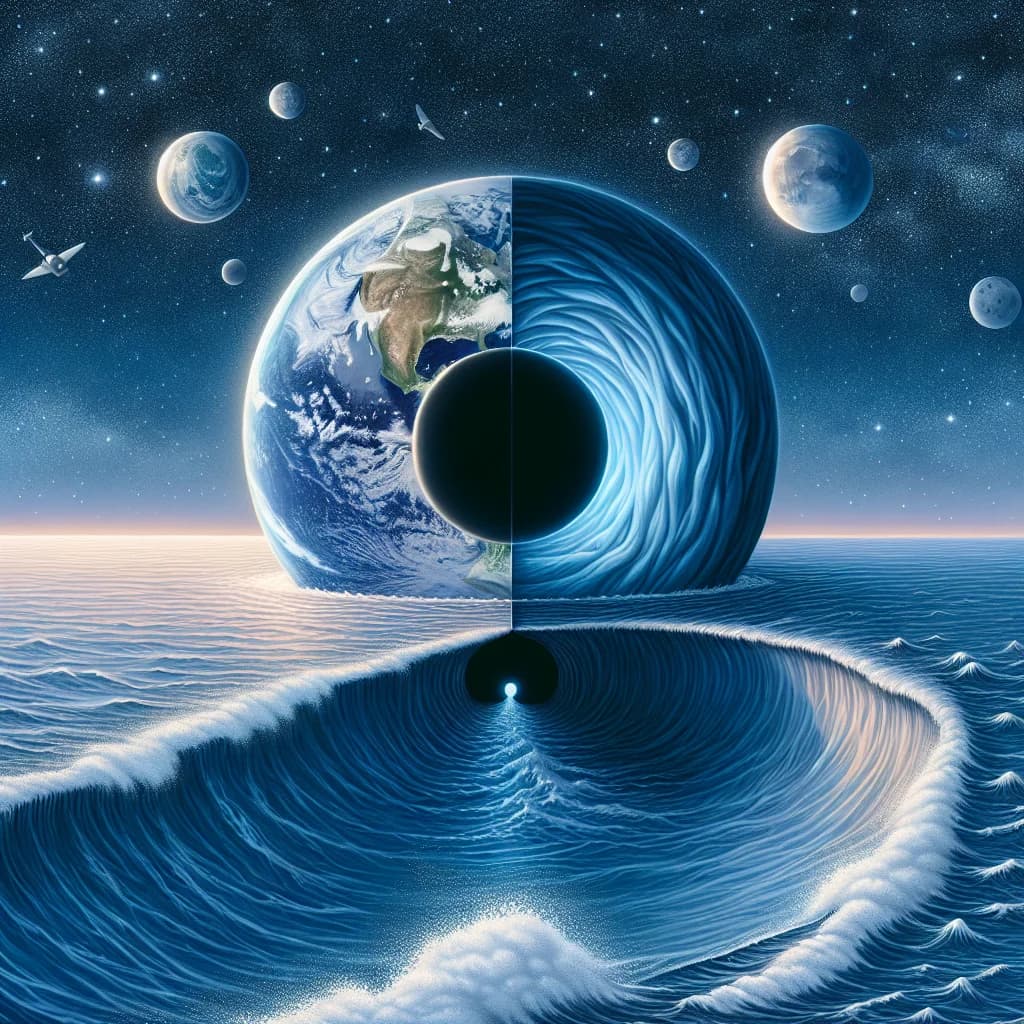
No, Earth’s tides would remain exactly the same. Because the black hole has the identical mass and is at the same distance as the Moon, the gravitational force exerted on our planet stays unchanged.
The Invisible Anchor: Would Earth’s Tides Change if the Moon Became a Black Hole?
Imagine looking up at the night sky and seeing... absolutely nothing. No pearly glow, no "Man in the Moon," just a silent, ink-black void where our celestial neighbor used to be. This isn't the plot of a science-fiction thriller, but rather a fascinating "what if" scenario in physics. If we were to perform a cosmic sleight of hand and replace the Moon with a black hole of the exact same mass, the visual impact would be staggering. But what about the physical impact? Specifically, would the rhythmic rising and falling of our oceans—the tides—undergo a catastrophic transformation, or would the Earth remain blissfully unaware of its neighbor’s dark makeover?
To answer this, we must look at the foundational parameters of our experiment. We are swapping the Moon ($7.34 \times 10^{22}$ kilograms) for a black hole of identical mass, placed at the exact same average distance of 384,400 kilometers. By applying the laws of Newtonian gravity and General Relativity, we can determine the fate of our coastlines.
The Gravity of the Situation
The most important thing to understand about gravity is that it is remarkably indifferent to what an object looks like. According to Newton’s Law of Universal Gravitation, the force of gravity between two objects depends on only two things: their masses and the distance between their centers.
Mathematically, this is expressed as: $F = G \times (m1 \times m2) / r^2$
In our scenario, $m1$ (the Earth’s mass) remains the same, $m2$ (the Moon/Black Hole mass) remains the same, and $r$ (the distance between them) remains the same. Because these variables do not change, the gravitational "tug" exerted by the black hole on the Earth would be identical to the tug exerted by the Moon. From a purely gravitational perspective, the Earth wouldn't feel a bit of difference.
A Grain of Sand in the Dark
While the mass remains the same, the volume changes dramatically. The Moon is a rocky sphere roughly 3,474 kilometers in diameter. A black hole, however, is a point of infinite density. The "size" of a black hole is usually defined by its Schwarzschild radius—the radius of the event horizon from which nothing can escape.
Using the formula $R_s = 2GM/c^2$, we can calculate the size of our new lunar black hole:
- Moon’s Radius: ~1,737,000 meters
- Black Hole’s Radius: ~0.1 millimeters
To put that in perspective, our "Lunar Black Hole" would be roughly the size of a grain of fine sand or the thickness of a human hair. Despite its incredible density, this tiny speck would still possess the gravitational might of the entire Moon because it contains the exact same amount of matter.
Why Tides Stay Steady
Tides are not caused by the total pull of gravity, but rather the tidal force—the difference in gravitational pull across the diameter of the Earth. The side of the Earth facing the Moon is pulled slightly more than the center, and the center is pulled slightly more than the far side. This "gradient" creates the tidal bulges in our oceans.
The Physics of the Gradient
Because the black hole is at the same distance as the Moon, the gradient of gravity across the Earth remains unchanged. The water on our coastlines would still rise and fall twice a day, following the same schedule and reaching the same heights as they do today. The "invisible anchor" would hold our oceans in the exact same grip as the familiar white orb we see tonight.
Biological and Atmospheric Impacts
While the tides remain stable, the environment would face other challenges:
- Total Darkness: Without moonlight, nocturnal species that rely on visual cues for hunting or mating would face a significant evolutionary hurdle.
- The Missing Reflection: The Moon reflects sunlight, providing a small amount of heat and light. A black hole would reflect nothing, though this would have a negligible effect on Earth's overall temperature.
The Scientific Outcome
In summary, if the Moon were replaced by a black hole of equal mass, Earth’s tides would not change at all. The mathematical reality of gravitational equivalence dictates that as long as the mass and distance remain constant, the tidal forces remain identical.
This thought experiment highlights a profound truth about our universe: gravity is a product of matter, not appearance. Whether that matter is a bright, dusty sphere of basalt and regolith or a tiny, invisible singularity, its relationship with the Earth remains governed by the same elegant laws of physics. It serves as a reminder that the most "monstrous" objects in the cosmos, like black holes, still follow the same predictable rules that govern a falling apple or a rising tide.