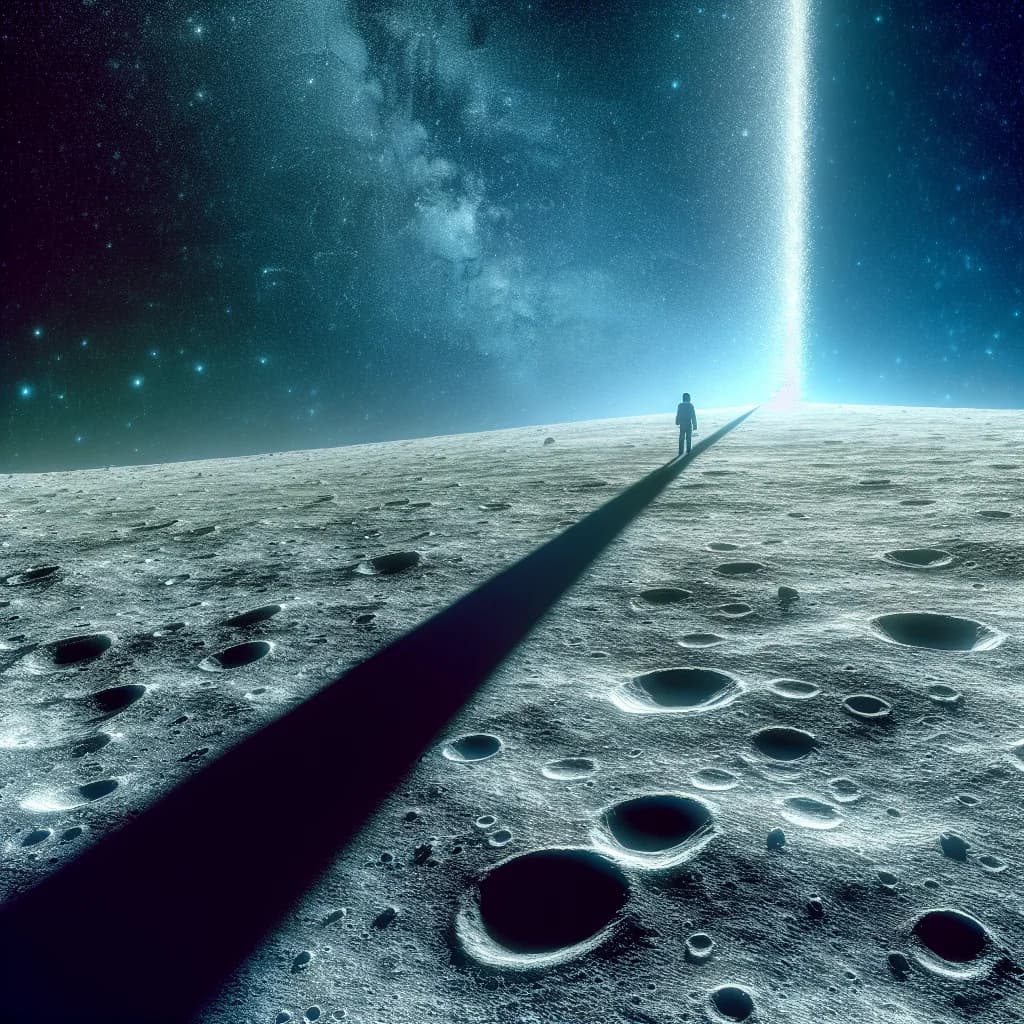
If the vacuum of space were replaced with air, how loud would the Sun sound on Earth
If the silence of space were replaced with air, the Sun would be a deafening, 100-decibel roar that could be heard from every corner of the globe. Discover why our peaceful sky is a literal lifesaver and what it would actually feel like to live inside a solar system that never stops screaming.


Too Long; Didn't Read
If space were filled with air, the Sun would produce a constant, deafening roar on Earth at approximately 125 decibels. This volume is equivalent to standing next to a jet engine or a rock concert, making it loud enough to cause permanent hearing damage over time.
A Celestial Cacophony: What If the Vacuum of Space Were Filled with Air?
We often think of the cosmos as a serene, silent theater of light and gravity. This silence is a physical necessity; sound is a mechanical wave that requires a medium, like air or water, to travel. In the vacuum of space, there are no molecules to vibrate, leaving the Sun’s violent outbursts to occur in total hushed isolation. But what if we conducted a cosmic experiment? If the 93 million miles between Earth and the Sun were suddenly filled with a pressurized atmosphere similar to our own, the "silent" Sun would become the loudest object in our lives. By applying the laws of acoustics and helioseismology, we can calculate exactly how much noise our star would make and how it would redefine life on Earth.
The Roar of a Trillion Nuclear Engines
To understand the Sun's volume, we must first look at its surface. The Sun is not a solid object; it is a roiling ball of plasma driven by nuclear fusion and massive convection currents. These currents involve pockets of hot gas the size of Texas rising and falling at incredible speeds.
Helioseismologists—scientists who study "sunquakes" and the Sun’s internal vibrations—estimate that the acoustic energy generated by this turbulent convection is staggering. If we could stand "near" the Sun’s photosphere, the sound level would be approximately 290 decibels (dB). To put that in perspective, a rock concert is about 120 dB, and a jet engine at close range is roughly 150 dB. Because the decibel scale is logarithmic, 290 dB is not just twice as loud as a jet; it is trillions of times more powerful.
The Journey Across the Void
In our hypothetical scenario, this sound would travel through the "air" of space toward Earth. However, sound loses intensity as it spreads out from a source, a principle known as the Inverse Square Law. As the sound waves travel the 150 million kilometers to Earth, the energy is distributed over an ever-increasing area.
Calculating the Decibel Drop
When we apply the math of acoustic attenuation over such a vast distance, the reduction is significant:
- Source Intensity: 290 dB at the Sun’s surface.
- Distance to Earth: 150,000,000 kilometers.
- Resulting Intensity: By the time the sound waves reached our upper atmosphere, the volume would drop by roughly 165 to 190 decibels.
This leaves us with a constant, droning sound level of approximately 100 to 125 decibels on the Earth's surface.
Comparing the Cosmic Noise
A consistent 100-125 dB roar would be transformative. For context:
- 100 dB: Comparable to standing next to a running chainsaw or a lawnmower all day, every day.
- 120 dB: The equivalent of a thunderclap or an emergency siren passing by your window—constantly.
At this level, human conversation would be impossible without specialized equipment. The sound would not be a musical note; it would likely be a "white noise" roar, a chaotic mix of frequencies caused by the billions of individual convection cells rising and falling on the solar surface.
Physical and Atmospheric Consequences
Beyond the noise, filling the solar system with air would trigger massive physical shifts. Sound is a form of energy, and such intense acoustic pressure would have measurable effects on our environment.
1. Atmospheric Drag and Heat
If space were filled with air, Earth would no longer be orbiting in a vacuum. It would be a sphere traveling at 67,000 miles per hour through a dense gas. This would create immense friction, leading to a significant thermal increase in the upper atmosphere. In a strictly clinical sense, the kinetic energy of our orbit would be converted into heat, potentially altering the structural integrity of our gaseous envelope.
2. Pressure and Gravitational Collapse
The Sun’s massive gravity would immediately begin pulling this "space air" toward its center. This would create a pressure gradient across the solar system. Near Earth, the air might remain breathable for a time, but the overarching physics would likely lead to a rapid accumulation of mass toward the Sun, potentially altering the star’s own fusion rate and life cycle.
Conclusion
If the vacuum of space were replaced with air, the Sun would transform from a silent guardian into a deafening, 125-decibel roar that would dominate every second of our existence. This thought experiment relies on the Inverse Square Law and the known acoustic output of solar convection to show us that the "silence" of space is, in many ways, a vital protective barrier.
While the Sun’s light provides the energy necessary for life, its mechanical energy—sound—is safely dampened by the vacuum of the cosmos. This exercise highlights the delicate balance of physical constants that allow life to thrive, reminding us that sometimes, the most beautiful thing about the universe is what we cannot hear.