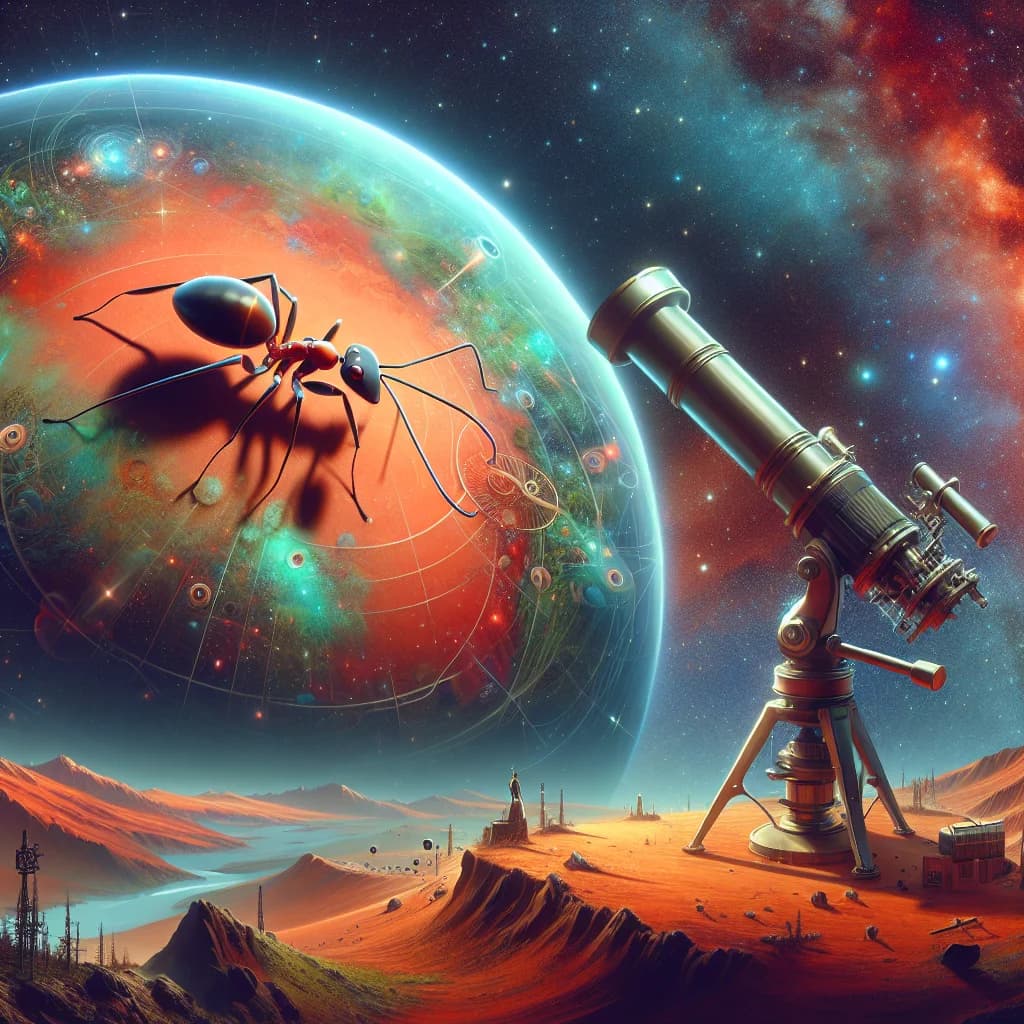
If you could build a telescope the size of Earth, could you see an ant on Mars
Imagine turning our entire planet into a giant lens aimed directly at the Red Planet. We dive into the mind-bending physics of resolution to see if science could actually spot a tiny insect from millions of miles away.

Too Long; Didn't Read
No, even an Earth-sized telescope cannot see an ant on Mars. Due to the physics of light diffraction, a telescope with Earth’s diameter could only resolve objects roughly the size of a person or a small car. To see something as tiny as an ant from that distance, you would need a telescope thousands of times larger than our planet.
The Ultimate Cosmic Zoom: If Your Telescope Was Earth-Sized, Could You Spot an Ant on Mars?
Imagine a lens so vast it spans the entire diameter of our planet—a shimmering, 12,742-kilometer-wide eye peering into the depths of the solar system. This is the ultimate "what if" of observational astronomy. We often wonder how far technology can push the boundaries of the visible world, but this thought experiment takes us to the absolute physical limit of optics. Could such a colossal instrument allow us to witness the mundane life of a tiny insect on the Red Planet? To answer this, we must look past the engineering impossibility and dive into the rigid laws of physics, specifically the Rayleigh criterion, the behavior of light waves, and the mathematics of angular resolution.
The Diffraction Limit: Physics’ Cosmic Blur
In the world of optics, bigger is always better, but even a perfect mirror has a fundamental limit. This is known as the diffraction limit. Light behaves like a wave, and when it passes through the aperture of a telescope, it bends and interferes with itself. This creates a slight blurring effect.
The ability of a telescope to distinguish between two close objects is called its angular resolution. This is dictated by the Rayleigh criterion, a formula that calculates the smallest angle ($\theta$) a telescope can resolve based on the wavelength of light ($\lambda$) and the diameter of the telescope's aperture ($D$). The formula looks like this:
$$\theta \approx 1.22 \times \frac{\lambda}{D}$$
To see an ant on Mars, the telescope's resolution must be sharper than the angular size of the ant as seen from Earth.
Doing the Math: Ants vs. Apertures
Let’s plug in some real-world metrics to see how the numbers stack up.
- The Target: An average ant is about 5 millimeters (0.005 meters) long.
- The Distance: Mars varies in distance, but let’s use an average distance of 225 million kilometers ($225 \times 10^9$ meters).
- The Telescope: An Earth-sized aperture with a diameter of approximately 12,742,000 meters.
- The Light: We will use visible green light, which has a wavelength of roughly 550 nanometers ($550 \times 10^{-9}$ meters).
First, we calculate the angular size of the ant from Earth. At that distance, a 5mm ant covers an angle of approximately $2.2 \times 10^{-14}$ radians.
Next, we calculate the resolution of our Earth-sized telescope. Using the Rayleigh criterion: $$1.22 \times \frac{550 \times 10^{-9}}{12,742,000} \approx 5.2 \times 10^{-14} \text{ radians}$$
The Verdict on Resolution
The results are surprisingly close! However, the telescope's resolution ($5.2 \times 10^{-14}$) is slightly larger than the ant's angular size ($2.2 \times 10^{-14}$). In scientific terms, this means the ant would be smaller than a single "pixel" of the telescope's theoretical maximum resolution. Instead of a clear image of a six-legged explorer, you would see a faint, blurry smudge of light—if you could see anything at all.
The Practical Hurdles: Light and Atmosphere
Even if we increased the telescope's size slightly to bridge that mathematical gap, several physical realities would still block our view:
- Photons are Scarce: An ant on Mars reflects an incredibly small number of photons. Even with a massive mirror, collecting enough light from such a tiny, non-luminescent object to form a recognizable image against the bright Martian dust would be nearly impossible.
- Atmospheric Disturbance: We are peering through two atmospheres. Earth’s atmosphere causes "twinkling" (scintillation), which smears fine details. Even the thin Martian atmosphere contains dust that would scatter the light.
- Planetary Motion: Both Earth and Mars are hurtling through space at different speeds. To keep a 5mm target in focus, the Earth-sized telescope would need to adjust its orientation with a precision that defies modern mechanics.
Conclusion
The scientific reality is a "nearly, but not quite." While an Earth-sized telescope is a masterclass in theoretical resolution, the diffraction of light and the staggering distance of the void mean a Martian ant would remain a mystery. We would be at the very edge of what physics allows, staring at a single point of light that might—just might—be a bug.
This experiment highlights the incredible scale of our universe. While we cannot yet see insects on other planets, astronomers already use a technique called Very Long Baseline Interferometry (VLBI) to link telescopes across the globe, effectively creating an Earth-sized "virtual" telescope. We use this not to find ants, but to capture images of supermassive black holes millions of light-years away, proving that while the small remains elusive, the truly massive is finally coming into focus.