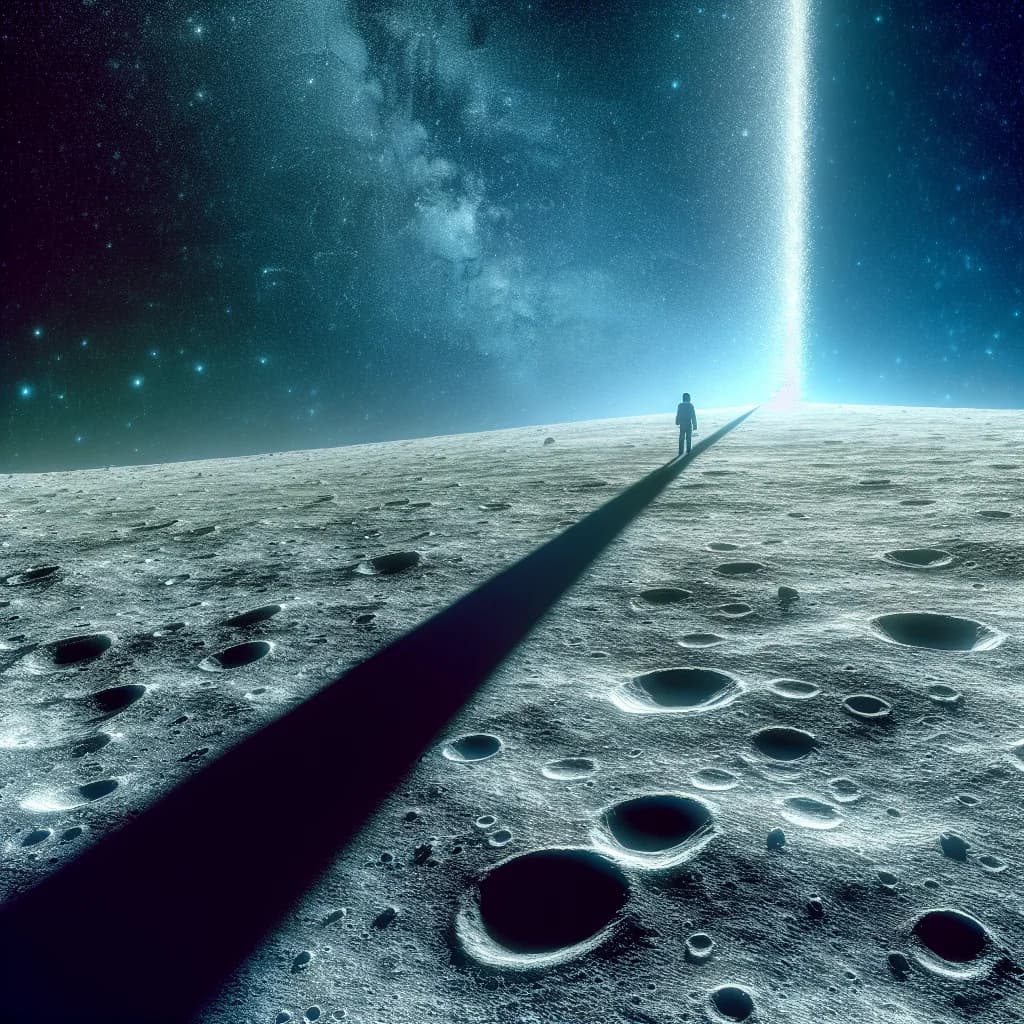
If you could fold a piece of paper 103 times, would it be wider than the observable universe
It sounds like a playground riddle, but the mind-bending math of exponential growth reveals a startling truth. Discover how a simple sheet of paper, folded just 103 times, could actually outstretch the entire observable universe.


Too Long; Didn't Read
Yes, due to exponential growth, folding a standard sheet of paper 103 times would result in a thickness exceeding the 93-billion-light-year diameter of the observable universe.
The 103-Fold Challenge: Can a Single Sheet of Paper Outgrow the Entire Observable Universe?
If you were to take a standard sheet of notebook paper and fold it in half, then in half again, and continue the process, most people believe you would hit a physical wall after only seven or eight folds. However, in the realm of theoretical mathematics, we are not bound by the strength of our triceps or the brittleness of wood pulp. This thought experiment asks us to imagine a scenario where paper can be folded indefinitely.
The core of this inquiry rests on the staggering power of exponential growth and the mind-bending scale of our cosmos. By defining our starting point—a standard sheet of paper approximately 0.1 millimeters thick—and applying geometric progression alongside cosmological measurements, we can determine if 103 folds truly surpass the limits of the observable universe. This analysis bridges the gap between simple arithmetic and the vast frontiers of astrophysics.
Exponential Growth: The Math Behind the Magic
To understand how a thin sheet of paper could ever rival a galaxy, we must first look at the principle of exponential growth. When you fold a piece of paper, you are not simply adding a layer; you are doubling the thickness. This is represented by the formula $T \times 2^n$, where $T$ is the initial thickness and $n$ is the number of folds.
While the first few folds seem underwhelming, the numbers escalate with terrifying efficiency:
- 3 Folds: The thickness of a fingernail.
- 10 Folds: About the width of a hand.
- 23 Folds: One kilometer (0.62 miles) thick.
- 42 Folds: This is the "magic number" where the paper tower reaches the Moon.
By the time we reach 103 folds, we are no longer dealing with human-scale measurements. We are dealing with a doubling process that has occurred over 100 times, resulting in a number so large it defies common intuition.
Crossing the Cosmic Finish Line
To answer our primary question, we must calculate the final thickness of the paper and compare it to the diameter of the observable universe, which is estimated to be approximately 93 billion light-years.
- The Calculation: A standard sheet of paper is roughly $10^{-4}$ meters thick. After 103 folds, the thickness becomes $10^{-4} \times 2^{103}$.
- The Result: $2^{103}$ is approximately $1.01 \times 10^{31}$. Multiplying this by our paper thickness gives us a total length of roughly $10^{27}$ meters.
- The Comparison: When we convert the diameter of the observable universe (93 billion light-years) into meters, we get approximately $8.8 \times 10^{26}$ meters.
Mathematically, the results are clear. At 103 folds, your paper tower would stretch approximately 107 billion light-years. This means the paper would not only be wider than the observable universe but would actually extend roughly 14 billion light-years beyond its current estimated boundaries.
The Physical Reality: Mass, Density, and Constraints
While the math is flawless, the laws of physics introduce fascinating constraints to this hypothetical scenario. If we were to actually attempt this, we would encounter several scientific hurdles:
- Mass and Volume: To maintain the thickness through 103 folds, the original sheet of paper would need to be unimaginably large. To have enough material to fold 103 times while maintaining a measurable surface area, the initial sheet would have to be larger than the universe itself.
- Conservation of Matter: Since we cannot create matter out of nothing, the "extra" paper required to reach the 103rd fold would exceed the total amount of baryonic matter available in the known cosmos.
- Gravitational Collapse: Long before the paper reached the edge of the solar system, the sheer mass of the paper tower would create a significant gravitational field. In a clinical sense, the material would undergo a gravitational collapse, compressing the paper into a hyper-dense structure due to its own weight, likely resulting in a celestial body of immense density.
Conclusion
The mathematical verdict is a resounding "yes." If you could fold a piece of paper 103 times, the resulting thickness would indeed exceed the 93-billion-light-year span of the observable universe. This outcome is dictated by the relentless nature of geometric progression, where doubling a value just 103 times transforms a microscopic measurement into a trans-cosmic distance.
This thought experiment serves as a powerful reminder of how human intuition often fails to grasp the true scale of exponential growth. While the physical world limits our ability to fold paper, the universe of mathematics allows us to build towers that reach beyond the stars, connecting a simple stationery item to the very limits of space and time.