If you could see magnetic fields, why would the Earth look like a giant jellyfish floating in space
Beyond our blue sky lies a hidden masterpiece of glowing energy and trailing "tentacles" that stretch millions of miles into the void. Discover the invisible forces that transform Earth into a shimmering celestial jellyfish pulsing against the solar wind.

Too Long; Didn't Read
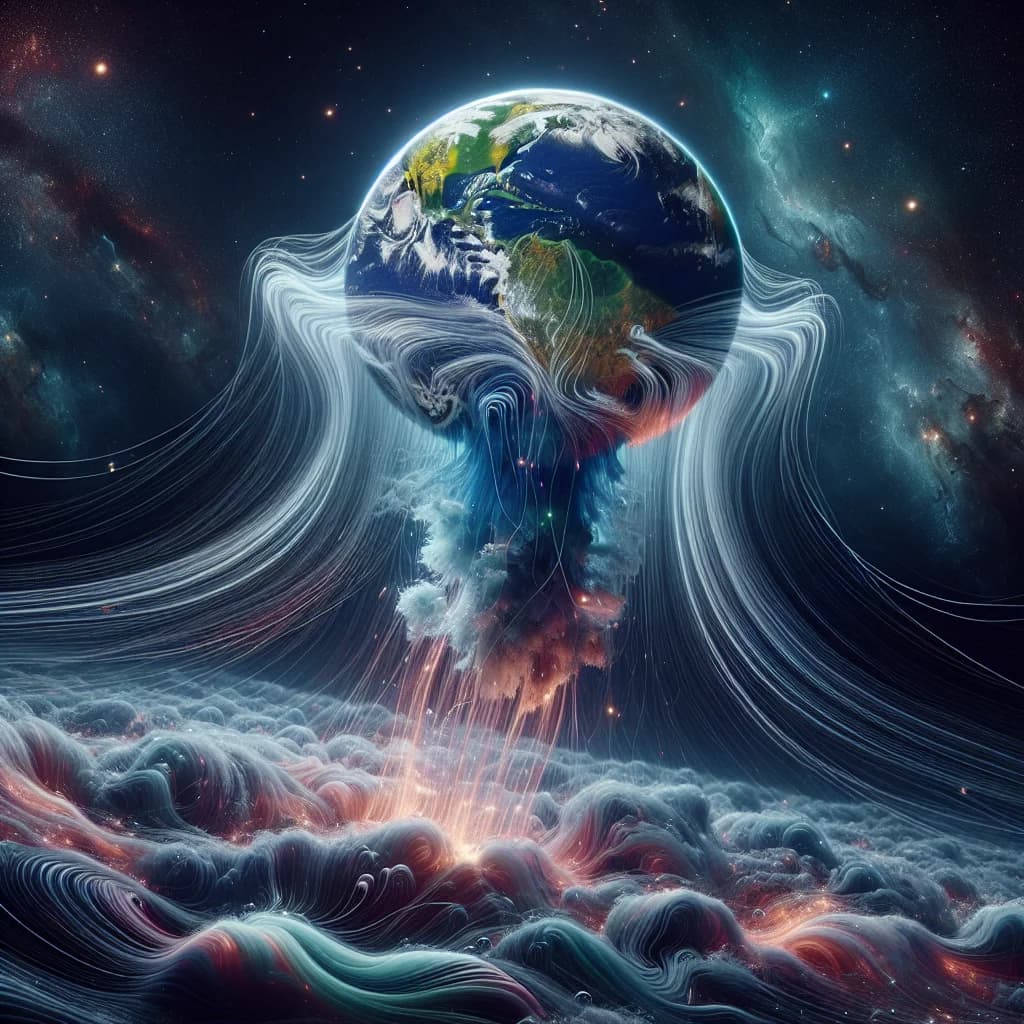
Earth’s magnetic field takes on a jellyfish shape because the solar wind compresses the side facing the sun into a rounded cap while stretching the opposite side into long, streaming tail-like tentacles that trail deep into space.
The Invisible Ocean: If We Could See Magnetic Fields, Why Would Earth Look Like a Giant Jellyfish?
Imagine waking up with the ability to see beyond the narrow sliver of the visible light spectrum. Instead of a lonely blue marble suspended in a black void, you would see Earth encased in a colossal, glowing, and translucent structure. This is the magnetosphere—a massive magnetic envelope that shields our planet from the harsh realities of the solar system. To the naked eye, this structure wouldn’t look like a sphere or a simple bar magnet's field. Instead, due to the constant pressure of the sun, Earth would resemble a gargantuan, bioluminescent jellyfish drifting through a cosmic current.
By applying the principles of plasma physics and magnetohydrodynamics, we can visualize this invisible architecture. This thought experiment explores how the interaction between Earth’s internal magnetic engine and the external pressure of the solar wind creates a distinct, gelatinous morphology that defines our planet's place in the sun's backyard.
The Geodynamo: Creating the Jellyfish’s "Bell"
Every jellyfish needs a head, or a "bell." For Earth, this is generated deep within the outer core. Through a process known as the geodynamo, the rotation of liquid iron and nickel creates electrical currents, which in turn produce a massive magnetic field.
If space were a perfect vacuum, this field would look like a symmetrical donut (a torus). However, space is far from empty. It is filled with the solar wind—a constant stream of charged particles (plasma) ejected from the sun at speeds averaging 400 kilometers per second (about 1.5 million kilometers per hour). This "cosmic current" hits our magnetic field with immense pressure, squashing the side facing the sun. This creates a rounded, blunt leading edge called the bow shock, much like the dome of a jellyfish pushing through the ocean.
The Magnetotail: Tentacles Stretching into the Dark
While the sunward side of our magnetic jellyfish is compressed, the "leeward" side—the side facing away from the sun—is stretched out into a magnificent, trailing structure called the magnetotail.
This is where the jellyfish resemblance becomes uncanny. The solar wind drags Earth’s magnetic field lines behind the planet, creating long, flowing "tentacles" of magnetic flux.
- The Scale: While the "bell" of our magnetic field extends roughly 65,000 kilometers toward the sun, the "tentacles" of the magnetotail stretch for more than 6,000,000 kilometers.
- The Comparison: To put that in perspective, if Earth were the size of a marble, the magnetotail would be a shimmering ribbon extending nearly 500 meters behind it.
These magnetic tentacles are not static; they flutter and vibrate in the solar wind, occasionally snapping and reconnecting in a process called magnetic reconnection, which sends bursts of energy back toward the "body" of the jellyfish.
A Protective Glow: The Auroral Fringe
If we could see these fields, they wouldn't just be gray lines; they would glow with the energy of trapped particles. Within the "body" of our jellyfish lie the Van Allen radiation belts—two donut-shaped regions where high-energy electrons and protons are trapped by the magnetic field.
Near the North and South Poles, where the "bell" meets the atmosphere, the magnetic field lines funnel these particles downward. When they collide with atmospheric gases, they create the Aurora Borealis and Aurora Australis. In our "magneto-vision" scenario, these would look like shimmering, neon fringes at the base of the jellyfish’s bell, pulsating with every gust of the solar wind.
The Physics of a Cosmic Shield
The "jellyfish" shape isn't just a visual quirk; it is a mathematical necessity of fluid dynamics. Because the solar wind is a plasma, it behaves like a fluid. The boundary where the solar wind’s pressure matches Earth’s magnetic pressure is called the magnetopause.
We can estimate the "stiffness" of our jellyfish using the formula for pressure balance: $P_{sw} = B^2 / (2\mu_0)$ Where $P_{sw}$ is the solar wind dynamic pressure and $B$ is the magnetic field strength. When the sun is active, the "bell" of our jellyfish is shoved closer to Earth; when the sun is quiet, the jellyfish expands. This dynamic breathing ensures that our atmosphere is never stripped away by the solar "current."
Conclusion
Ultimately, the image of Earth as a giant cosmic jellyfish is a powerful reminder that our planet is not an isolated rock, but a dynamic participant in the life of the solar system. This hypothetical "magneto-vision" reveals the magnetosphere as a masterpiece of magnetohydrodynamics—a structure defined by the push and pull of celestial forces.
The core scientific principles of electromagnetism and plasma physics dictate that as long as our core is spinning and the sun is shining, we will continue to drift through space inside this invisible, protective organism. While we cannot see the "tentacles" or the "bell" with our eyes, we live every day under their protection, tucked safely inside the most magnificent jellyfish in the galaxy.